OCR · GCSE · English Literature
To His Coy Mistress (Andrew Marvell)
Andrew Marvell's 'To His Coy Mistress' is a masterclass in poetic argument and persuasion. This guide will deconstruct its famous 'Carpe Diem' message, revealing how Marvell uses logic, wit, and shocking imagery to create a poem that is both a seductive masterpiece and a chilling reminder of mortality, securing top marks for candidates who can analyse its complex, manipulative tone."
- 7 min read
- 2 worked examples
Study Notes

Overview
Andrew Marvell’s ‘To His Coy Mistress’ is a quintessential metaphysical poem, renowned for its intellectual rigour and passionate urgency. For the OCR GCSE English Literature exam, candidates must analyse it within the ‘Love and Relationships’ cluster, focusing on its persuasive structure and manipulative tone. The poem is a dramatic monologue framed as a syllogism—a three-part logical argument. The speaker attempts to seduce his ‘coy’ (shy or reluctant) addressee by contrasting the infinite time he would spend wooing her in a hypothetical world with the harsh reality of their fleeting mortality. Examiners expect candidates to trace this logical progression, analyse the dramatic shifts in imagery from courtly flattery to grotesque realism, and integrate the context of the 17th-century ‘Carpe Diem’ tradition. Credit is given for a nuanced understanding that the poem is not merely a love lyric, but a powerful, coercive piece of rhetoric.
Plot/Content Overview
The poem unfolds in three distinct sections, mirroring its logical structure:
-
The Hypothetical (Lines 1-20): The speaker begins with the premise, ‘Had we but world enough, and time’. In this idealised scenario, he claims he would devote vast ages to adoring his mistress. He uses hyperbole to describe this endless courtship, referencing the vast distances between the ‘Indian Ganges’ and the ‘Humber’ in England. He would spend ‘an hundred years’ praising her eyes, and ‘thirty thousand to the rest’, a poetic catalogue of her beauties known as a ‘blazon’. The tone is one of patient, courtly devotion, but it is entirely conditional.
-
The Reality (Lines 21-32): A sudden, dramatic shift occurs with the word ‘But’. The speaker introduces the reality of time’s relentless passage, personified as ‘Time’s winged chariot hurrying near’. The imagery turns dark and morbid. He describes the ‘deserts of vast eternity’ that await them and the grim fate of her ‘long-preserv’d virginity’, which will be tried by ‘worms’ in the ‘marble vault’. This section is a powerful ‘memento mori’ (a reminder of death), designed to shock the mistress out of her coyness.
-
The Conclusion (Lines 33-46): The argument reaches its urgent climax with ‘Now therefore’. Since time is short, the speaker insists they must seize the moment. The language becomes forceful and energetic. He urges her, ‘let us sport us while we may’, and to ‘roll all our strength and all our sweetness up into one ball’. They will ‘tear our pleasures with rough strife / Through the iron gates of life’. The final couplet suggests that while they cannot stop time, they can defy it by living passionately, making the sun ‘run’.
Themes
Theme 1: Time and Mortality
This is the central theme driving the poem’s argument. Marvell explores the tension between the human desire for infinite time and the reality of a finite lifespan. The speaker uses the inevitability of death as his primary tool of persuasion. Initially, time is presented as a luxury they don’t have, a vast expanse needed for proper courtship. This is then brutally contrasted with the image of ‘Time’s winged chariot’, a powerful metaphor for its speed and unstoppable nature. The poem forces the reader, and the mistress, to confront the physical decay that time brings, making the call to ‘seize the day’ intensely powerful.
Key Quotes:
- ‘Had we but world enough, and time’ - Establishes the hypothetical premise and the central problem of the poem.
- ‘But at my back I always hear / Time’s winged chariot hurrying near’ - A famous personification of time as a relentless, threatening force.
- ‘Thus, though we cannot make our sun / Stand still, yet we will make him run.’ - The final, defiant assertion that passionate living is a way to triumph over time’s limitations.
Theme 2: Seduction and Manipulation
The poem is a masterclass in rhetoric, the art of persuasion. While it can be read as a passionate love poem, it is more accurately analysed as a coercive argument. The speaker uses a variety of tactics to manipulate his mistress. He begins with extravagant flattery (the blazon), then switches to fear-mongering (the grotesque imagery of the tomb), and finally moves to a call for mutual, energetic action. Candidates are rewarded for exploring this manipulative element. The speaker’s argument is entirely self-serving; the mistress’s feelings or desires are never considered. The poem’s title, with the word ‘coy’, already frames her reluctance as a problem to be overcome, rather than a valid position.
Key Quotes:
- ‘This coyness, lady, were no crime’ - Implies that in their real, time-bound circumstances, her coyness is a crime against nature and pleasure.
- ‘then worms shall try / That long preserv’d virginity’ - A shockingly graphic and threatening image, designed to provoke fear and disgust at the prospect of dying a virgin.
- ‘Let us roll all our strength and all / Our sweetness up into one ball’ - A shift to inclusive language (‘us’, ‘our’) to create a sense of a shared, passionate enterprise, masking the one-sided nature of the argument.
Writer's Methods
Structure: The poem’s most important structural feature is the syllogism. This logical form (If... But... Therefore...) gives the speaker’s argument an air of irrefutable proof. It makes his passionate plea seem like a rational conclusion, which is a key part of his persuasive strategy. The poem is also written in iambic tetrameter and uses rhyming couplets (AABB). The regular rhythm and rhyme create a sense of control and relentless forward momentum, mirroring the speaker’s argument and the unstoppable march of time.

Imagery: Marvell employs a dramatic contrast in imagery. The first stanza is filled with hyperbole and images of vast space and time (‘vaster than empires’, ‘an age at least’). The second stanza shifts to grotesque and macabre imagery of death and decay (‘worms’, ‘dust’, ‘ashes’). The final stanza uses images of energy and violence (‘tear our pleasures with rough strife’). This sharp contrast is a key method for manipulating the mistress’s emotions.
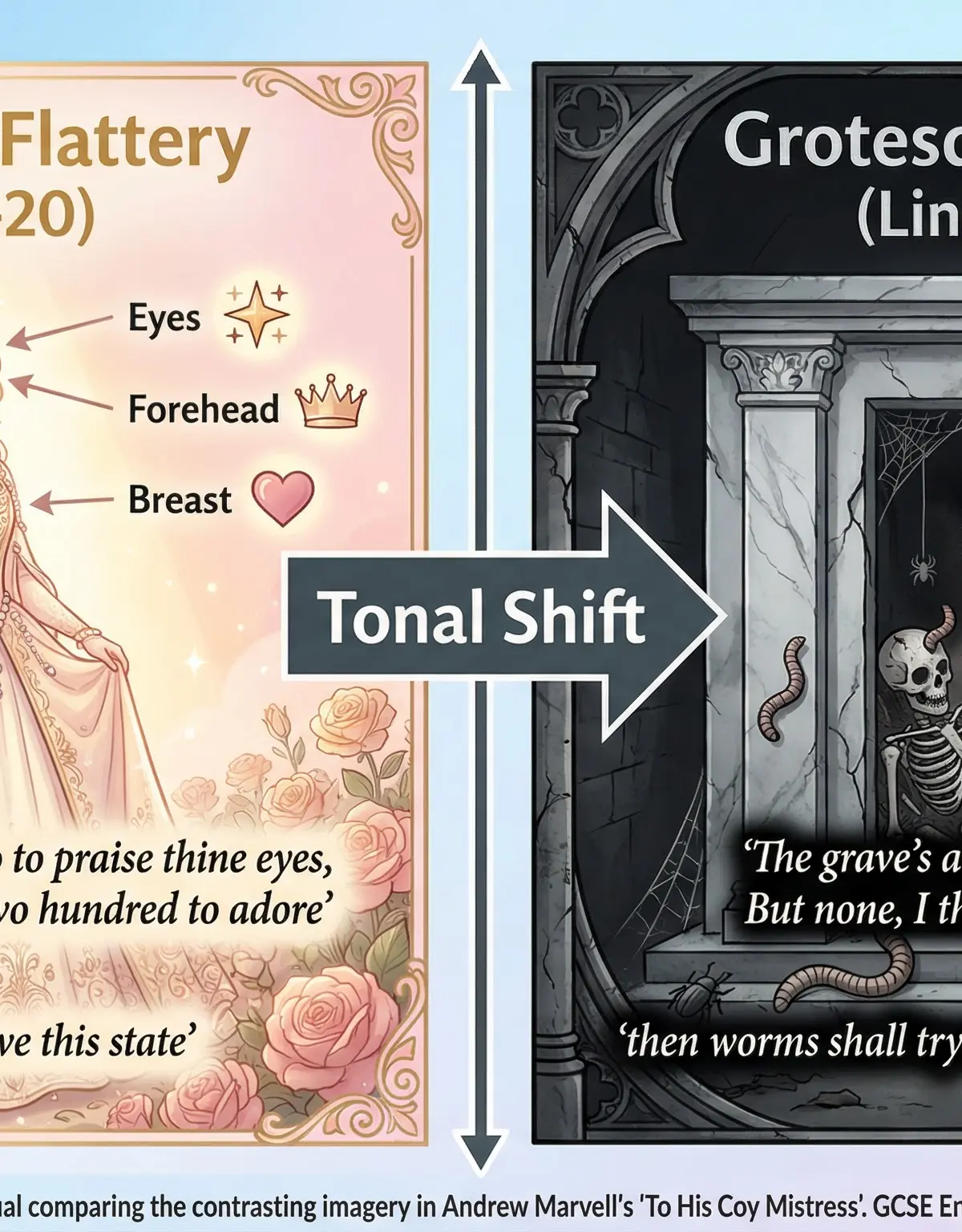
Tone: The speaker’s tone shifts dramatically throughout the poem. It begins as courtly and flattering, moves to being morbid and threatening, and ends as urgent and passionate. Analysing these tonal shifts is crucial for understanding how the speaker constructs his argument.
Context
- Metaphysical Poetry: Marvell was a Metaphysical poet, a group known for their use of intellectual wit, complex arguments (conceits), and the fusion of passion and reason. ‘To His Coy Mistress’ is a prime example, with its logical structure and philosophical exploration of time and mortality.
- Carpe Diem: Latin for ‘seize the day’, this was a very common literary tradition. Poets urged their readers (or lovers) to live life to the fullest in the face of certain death. Understanding this tradition helps explain the poem’s central message.
- 17th-Century England: The poem was written around the time of the English Civil War (1642-1651), a period of immense social and political instability. Life was precarious, and the awareness of death was acute. This historical backdrop gives the poem’s urgent message a powerful resonance. The speaker’s desire to create a private world of pleasure can be seen as a response to a chaotic and dangerous public world.
- Attitudes to Women: In the 17th century, women had far less social power than men. A woman’s ‘honour’ was tied to her virginity. The speaker’s attempt to overcome his mistress’s ‘coyness’ can be read through a feminist lens as an example of patriarchal pressure and the silencing of female desire.
"
Worked Examples
2 worked examples — open one to explore the question and available guidance.
Test your understanding of To His Coy Mistress (Andrew Marvell)
Active recall beats re-reading. Take an instant quiz now to test what you’ve learned and lock it into long-term memory.
7 days Premium · Then free forever · No card, no charge