OCR · GCSE · History
Course version: J410 · Version from Mar 2026
Form and Function c.1000–1750 (J410/12 and J410/13) - Day to day…
Full specification wording
Castles: Form and Function c.1000–1750 (J410/12 and J410/13) - Day to day function(s) of Kenilworth Castle at different times in its history: Kenilworth Castle as a dwelling place.
Kenilworth Castle in Warwickshire was lived in across several centuries, and its buildings show how a fortress also worked as a home.
Checked against the OCR J410 specification (opens in a new tab) on .
- Point 4 of 5
- 4 key terms
Study notes
From the checked teaching notes for this specification point.
The idea
Kenilworth Castle in Warwickshire was lived in across several centuries, and its buildings show how a fortress also worked as a home. In the medieval period the keep and the great hall served the household of its lords, providing chambers, kitchens, storage and space for eating and meeting. In the later sixteenth century the castle was remodelled so that it could receive Elizabeth I in comfort, with enlarged windows, a new range of lodgings and a garden laid out for display and leisure. A question on this topic asks you to identify which feature or period best shows the castle used as a dwelling, so link each building to the everyday needs of the people who lived there rather than to defence alone.
What earns the marks
- Identifies a building or range at Kenilworth, such as the keep, great hall or Elizabethan lodgings, as space used for living rather than only for defence.
- Explains that the great hall and kitchens met the daily needs of a resident household, including eating, meeting and storing food.
- Recognises that the sixteenth-century remodelling added comfort and display, showing the castle functioning as an elite residence.
- Links a named feature to the people who used it, such as the lord's household or a royal guest, rather than describing the feature in isolation.
Common mistakes and how to put them right
Treats Kenilworth only as a military fortress.
Put it right: Recognise that the same site also housed a household with domestic needs.
Assumes every part of the castle was lived in throughout its history.
Put it right: Note that different buildings served as dwellings at different times.
Confuses display features such as the garden with purely defensive works.
Put it right: Explain that they supported the castle's role as a residence.
Exam tips
- Read the question stem carefully to see whether it asks about dwelling, defence or another function before choosing an option.
- Match each option to a specific building or period at Kenilworth rather than to castles in general.
- Eliminate options that describe a function the named feature did not perform, such as treating a garden as a defensive structure.
Try the lesson
The start of the Castles: Form and Function c.1000–1750 (J410/12 and J410/13) - Day to day function(s) of Kenilworth Castle at different times in its history: Kenilworth Castle as a dwelling place. lesson, made from checked teaching notes for this specification point.
Have a go first
Which feature of a castle most directly shows that it was designed as a comfortable dwelling for its lord?
Listen
Kenilworth Castle in Warwickshire was lived in across several centuries, and its buildings show how a fortress also worked as a home. In the medieval period the keep and the great hall served the household of its lords, providing chambers, kitchens, storage and space for eating and meeting. In the later sixteenth century the castle was remodelled so that it could receive Elizabeth I in comfort, with enlarged windows, a new range of lodgings and a garden laid out for display and leisure. A question on this topic asks you to identify which feature or period best shows the castle used as a dwelling, so link each building to the everyday needs of the people who lived there rather than to defence alone. A strong answer earns marks for these points. Identifies a building or range at Kenilworth, such as the keep, great hall or Elizabethan lodgings, as space used for living rather than only for defence. Explains that the great hall and kitchens met the daily needs of a resident household, including eating, meeting and storing food. Recognises that the sixteenth-century remodelling added comfort and display, showing the castle functioning as an elite residence. Links a named feature to the people who used it, such as the lord's household or a royal guest, rather than describing the feature in isolation. Exam tip: Read the question stem carefully to see whether it asks about dwelling, defence or another function before choosing an option.
See it
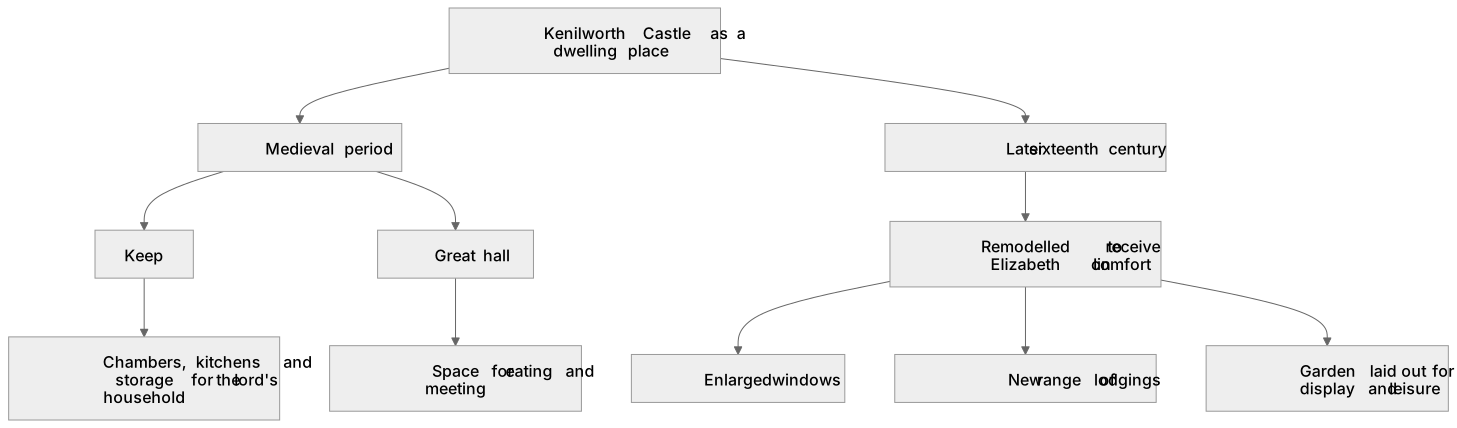
Key words
Say what each word means before you turn the card.
Domestic life in a castle
Try answering aloud or in your head before turning the card.
Change in function over time
Try answering aloud or in your head before turning the card.
The great hall and household
Try answering aloud or in your head before turning the card.
Elizabethan remodelling and royal hospitality
Try answering aloud or in your head before turning the card.
See every definition
- Domestic life in a castle
- The keep and the great hall served the household of its lords, providing chambers, kitchens, storage and space for eating and meeting.
- Change in function over time
- Different buildings served as dwellings at different times, and the castle was lived in across several centuries.
- The great hall and household
- The great hall and kitchens met the daily needs of a resident household, including eating, meeting and storing food.
- Elizabethan remodelling and royal hospitality
- The castle was remodelled so that it could receive Elizabeth I in comfort, with enlarged windows, a new range of lodgings and a garden laid out for display and leisure.
Label the diagram
Some boxes have lost their names. Pick the right name for each number.
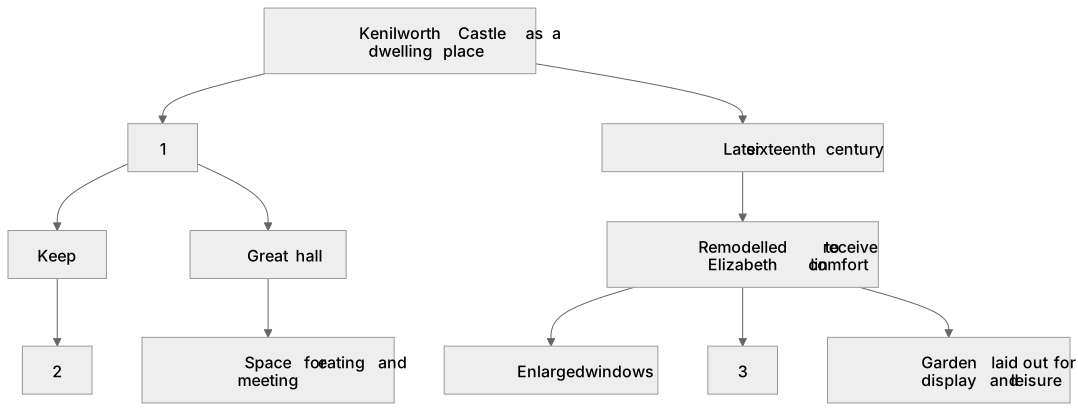
1Box 1
2Box 2
3Box 3
There is more to this lesson
The full lesson goes on to check your understanding and help you earn the marks. Create a free account to carry on, with your progress saved.
A week of Premium from your first lesson · Then the free plan continues · No card, no charge
Test your understanding of Castles: Form and Function c.1000–1750 (J410/12 and J410/13) - Day to day function(s) of Kenilworth Castle at different times in its history: Kenilworth Castle as a dwelling place.
Active recall beats re-reading. Take an instant quiz now to test what you’ve learned and lock it into long-term memory.
A week of Premium from your first lesson · Then the free plan continues · No card, no charge