OCR · GCSE · History
Course version: J410 · Version from Mar 2026
Form and Function c.1000–1750 (J410/12 and J410/13) - Day to day…
Full specification wording
Castles: Form and Function c.1000–1750 (J410/12 and J410/13) - Day to day function(s) of Kenilworth Castle at different times in its history: The evidence used by historians, e.g. royal licenses, newspaper articles.
Historians studying how Kenilworth Castle was used rely on different kinds of evidence, and each type has strengths and limits.
Checked against the OCR J410 specification (opens in a new tab) on .
- Point 5 of 5
- 4 key terms
Study notes
From the checked teaching notes for this specification point.
The idea
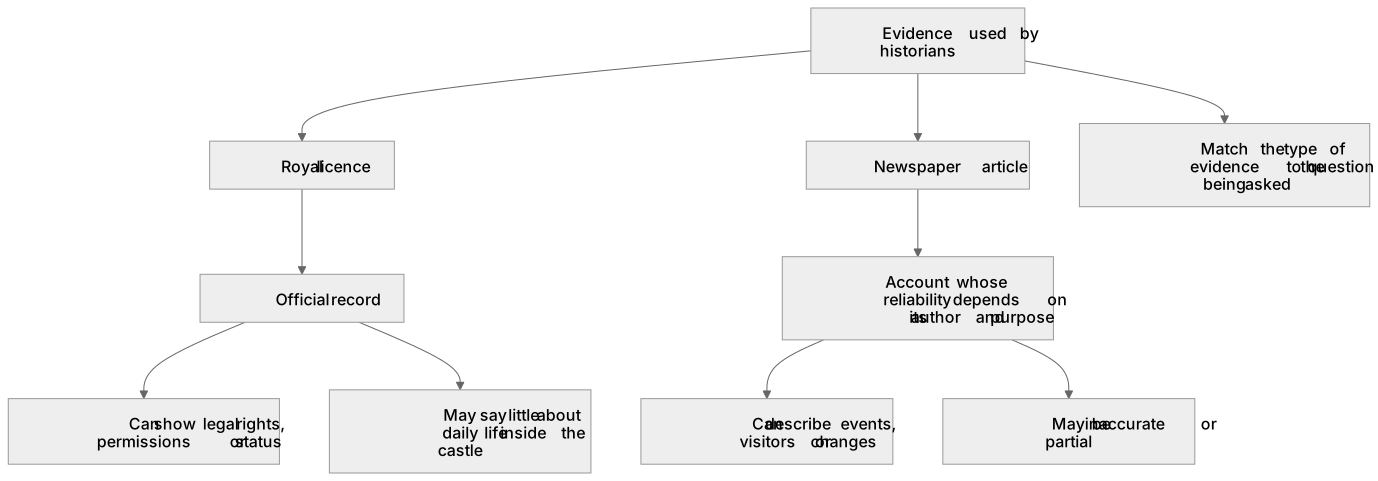
Historians studying how Kenilworth Castle was used rely on different kinds of evidence, and each type has strengths and limits. A royal licence, such as permission to crenellate or to hold land, is an official record that can show legal rights and status, but it may say little about daily life inside the castle. A newspaper article can describe events, visitors or changes at the site, yet it reflects the viewpoint and purpose of its writer and may be inaccurate or partial. A question on this topic asks you to judge which source would best answer a particular enquiry, so match the type of evidence to the question being asked and consider what each source can and cannot reveal.
What earns the marks
- Identifies a royal licence as an official record that can show legal rights, permissions or status connected with a castle.
- Recognises that a newspaper article offers a later or contemporary account whose reliability depends on its author and purpose.
- Matches a type of evidence to the enquiry it can answer, such as using an official record for legal status rather than for daily domestic detail.
- Explains a limitation of a named source, such as an official document omitting everyday life or an article reflecting a particular viewpoint.
Common mistakes and how to put them right
Treats any single source as a complete and unbiased record.
Put it right: Weigh what the source was created to do and what it leaves out.
Assumes a newspaper article is automatically accurate because it is printed.
Put it right: Consider the writer's purpose and check against other evidence.
Uses a royal licence to describe daily life inside the castle.
Put it right: Recognise that official records mainly show rights and status.
Exam tips
- Ask what question the evidence is meant to answer before deciding whether it is useful.
- Compare two source types and note what each can and cannot show about the castle's function.
- Reject options that claim a source is useful for everything, since every type of evidence has limits.
Try the lesson
The start of the Castles: Form and Function c.1000–1750 (J410/12 and J410/13) - Day to day function(s) of Kenilworth Castle at different times in its history: The evidence used by historians, e.g. royal licenses, newspaper articles. lesson, made from checked teaching notes for this specification point.
Have a go first
A historian wants to know how Kenilworth Castle was used as a residence in the sixteenth century. Which type of evidence would most directly describe rooms, furnishings and household arrangements?
Listen
Historians studying how Kenilworth Castle was used rely on different kinds of evidence, and each type has strengths and limits. A royal licence, such as permission to crenellate or to hold land, is an official record that can show legal rights and status, but it may say little about daily life inside the castle. A newspaper article can describe events, visitors or changes at the site, yet it reflects the viewpoint and purpose of its writer and may be inaccurate or partial. A question on this topic asks you to judge which source would best answer a particular enquiry, so match the type of evidence to the question being asked and consider what each source can and cannot reveal. A strong answer earns marks for these points. Identifies a royal licence as an official record that can show legal rights, permissions or status connected with a castle. Recognises that a newspaper article offers a later or contemporary account whose reliability depends on its author and purpose. Matches a type of evidence to the enquiry it can answer, such as using an official record for legal status rather than for daily domestic detail. Explains a limitation of a named source, such as an official document omitting everyday life or an article reflecting a particular viewpoint. Exam tip: Ask what question the evidence is meant to answer before deciding whether it is useful.
See it
Key words
Say what each word means before you turn the card.
Types of historical evidence
Try answering aloud or in your head before turning the card.
Reliability and usefulness of sources
Try answering aloud or in your head before turning the card.
Official records and their limits
Try answering aloud or in your head before turning the card.
Using evidence to answer an enquiry
Try answering aloud or in your head before turning the card.
See every definition
- Types of historical evidence
- The different kinds of evidence used by historians, such as royal licences and newspaper articles.
- Reliability and usefulness of sources
- Each type of evidence has strengths and limits, and its reliability depends on its author and purpose.
- Official records and their limits
- An official record can show legal rights and status, but it may say little about daily life inside the castle.
- Using evidence to answer an enquiry
- Matching the type of evidence to the question being asked and considering what each source can and cannot reveal.
Label the diagram
Some boxes have lost their names. Pick the right name for each number.
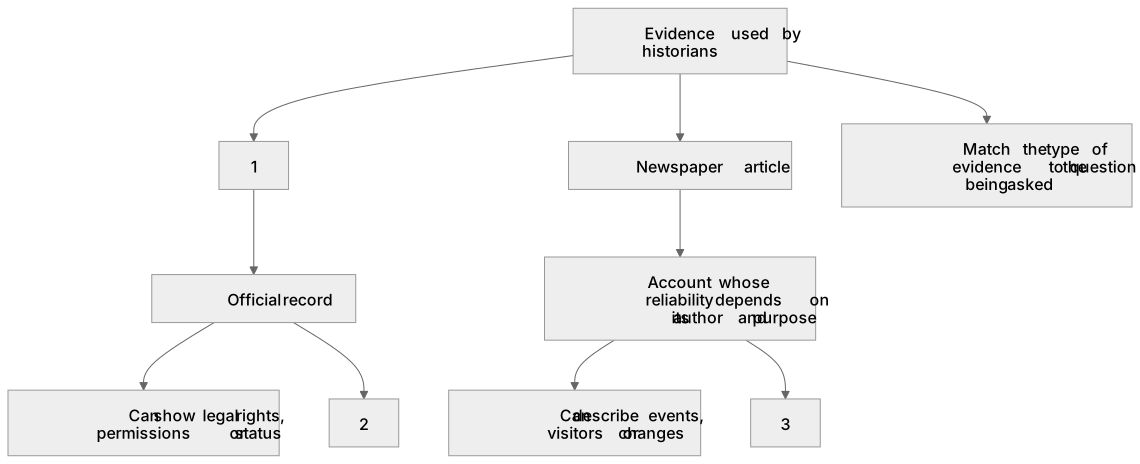
1Box 1
2Box 2
3Box 3
There is more to this lesson
The full lesson goes on to check your understanding and help you earn the marks. Create a free account to carry on, with your progress saved.
A week of Premium from your first lesson · Then the free plan continues · No card, no charge
Test your understanding of Castles: Form and Function c.1000–1750 (J410/12 and J410/13) - Day to day function(s) of Kenilworth Castle at different times in its history: The evidence used by historians, e.g. royal licenses, newspaper articles.
Active recall beats re-reading. Take an instant quiz now to test what you’ve learned and lock it into long-term memory.
A week of Premium from your first lesson · Then the free plan continues · No card, no charge