OCR · GCSE · History
Course version: J410 · Version from Mar 2026
Form and Function c.1000–1750 (J410/12 and J410/13) - Day to day…
Full specification wording
Castles: Form and Function c.1000–1750 (J410/12 and J410/13) - Day to day function(s) of Kenilworth Castle at different times in its history: Kenilworth Castle as centre of administration, justice etc.
Beyond warfare, Kenilworth Castle ran the everyday business of a great estate.
Checked against the OCR J410 specification (opens in a new tab) on .
- Point 3 of 5
- 4 key terms
Study notes
From the checked teaching notes for this specification point.
The idea
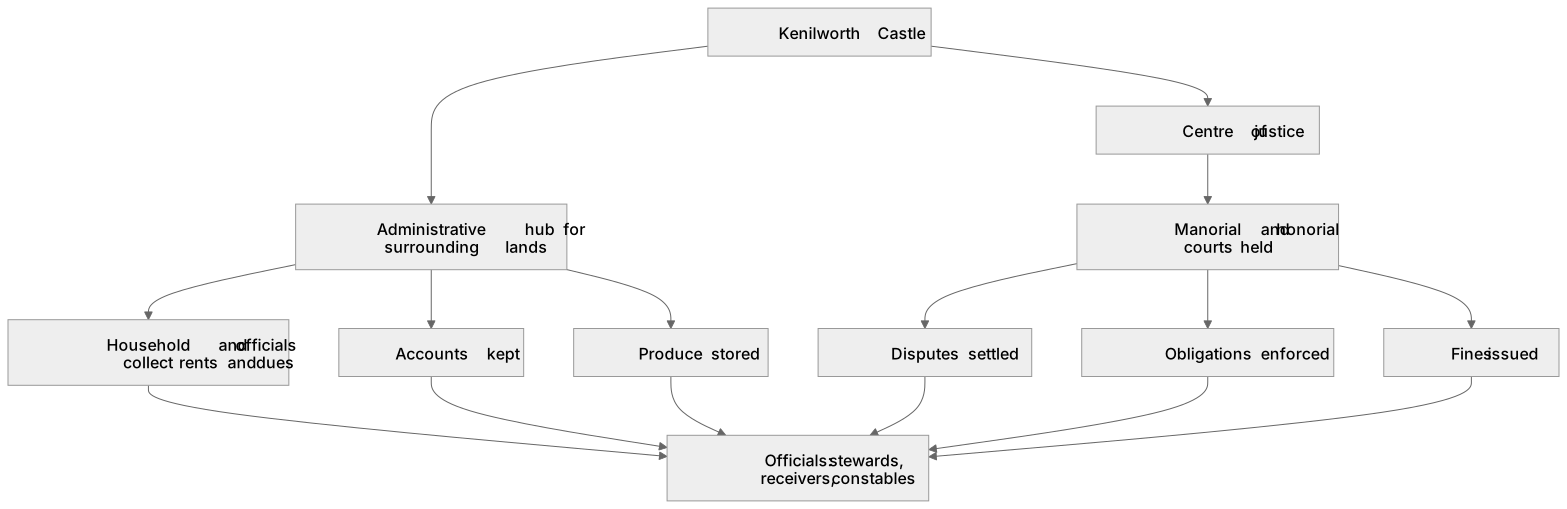
Beyond warfare, Kenilworth Castle ran the everyday business of a great estate. Its household and officials collected rents and dues, kept accounts and stored produce, so the castle acted as an administrative hub for the lands around it. Lords or their stewards held manorial and honorial courts there, settling disputes, enforcing obligations and issuing fines, which made the castle a centre of justice as well as of local government. Officials such as stewards, receivers and constables managed these tasks on the owner's behalf. The castle therefore functioned as a working centre of administration and law, not only a fortress, and this routine activity continued across different periods of its history.
What earns the marks
- Identifies Kenilworth as a centre for collecting rents, dues and estate accounts.
- Explains how courts held at the castle delivered justice and settled local disputes.
- Names officials or household roles, such as steward or constable, who ran administration.
- Recognises that administrative and legal functions continued alongside military use.
Common mistakes and how to put them right
Limits the castle's role to defence.
Put it right: Include its administrative and legal work.
Assumes justice was delivered only by royal judges.
Put it right: Note that lords and their stewards held courts at the castle.
Ignores the household officials.
Put it right: Identify roles such as steward or receiver who managed estate business.
Exam tips
- Look for options naming courts, accounts or officials when the question asks about administration.
- Discard options that describe only siege warfare if the stem asks about day-to-day function.
- Link each option to a concrete activity such as collecting rents or holding a court.
Try the lesson
The start of the Castles: Form and Function c.1000–1750 (J410/12 and J410/13) - Day to day function(s) of Kenilworth Castle at different times in its history: Kenilworth Castle as centre of administration, justice etc. lesson, made from checked teaching notes for this specification point.
Have a go first
Which everyday function best describes Kenilworth Castle acting as a centre of local government for its estate?
Listen
Beyond warfare, Kenilworth Castle ran the everyday business of a great estate. Its household and officials collected rents and dues, kept accounts and stored produce, so the castle acted as an administrative hub for the lands around it. Lords or their stewards held manorial and honorial courts there, settling disputes, enforcing obligations and issuing fines, which made the castle a centre of justice as well as of local government. Officials such as stewards, receivers and constables managed these tasks on the owner's behalf. The castle therefore functioned as a working centre of administration and law, not only a fortress, and this routine activity continued across different periods of its history. A strong answer earns marks for these points. Identifies Kenilworth as a centre for collecting rents, dues and estate accounts. Explains how courts held at the castle delivered justice and settled local disputes. Names officials or household roles, such as steward or constable, who ran administration. Recognises that administrative and legal functions continued alongside military use. Exam tip: Look for options naming courts, accounts or officials when the question asks about administration.
See it
Key words
Say what each word means before you turn the card.
Estate administration
Try answering aloud or in your head before turning the card.
Manorial and honorial justice
Try answering aloud or in your head before turning the card.
Household officials
Try answering aloud or in your head before turning the card.
Day-to-day function of castles
Try answering aloud or in your head before turning the card.
See every definition
- Estate administration
- Collecting rents and dues, keeping accounts and storing produce, so the castle acted as an administrative hub for the lands around it.
- Manorial and honorial justice
- Lords or their stewards held courts there, settling disputes, enforcing obligations and issuing fines, making the castle a centre of justice.
- Household officials
- Stewards, receivers and constables managed these tasks on the owner's behalf.
- Day-to-day function of castles
- A working centre of administration and law, not only a fortress, with routine activity continuing across different periods of its history.
Label the diagram
Some boxes have lost their names. Pick the right name for each number.
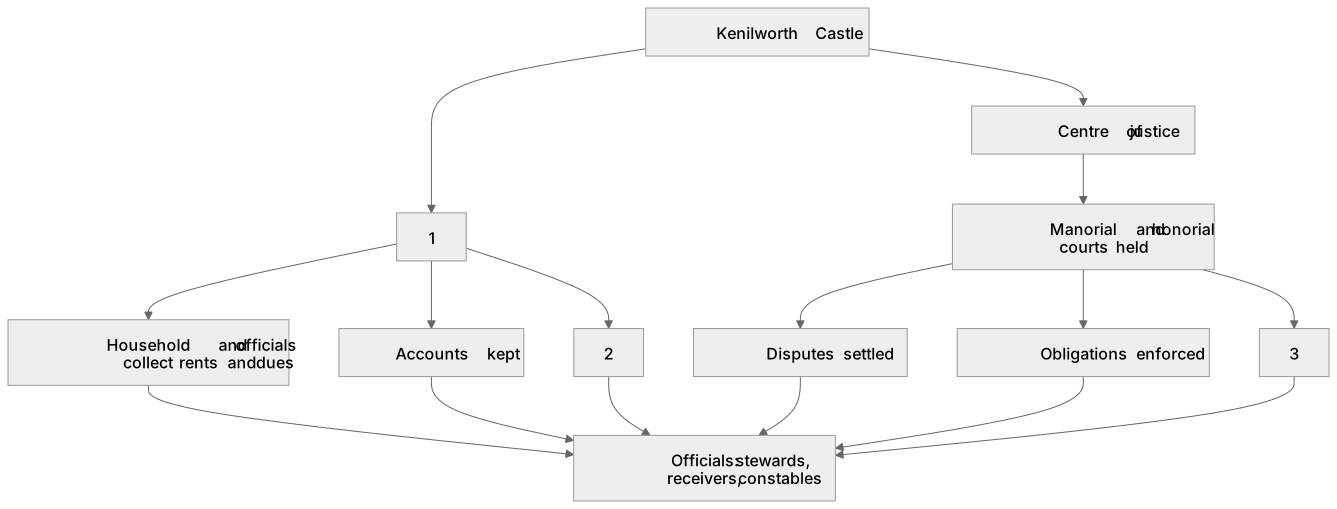
1Box 1
2Box 2
3Box 3
There is more to this lesson
The full lesson goes on to check your understanding and help you earn the marks. Create a free account to carry on, with your progress saved.
A week of Premium from your first lesson · Then the free plan continues · No card, no charge
Test your understanding of Castles: Form and Function c.1000–1750 (J410/12 and J410/13) - Day to day function(s) of Kenilworth Castle at different times in its history: Kenilworth Castle as centre of administration, justice etc.
Active recall beats re-reading. Take an instant quiz now to test what you’ve learned and lock it into long-term memory.
A week of Premium from your first lesson · Then the free plan continues · No card, no charge