OCR · GCSE · History
Course version: J410 · Version from Mar 2026
Form and Function c.1000–1750 (J410/12 and J410/13) - Life in Kenilworth…
Full specification wording
Castles: Form and Function c.1000–1750 (J410/12 and J410/13) - Life in Kenilworth Castle at different times in its history: The evidence used by historians e.g. bills and accounts, inventories.
Historians studying life at Kenilworth Castle rely on surviving written records rather than guesswork.
Checked against the OCR J410 specification (opens in a new tab) on .
- Point 3 of 3
- 4 key terms
Study notes
From the checked teaching notes for this specification point.
The idea
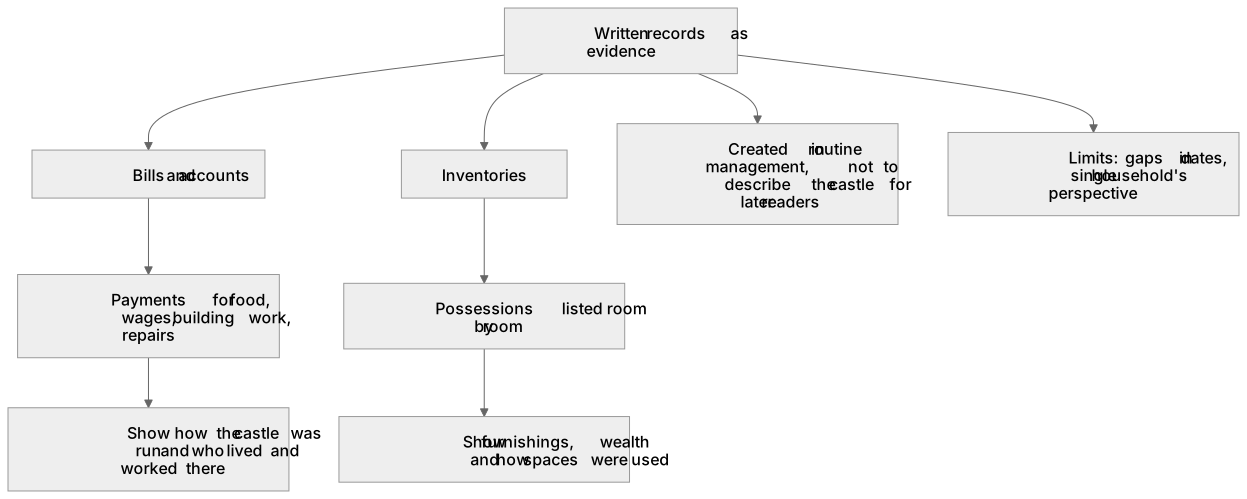
Historians studying life at Kenilworth Castle rely on surviving written records rather than guesswork. Bills and accounts show what was bought, paid for and consumed: payments for food, wages, building work or repairs reveal how the castle was run and who lived and worked there. Inventories list possessions room by room, so they indicate furnishings, wealth and how spaces were used. Such documents are evidence because they were produced in the ordinary course of managing the castle, not written to describe it for later readers. A learner should be able to identify which type of document would answer a given question, for example using an inventory to find what hung in a chamber, and recognise that each source has limits, such as gaps in dates or a single household's perspective.
What earns the marks
- Identifies bills and accounts as records of payments that reveal purchases, wages and running costs at the castle.
- Identifies inventories as lists of possessions that show furnishings, wealth and how rooms were used.
- Explains that such documents count as evidence because they were created in the routine management of the castle.
- Selects an appropriate document type for a given enquiry, such as an inventory for furnishings or accounts for expenditure.
- Recognises a limitation of these records, such as incomplete survival or a single household's viewpoint.
Common mistakes and how to put them right
Treats any old document as equally useful evidence.
Put it right: Match the document type to the specific question being asked.
Assumes inventories record only money.
Put it right: Inventories list possessions, while accounts record payments.
Ignores the limits of the evidence.
Put it right: Note that records may be incomplete or reflect one household's perspective.
Exam tips
- Read the question to identify what information is needed, then choose the document type that would supply it.
- Link each document to a concrete detail, such as an inventory entry for a chamber's contents.
- State one limitation of the evidence to show understanding that sources are partial.
Try the lesson
The start of the Castles: Form and Function c.1000–1750 (J410/12 and J410/13) - Life in Kenilworth Castle at different times in its history: The evidence used by historians e.g. bills and accounts, inventories. lesson, made from checked teaching notes for this specification point.
Have a go first
Which type of historical source would be most useful for finding out how much money was spent on food at Kenilworth Castle in a particular year?
Listen
Historians studying life at Kenilworth Castle rely on surviving written records rather than guesswork. Bills and accounts show what was bought, paid for and consumed: payments for food, wages, building work or repairs reveal how the castle was run and who lived and worked there. Inventories list possessions room by room, so they indicate furnishings, wealth and how spaces were used. Such documents are evidence because they were produced in the ordinary course of managing the castle, not written to describe it for later readers. A learner should be able to identify which type of document would answer a given question, for example using an inventory to find what hung in a chamber, and recognise that each source has limits, such as gaps in dates or a single household's perspective. A strong answer earns marks for these points. Identifies bills and accounts as records of payments that reveal purchases, wages and running costs at the castle. Identifies inventories as lists of possessions that show furnishings, wealth and how rooms were used. Explains that such documents count as evidence because they were created in the routine management of the castle. Selects an appropriate document type for a given enquiry, such as an inventory for furnishings or accounts for expenditure. Exam tip: Read the question to identify what information is needed, then choose the document type that would supply it.
See it
Key words
Say what each word means before you turn the card.
Bills and accounts
Try answering aloud or in your head before turning the card.
Inventories
Try answering aloud or in your head before turning the card.
Evidence
Try answering aloud or in your head before turning the card.
Limitation
Try answering aloud or in your head before turning the card.
See every definition
- Bills and accounts
- Records of payments that reveal purchases, wages and running costs at the castle.
- Inventories
- Lists of possessions that show furnishings, wealth and how rooms were used.
- Evidence
- Documents such as bills, accounts and inventories, produced in the ordinary course of managing the castle rather than written to describe it for later readers.
- Limitation
- A limit of these records, such as gaps in dates or a single household's perspective.
Label the diagram
Some boxes have lost their names. Pick the right name for each number.
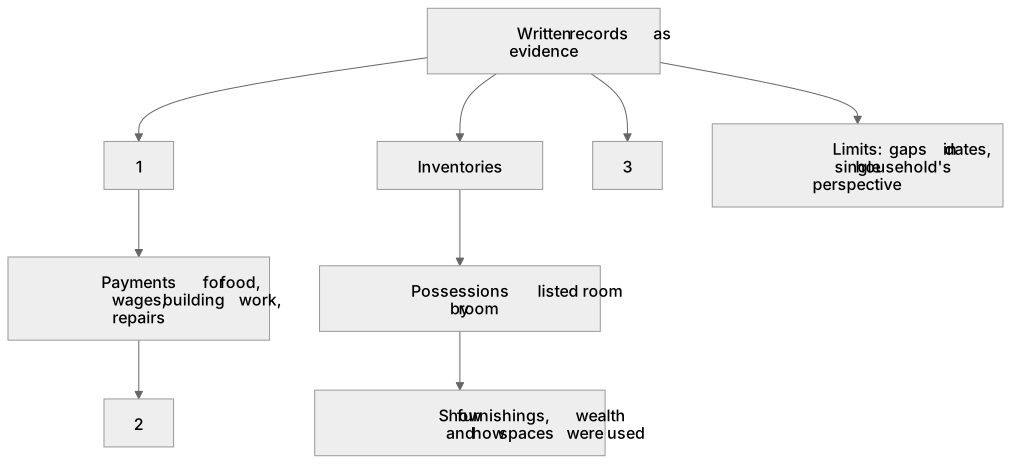
1Box 1
2Box 2
3Box 3
There is more to this lesson
The full lesson goes on to check your understanding and help you earn the marks. Create a free account to carry on, with your progress saved.
A week of Premium from your first lesson · Then the free plan continues · No card, no charge
Test your understanding of Castles: Form and Function c.1000–1750 (J410/12 and J410/13) - Life in Kenilworth Castle at different times in its history: The evidence used by historians e.g. bills and accounts, inventories.
Active recall beats re-reading. Take an instant quiz now to test what you’ve learned and lock it into long-term memory.
A week of Premium from your first lesson · Then the free plan continues · No card, no charge