OCR · GCSE · History
Course version: J410 · Version from Mar 2026
Form and Function c.1000–1750 (J410/12 and J410/13) - Day to day…
Full specification wording
Castles: Form and Function c.1000–1750 (J410/12 and J410/13) - Day to day function(s) of Kenilworth Castle at different times in its history: Kenilworth Castle as means of conquest, particularly in the Norman period.
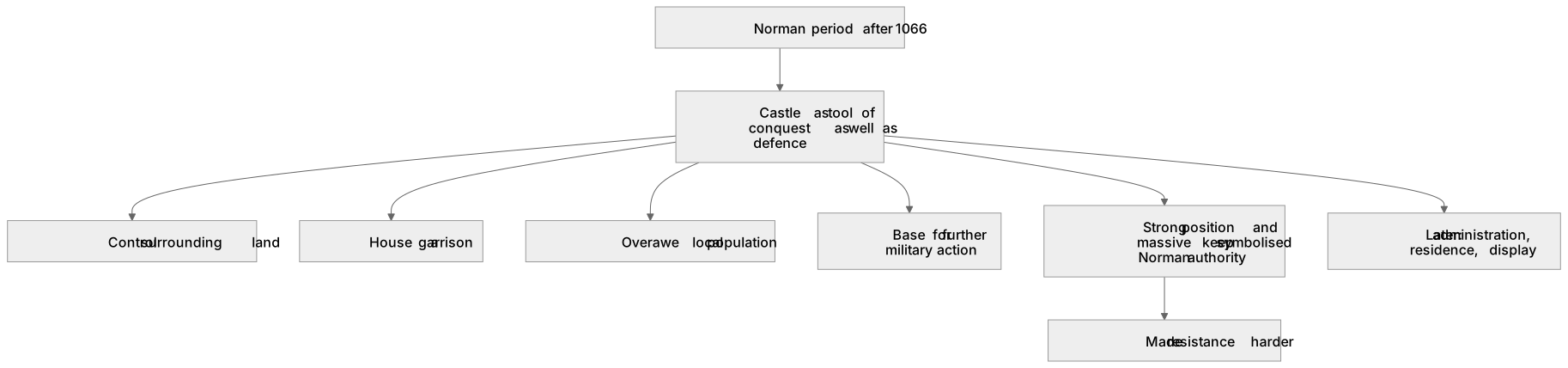
In the Norman period after 1066 castles were a tool of conquest as well as defence.
Checked against the OCR J410 specification (opens in a new tab) on .
- Point 1 of 5
- 4 key terms
Study notes
From the checked teaching notes for this specification point.
The idea
In the Norman period after 1066 castles were a tool of conquest as well as defence. A castle such as Kenilworth let a Norman lord control the surrounding land, house a garrison, overawe the local population and act as a base for further military action. Its strong position and massive keep symbolised Norman authority and made resistance harder. Over time the same site took on other day-to-day functions, such as administration, residence and later display, but in the Norman period its role in securing and holding conquered territory was central. Historians therefore read the castle's form and location as evidence of how conquest was enforced and maintained.
What earns the marks
- Explains that Norman castles such as Kenilworth helped control conquered land and the local population.
- Identifies the castle as a military base housing a garrison and supporting further action.
- Recognises that a strong keep and position symbolised and enforced Norman authority.
- Notes that the castle's function changed over time, with conquest central in the Norman period but other roles developing later.
Common mistakes and how to put them right
Treats the castle only as a comfortable residence.
Put it right: Recognise that in the Norman period its main role was military control and conquest.
Assumes castles were purely defensive.
Put it right: Explain that they also projected authority and helped hold conquered territory.
Ignores change over time.
Put it right: Note that conquest was central in the Norman period while later functions differed.
Believes a castle's location was unimportant.
Put it right: Recognise that position helped control land and people.
Exam tips
- Focus on the Norman period when the question asks about conquest.
- Link the castle's form and position to control of land and people, not just defence.
- Reject options that describe the castle only as a home or only as a defensive wall.
Try the lesson
The start of the Castles: Form and Function c.1000–1750 (J410/12 and J410/13) - Day to day function(s) of Kenilworth Castle at different times in its history: Kenilworth Castle as means of conquest, particularly in the Norman period. lesson, made from checked teaching notes for this specification point.
Have a go first
How did a Norman castle help its lord collect taxes and enforce the law in the local area?
Listen
In the Norman period after 1066 castles were a tool of conquest as well as defence. A castle such as Kenilworth let a Norman lord control the surrounding land, house a garrison, overawe the local population and act as a base for further military action. Its strong position and massive keep symbolised Norman authority and made resistance harder. Over time the same site took on other day-to-day functions, such as administration, residence and later display, but in the Norman period its role in securing and holding conquered territory was central. Historians therefore read the castle's form and location as evidence of how conquest was enforced and maintained. A strong answer earns marks for these points. Explains that Norman castles such as Kenilworth helped control conquered land and the local population. Identifies the castle as a military base housing a garrison and supporting further action. Recognises that a strong keep and position symbolised and enforced Norman authority. Notes that the castle's function changed over time, with conquest central in the Norman period but other roles developing later. Exam tip: Focus on the Norman period when the question asks about conquest.
See it
Key words
Say what each word means before you turn the card.
Norman conquest and control
Try answering aloud or in your head before turning the card.
Castles as military bases
Try answering aloud or in your head before turning the card.
Symbols of authority
Try answering aloud or in your head before turning the card.
Change in function over time
Try answering aloud or in your head before turning the card.
See every definition
- Norman conquest and control
- After 1066 castles were a tool of conquest as well as defence, letting a Norman lord control the surrounding land and hold conquered territory.
- Castles as military bases
- A castle such as Kenilworth housed a garrison and acted as a base for further military action.
- Symbols of authority
- Its strong position and massive keep symbolised Norman authority and made resistance harder.
- Change in function over time
- Over time the same site took on other day-to-day functions, such as administration, residence and later display, but conquest was central in the Norman period.
Label the diagram
Some boxes have lost their names. Pick the right name for each number.
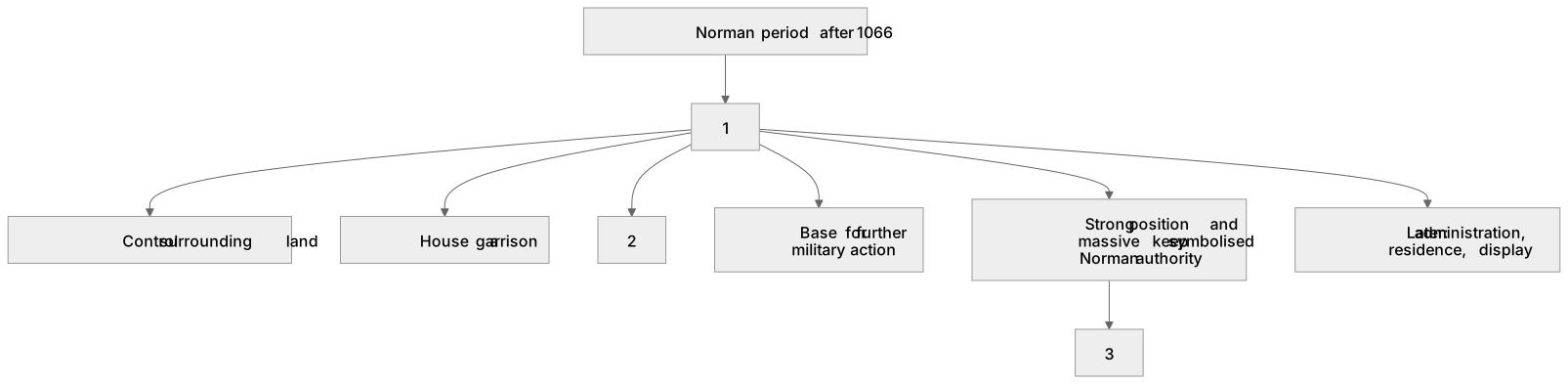
1Box 1
2Box 2
3Box 3
There is more to this lesson
The full lesson goes on to check your understanding and help you earn the marks. Create a free account to carry on, with your progress saved.
A week of Premium from your first lesson · Then the free plan continues · No card, no charge
Test your understanding of Castles: Form and Function c.1000–1750 (J410/12 and J410/13) - Day to day function(s) of Kenilworth Castle at different times in its history: Kenilworth Castle as means of conquest, particularly in the Norman period.
Active recall beats re-reading. Take an instant quiz now to test what you’ve learned and lock it into long-term memory.
A week of Premium from your first lesson · Then the free plan continues · No card, no charge