OCR · GCSE · History
Course version: J410 · Version from Mar 2026
Form and Function c.1000–1750 (J410/12 and J410/13) - The location of…
Full specification wording
Castles: Form and Function c.1000–1750 (J410/12 and J410/13) - The location of Kenilworth Castle: The strategic location of Kenilworth Castle.
This criterion asks you to explain why Kenilworth Castle was sited where it is, in terms of strategic advantage.
Checked against the OCR J410 specification (opens in a new tab) on .
- Point 1 of 4
- 4 key terms
Study notes
From the checked teaching notes for this specification point.
The idea
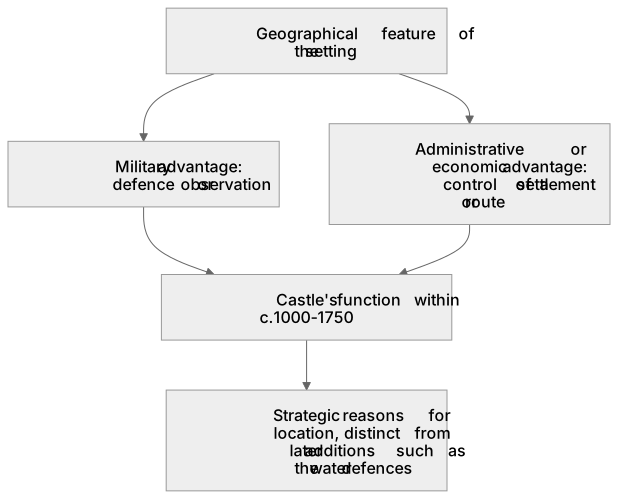
This criterion asks you to explain why Kenilworth Castle was sited where it is, in terms of strategic advantage. Consider what a castle needed from its location: defensible high ground or a rise above surrounding land; control of routes such as roads, river crossings or a ford; proximity to a settlement or manor it was meant to dominate; access to water and to building materials; and a position that could be supplied and reinforced. Kenilworth sits in Warwickshire with its great keep and later water defences, and its location allowed control of the surrounding area and approach routes. A strong answer links a specific geographical feature to a military or administrative advantage within the period c.1000–1750.
What earns the marks
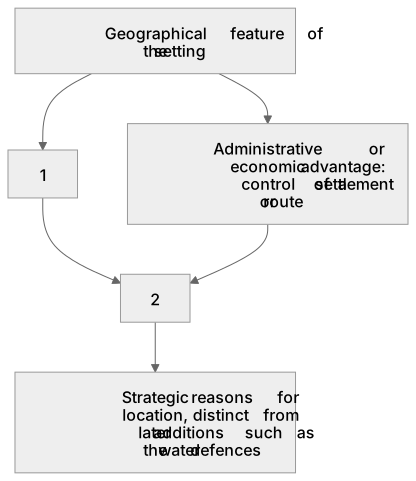
- Identifies a geographical feature of the castle's setting, such as raised ground, water or a routeway.
- Explains the military advantage that feature gave, such as defence or observation.
- Explains the administrative or economic advantage, such as control of a settlement or route.
- Connects the location to the castle's function within the period c.1000–1750.
- Distinguishes strategic reasons for location from later additions such as the water defences.
Common mistakes and how to put them right
Describes the castle's appearance instead of its location.
Put it right: Focus on why the site was chosen.
Names a feature without stating the advantage it gave.
Put it right: Explain what the feature allowed defenders or lords to do.
Confuses the original strategic siting with later building work.
Put it right: Separate the choice of site from later construction.
Places the castle outside the stated period.
Put it right: Keep the reasoning within c.1000–1750.
Exam tips
- Eliminate options that describe the castle's fabric rather than its setting.
- Choose the option that links a geographical feature to a strategic purpose.
- Reject options that give no reason connected to defence, control or supply.
- Check that the option is consistent with the period c.1000–1750.
Try the lesson
The start of the Castles: Form and Function c.1000–1750 (J410/12 and J410/13) - The location of Kenilworth Castle: The strategic location of Kenilworth Castle. lesson, made from checked teaching notes for this specification point.
Have a go first
Which natural feature would most help a castle such as Kenilworth defend itself against attackers?
Listen
This criterion asks you to explain why Kenilworth Castle was sited where it is, in terms of strategic advantage. Consider what a castle needed from its location: defensible high ground or a rise above surrounding land; control of routes such as roads, river crossings or a ford; proximity to a settlement or manor it was meant to dominate; access to water and to building materials; and a position that could be supplied and reinforced. Kenilworth sits in Warwickshire with its great keep and later water defences, and its location allowed control of the surrounding area and approach routes. A strong answer links a specific geographical feature to a military or administrative advantage within the period c.1000–1750. A strong answer earns marks for these points. Identifies a geographical feature of the castle's setting, such as raised ground, water or a routeway. Explains the military advantage that feature gave, such as defence or observation. Explains the administrative or economic advantage, such as control of a settlement or route. Connects the location to the castle's function within the period c.1000–1750. Exam tip: Eliminate options that describe the castle's fabric rather than its setting.
See it
Key words
Say what each word means before you turn the card.
Defensible siting and use of high ground
Try answering aloud or in your head before turning the card.
Control of routes, crossings and settlement
Try answering aloud or in your head before turning the card.
Water supply and water defences
Try answering aloud or in your head before turning the card.
Administrative and economic control of the surrounding area
Try answering aloud or in your head before turning the card.
See every definition
- Defensible siting and use of high ground
- A castle needed defensible high ground or a rise above surrounding land as part of what it required from its location.
- Control of routes, crossings and settlement
- A castle needed control of routes such as roads, river crossings or a ford, and proximity to a settlement or manor it was meant to dominate.
- Water supply and water defences
- A castle needed access to water, and Kenilworth has later water defences, which should be distinguished from strategic reasons for location.
- Administrative and economic control of the surrounding area
- Kenilworth's location allowed control of the surrounding area and approach routes, giving an administrative or economic advantage.
Label the diagram
Some boxes have lost their names. Pick the right name for each number.
1Box 1
2Box 2
There is more to this lesson
The full lesson goes on to check your understanding and help you earn the marks. Create a free account to carry on, with your progress saved.
A week of Premium from your first lesson · Then the free plan continues · No card, no charge
Test your understanding of Castles: Form and Function c.1000–1750 (J410/12 and J410/13) - The location of Kenilworth Castle: The strategic location of Kenilworth Castle.
Active recall beats re-reading. Take an instant quiz now to test what you’ve learned and lock it into long-term memory.
A week of Premium from your first lesson · Then the free plan continues · No card, no charge