OCR · GCSE · History
Course version: J410 · Version from Mar 2026
Patterns of Migration (J410/11) - The impact of migration on the area: The…
Full specification wording
Urban Environments: Patterns of Migration (J410/11) - The impact of migration on the area: The nature of the current multicultural community.
This criterion asks you to characterise the present-day multicultural community of a studied urban area: its ethnic and cultural mix, the institutions that sustain it (shops, places of worship,…
Checked against the OCR J410 specification (opens in a new tab) on .
- Point 1 of 2
- 4 key terms
Study notes
From the checked teaching notes for this specification point.
The idea
This criterion asks you to characterise the present-day multicultural community of a studied urban area: its ethnic and cultural mix, the institutions that sustain it (shops, places of worship, community organisations, schools), the languages spoken, and the everyday interactions between groups. A strong answer recognises that a multicultural community is not simply a count of nationalities but a lived pattern of coexistence, mixing and sometimes friction. Be ready to identify accurate features and reject inaccurate ones, for example confusing diversity of population with an absence of community tension, or assuming all groups integrate identically. Ground your choices in specific evidence about the area rather than general assumptions.
What earns the marks
- Identifies accurate features of the area's present-day ethnic and cultural mix.
- Recognises institutions and spaces that sustain multicultural community life.
- Distinguishes genuine features of the community from inaccurate generalisations.
- Links the character of the community to evidence about the area rather than assumption.
Common mistakes and how to put them right
Equates a multicultural population with the absence of tension.
Put it right: Recognise coexistence and friction can both exist.
Assumes all migrant groups experience the area identically.
Put it right: Distinguish between groups and experiences.
Selects an option on general impression rather than evidence about the specific area.
Put it right: Check each option against what you know.
Exam tips
- Read every option before choosing and eliminate those contradicted by evidence.
- Look for the option that describes the community accurately rather than the most dramatic one.
- Anchor your choice in a specific feature such as shops, worship or language.
Try the lesson
The start of the Urban Environments: Patterns of Migration (J410/11) - The impact of migration on the area: The nature of the current multicultural community. lesson, made from checked teaching notes for this specification point.
Have a go first
A neighbourhood has shops, places of worship and restaurants serving several different cultural groups. This is best described as what kind of community?
Listen
This criterion asks you to characterise the present-day multicultural community of a studied urban area: its ethnic and cultural mix, the institutions that sustain it (shops, places of worship, community organisations, schools), the languages spoken, and the everyday interactions between groups. A strong answer recognises that a multicultural community is not simply a count of nationalities but a lived pattern of coexistence, mixing and sometimes friction. Be ready to identify accurate features and reject inaccurate ones, for example confusing diversity of population with an absence of community tension, or assuming all groups integrate identically. Ground your choices in specific evidence about the area rather than general assumptions. A strong answer earns marks for these points. Identifies accurate features of the area's present-day ethnic and cultural mix. Recognises institutions and spaces that sustain multicultural community life. Distinguishes genuine features of the community from inaccurate generalisations. Links the character of the community to evidence about the area rather than assumption. Exam tip: Read every option before choosing and eliminate those contradicted by evidence.
See it

Key words
Say what each word means before you turn the card.
Multicultural community
Try answering aloud or in your head before turning the card.
Community institutions
Try answering aloud or in your head before turning the card.
Coexistence and tension
Try answering aloud or in your head before turning the card.
Cultural diversity
Try answering aloud or in your head before turning the card.
See every definition
- Multicultural community
- A lived pattern of coexistence, mixing and sometimes friction, not simply a count of nationalities.
- Community institutions
- Shops, places of worship, community organisations and schools that sustain multicultural community life.
- Coexistence and tension
- Recognising that coexistence and friction can both exist, rather than equating a multicultural population with the absence of tension.
- Cultural diversity
- The ethnic and cultural mix of an area, together with the languages spoken and everyday interactions between groups.
Label the diagram
Some boxes have lost their names. Pick the right name for each number.
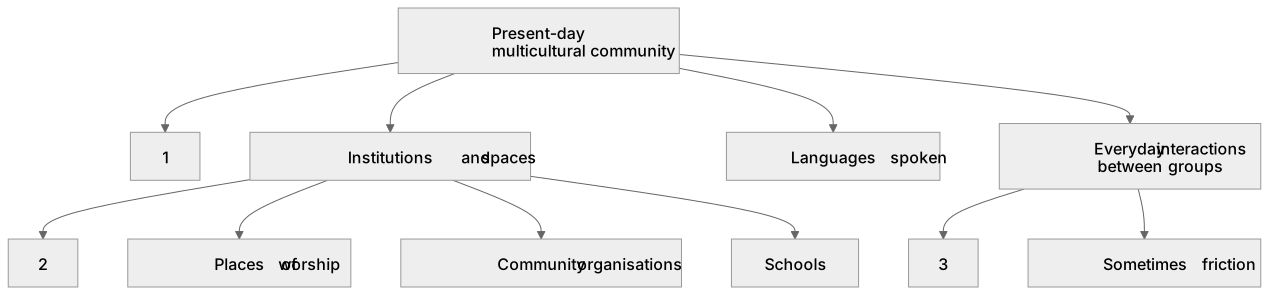
1Box 1
2Box 2
3Box 3
There is more to this lesson
The full lesson goes on to check your understanding and help you earn the marks. Create a free account to carry on, with your progress saved.
A week of Premium from your first lesson · Then the free plan continues · No card, no charge
Test your understanding of Urban Environments: Patterns of Migration (J410/11) - The impact of migration on the area: The nature of the current multicultural community.
Active recall beats re-reading. Take an instant quiz now to test what you’ve learned and lock it into long-term memory.
A week of Premium from your first lesson · Then the free plan continues · No card, no charge