OCR · A-Level · Psychology
Course version: H567 · Version from Sept 2015
Understand the difference between primary and secondary data (to include:…
Full specification wording
D.1 – handling data: Understand the difference between primary and secondary data (to include: stating whether data collected by a researcher dealing directly with participants is primary or secondary data)
The distinction turns on who gathered the information and what for, not on whether it is words or numbers.
- Point 17 of 17
- 4 key terms
Study notes
From the teaching notes for this specification point.
The idea
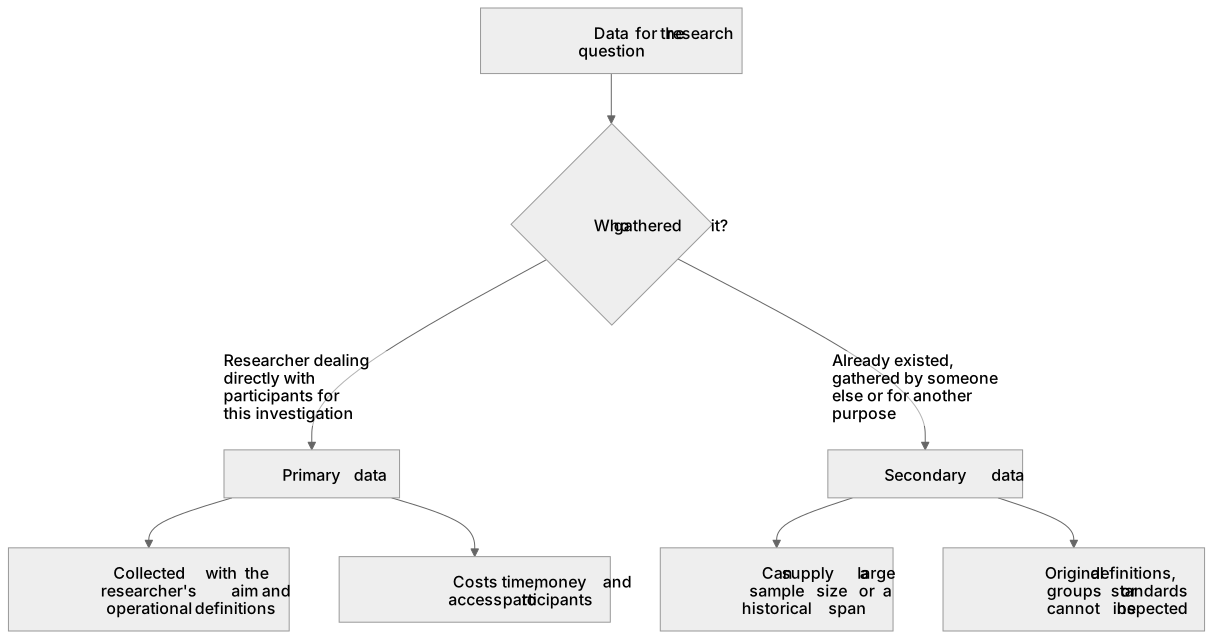
The distinction turns on who gathered the information and what for, not on whether it is words or numbers. Anything a researcher collects at first hand for the question in front of them counts as original data, whether that is timing participants or writing down interview answers. Anything that already existed, gathered by someone else or for another purpose, is second hand: official crime figures, medical records, or the wartime Army intelligence test scores that Gould (1982) re-examined. Casey et al. (2011) carries both at once, since the childhood delay of gratification measures came from an existing longitudinal sample while the go/no-go performance and the brain scans were gathered fresh.
What earns the marks
- Naming what follows from that, that primary data are collected with the aim and the operational definitions the researcher chose, so they fit the hypothesis and their reliability can be checked at source.
- Naming the cost as well, that primary collection takes time, money and access to participants, while secondary sources can supply a sample size or a historical span nobody could gather now.
- A limitation of secondary data with a reason attached, that the original team may have defined the variable differently, omitted the group of interest, or worked to standards the present researcher cannot inspect.
Common mistakes and how to put them right
Assuming secondary data means published research only.
Put it right: A school attendance register or a hospital waiting list becomes secondary data the moment a psychologist analyses it.
Calling a meta-analysis primary because the researcher did the calculations.
Put it right: The scores being pooled were collected by other teams, so the data remain second hand however new the analysis is.
Muddling the pair with quantitative and qualitative, and writing that primary data are numerical while secondary data are descriptive.
Saying secondary data is unreliable without explaining why, when the mark is for naming what cannot be checked, such as how the original sample was recruited.
Exam tips
- The short version simply asks which kind is being described, so scan the stem for who did the collecting rather than for what the data look like.
- Longer items ask you to suggest a secondary source for a stated aim, so name a real one, official statistics or a previous study table, and say why it matches the variable under investigation.
- Ethics can earn a point here, since using existing records avoids putting new participants through a stressful procedure, which is worth raising when evaluating a proposed design.
Try the lesson
The start of the D.1 – handling data: Understand the difference between primary and secondary data (to include: stating whether data collected by a researcher dealing directly with participants is primary or secondary data) lesson, made from teaching notes for this specification point.
Have a go first
A researcher conducts an experiment and records the reaction times of participants directly. Which type of data has the researcher collected?
Listen
The distinction turns on who gathered the information and what for, not on whether it is words or numbers. Anything a researcher collects at first hand for the question in front of them counts as original data, whether that is timing participants or writing down interview answers. Anything that already existed, gathered by someone else or for another purpose, is second hand: official crime figures, medical records, or the wartime Army intelligence test scores that Gould (1982) re-examined. Casey et al. (2011) carries both at once, since the childhood delay of gratification measures came from an existing longitudinal sample while the go/no-go performance and the brain scans were gathered fresh. A strong answer earns marks for these points. Stating a test that can be applied to any stem, that data collected by the researcher dealing directly with participants for this investigation is primary, and data that already existed is secondary however recently it was published. Naming what follows from that, that primary data are collected with the aim and the operational definitions the researcher chose, so they fit the hypothesis and their reliability can be checked at source. Naming the cost as well, that primary collection takes time, money and access to participants, while secondary sources can supply a sample size or a historical span nobody could gather now. A limitation of secondary data with a reason attached, that the original team may have defined the variable differently, omitted the group of interest, or worked to standards the present researcher cannot inspect. Exam tip: The short version simply asks which kind is being described, so scan the stem for who did the collecting rather than for what the data look like.
See it
Key words
Say what each word means before you turn the card.
primary data
Try answering aloud or in your head before turning the card.
secondary data
Try answering aloud or in your head before turning the card.
meta-analysis
Try answering aloud or in your head before turning the card.
checking data quality
Try answering aloud or in your head before turning the card.
See every definition
- primary data
- Data collected by the researcher dealing directly with participants for this investigation, gathered at first hand for the question in front of them.
- secondary data
- Data that already existed, gathered by someone else or for another purpose, such as official crime figures, medical records or wartime Army intelligence test scores.
- meta-analysis
- Pooling scores that were collected by other teams, so the data remain second hand however new the analysis is.
- checking data quality
- Primary data fit the hypothesis and their reliability can be checked at source, while with secondary data the original team may have defined the variable differently or worked to standards the present researcher cannot inspect.
There is more to this lesson
The full lesson goes on to check your understanding and help you earn the marks. Create a free account to carry on, with your progress saved.
A week of Premium from your first lesson · Then the free plan continues · No card, no charge
Test your understanding of D.1 – handling data: Understand the difference between primary and secondary data (to include: stating whether data collected by a researcher dealing directly with participants is primary or secondary data)
Active recall beats re-reading. Take an instant quiz now to test what you’ve learned and lock it into long-term memory.
A week of Premium from your first lesson · Then the free plan continues · No card, no charge