OCR · A-Level · Psychology
Course version: H567 · Version from Sept 2015
Understand the principles of sampling as applied to scientific data (to…
Full specification wording
D.1 – handling data: Understand the principles of sampling as applied to scientific data (to include: explaining how a random or stratified sample could be obtained from a target population)
A sample is drawn from a target population, and how it is drawn decides how far the findings can travel.
- Point 5 of 17
- 4 key terms
Study notes
From the teaching notes for this specification point.
The idea
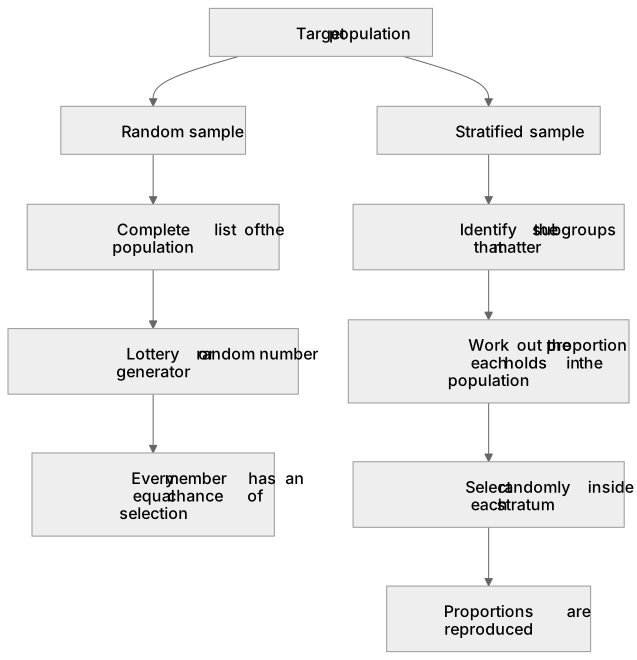
A sample is drawn from a target population, and how it is drawn decides how far the findings can travel. A random sample gives every member an equal chance of selection, which in practice means a complete list of the population and then a lottery or a random number generator; it removes researcher bias but needs that list and can still throw up an unrepresentative set by chance. A stratified sample identifies the subgroups that matter, works out the proportion each holds in the population, and then selects randomly inside each stratum so those proportions are reproduced. Milgram recruited by newspaper advertisement, so his obedience figures rest on self selected men, and the broader problem is that published samples remain heavily Western and student based.
What earns the marks
- A random sample is credited only when the equal chance of selection is stated together with the method, which is a complete list of the target population and a genuinely random selection procedure.
- Evaluating the method in context is rewarded, for example that stratification improves representativeness but takes time and depends on accurate population figures.
- Linking the method to generalisability, and naming a specific bias such as an all male or all student sample, earns the evaluation mark.
Common mistakes and how to put them right
Calling an opportunity sample random because the researcher did not deliberately choose.
Put it right: Random has a technical meaning and approaching whoever is in the canteen does not meet it.
Describing stratified sampling as simply including some of each group, leaving out both the proportions and the random selection within each stratum.
Assuming a large sample must be representative, when a large biased sample is still biased and simply repeats the bias more confidently.
Exam tips
- Sampling items normally ask how a named method could be obtained for the study in the stem, so write the procedure as ordered steps applied to that population rather than as a textbook definition.
- Expect a linked evaluation part, so pair each method with one strength and one weakness expressed in terms of bias and generalisability.
- Where the study in the stem used one method, you may be asked to suggest an alternative and justify it, which needs a reason drawn from that study's own target population.
Try the lesson
The start of the D.1 – handling data: Understand the principles of sampling as applied to scientific data (to include: explaining how a random or stratified sample could be obtained from a target population) lesson, made from teaching notes for this specification point.
Have a go first
A researcher wants to obtain a simple random sample of 50 students from a college of 1000 students. Which procedure describes a valid method for achieving this?
Listen
A sample is drawn from a target population, and how it is drawn decides how far the findings can travel. A random sample gives every member an equal chance of selection, which in practice means a complete list of the population and then a lottery or a random number generator; it removes researcher bias but needs that list and can still throw up an unrepresentative set by chance. A stratified sample identifies the subgroups that matter, works out the proportion each holds in the population, and then selects randomly inside each stratum so those proportions are reproduced. Milgram recruited by newspaper advertisement, so his obedience figures rest on self selected men, and the broader problem is that published samples remain heavily Western and student based. A strong answer earns marks for these points. A random sample is credited only when the equal chance of selection is stated together with the method, which is a complete list of the target population and a genuinely random selection procedure. Stratified sampling needs the strata named, the proportions calculated and the random step inside each stratum, so for a school of five hundred with three hundred girls a sample of fifty would hold thirty girls and twenty boys. Evaluating the method in context is rewarded, for example that stratification improves representativeness but takes time and depends on accurate population figures. Linking the method to generalisability, and naming a specific bias such as an all male or all student sample, earns the evaluation mark. Exam tip: Sampling items normally ask how a named method could be obtained for the study in the stem, so write the procedure as ordered steps applied to that population rather than as a textbook definition.
See it
Key words
Say what each word means before you turn the card.
target population
Try answering aloud or in your head before turning the card.
random sampling
Try answering aloud or in your head before turning the card.
stratified sampling
Try answering aloud or in your head before turning the card.
representativeness and generalisability
Try answering aloud or in your head before turning the card.
See every definition
- target population
- The group from which a sample is drawn, and how the sample is drawn decides how far the findings can travel.
- random sampling
- Every member has an equal chance of selection, which in practice means a complete list of the population and then a lottery or a random number generator.
- stratified sampling
- The subgroups that matter are identified, the proportion each holds in the population is worked out, and selection is random inside each stratum so those proportions are reproduced.
- representativeness and generalisability
- Stratification improves representativeness but takes time and depends on accurate population figures, and a large biased sample is still biased.
Label the diagram
Some boxes have lost their names. Pick the right name for each number.
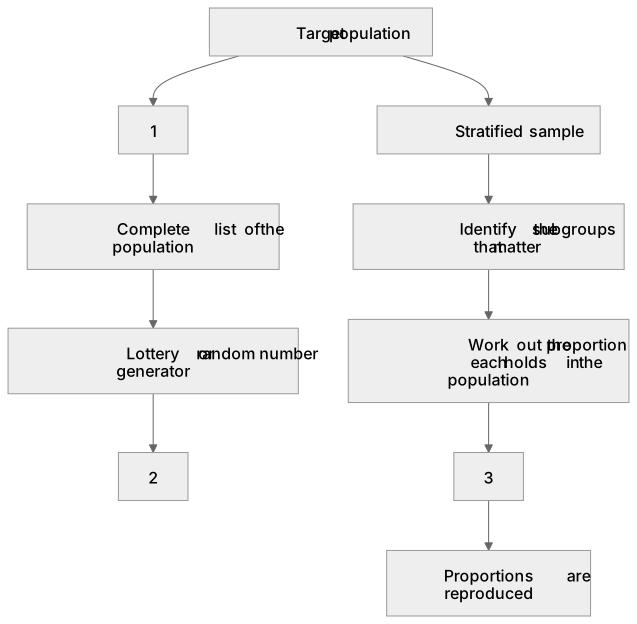
1Box 1
2Box 2
3Box 3
There is more to this lesson
The full lesson goes on to check your understanding and help you earn the marks. Create a free account to carry on, with your progress saved.
A week of Premium from your first lesson · Then the free plan continues · No card, no charge
Test your understanding of D.1 – handling data: Understand the principles of sampling as applied to scientific data (to include: explaining how a random or stratified sample could be obtained from a target population)
Active recall beats re-reading. Take an instant quiz now to test what you’ve learned and lock it into long-term memory.
A week of Premium from your first lesson · Then the free plan continues · No card, no charge