OCR · A-Level · Psychology
Course version: H567 · Version from Sept 2015
Solve simple algebraic equations (to include: calculating the degrees of…
Full specification wording
D.2 – algebra: Solve simple algebraic equations (to include: calculating the degrees of freedom for a Chi Square test)
Basic algebraic rearrangement allows psychologists to find missing values, such as recovering a total from a mean.
- Point 3 of 3
- 3 key terms
Study notes
From the teaching notes for this specification point.
The idea
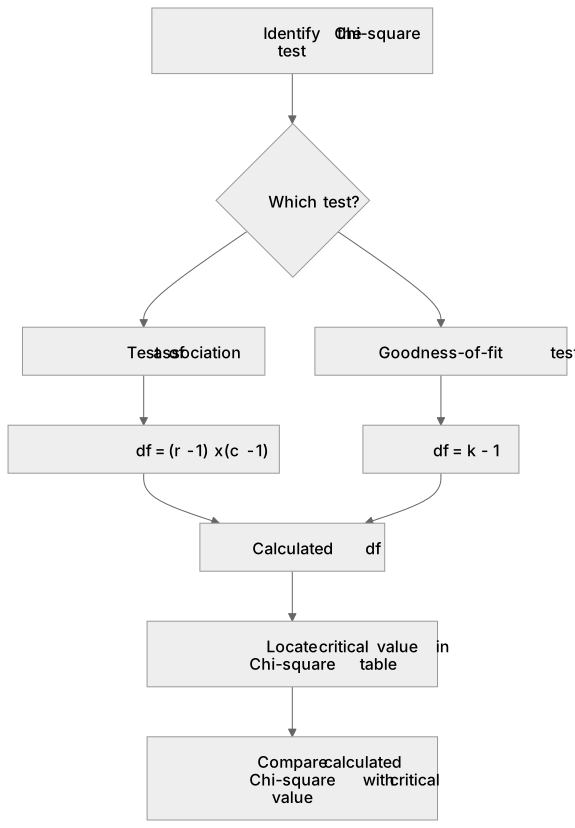
Basic algebraic rearrangement allows psychologists to find missing values, such as recovering a total from a mean. A key application is calculating degrees of freedom ($df$) for a Chi-square ($\chi^2$) test to determine the correct critical value. For a $\chi^2$ test of association, $df$ is found using $df = (r - 1) \times (c - 1)$, where $r$ is rows and $c$ is columns. For example, a $2 \times 2$ table yields $df = (2 - 1) \times (2 - 1) = 1$. For a $\chi^2$ goodness-of-fit test, $df = k - 1$, where $k$ is the number of categories. Calculating $df$ incorrectly leads to reading the wrong critical value, potentially reversing the significance decision. Once the correct critical value is identified, the calculated $\chi^2$ value must equal or exceed it for the result to be significant.
What earns the marks
- Stating and applying the correct formula for a Chi-square ($\chi^2$) test of association: $df = (r - 1) \times (c - 1)$.
- Calculating degrees of freedom for a goodness-of-fit test using $df = k - 1$, where $k$ represents the number of categories.
- Rearranging simple algebraic equations to solve for an unknown, such as finding a missing score when the mean and total number of scores are provided.
- Using the calculated $df$ to locate the correct critical value in a $\chi^2$ table at the specified level of significance (e.g., $p = 0.05$).
Common mistakes and how to put them right
Including the row and column totals when counting $r$ and $c$ for a contingency table, causing a $2 \times 2$ table to be incorrectly treated as $3 \times 3$, yielding $df = 4$ instead of $1$.
Multiplying rows by columns and then subtracting one (e.g., $(2 \times 2) - 1 = 3$), rather than subtracting one from each dimension before multiplying.
Using $N - 1$ (total participants minus one) to calculate $df$ for a Chi-square ($\chi^2$) test, which applies to other statistical tests but produces an invalid, overly large figure here.
Exam tips
- Always write out the full substitution for the $df$ formula (e.g., $(2 - 1) \times (2 - 1) = 1$) as mark schemes often award credit for the working even if the final lookup fails.
- Remember that the smallest possible contingency table ($2 \times 2$) always gives a degrees of freedom value of $1$, which serves as a useful sanity check during exams.
Try the lesson
The start of the D.2 – algebra: Solve simple algebraic equations (to include: calculating the degrees of freedom for a Chi Square test) lesson, made from teaching notes for this specification point.
Have a go first
A researcher conducts a Chi-Square test of association using a contingency table that has 2 rows and 3 columns. What is the correct calculated value for the degrees of freedom?
Listen
Basic algebraic rearrangement allows psychologists to find missing values, such as recovering a total from a mean. A key application is calculating degrees of freedom (df) for a Chi-square (\chi^2) test to determine the correct critical value. For a \chi^2 test of association, df is found using df = (r - 1) \times (c - 1), where r is rows and c is columns. For example, a 2 \times 2 table yields df = (2 - 1) \times (2 - 1) = 1. For a \chi^2 goodness-of-fit test, df = k - 1, where k is the number of categories. Calculating df incorrectly leads to reading the wrong critical value, potentially reversing the significance decision. Once the correct critical value is identified, the calculated \chi^2 value must equal or exceed it for the result to be significant. A strong answer earns marks for these points. Stating and applying the correct formula for a Chi-square (\chi^2) test of association: df = (r - 1) \times (c - 1). Calculating degrees of freedom for a goodness-of-fit test using df = k - 1, where k represents the number of categories. Rearranging simple algebraic equations to solve for an unknown, such as finding a missing score when the mean and total number of scores are provided. Using the calculated df to locate the correct critical value in a \chi^2 table at the specified level of significance (e.g., p = 0.05). Exam tip: Always write out the full substitution for the df formula (e.g., (2 - 1) \times (2 - 1) = 1) as mark schemes often award credit for the working even if the final lookup fails.
See it
Key words
Say what each word means before you turn the card.
degrees of freedom
Try answering aloud or in your head before turning the card.
Chi-square test
Try answering aloud or in your head before turning the card.
algebraic rearrangement
Try answering aloud or in your head before turning the card.
See every definition
- degrees of freedom
- A value calculated for a Chi-square test, found using df = (r - 1) × (c - 1) for a test of association or df = k - 1 for a goodness-of-fit test.
- Chi-square test
- A statistical test whose degrees of freedom are calculated to determine the correct critical value, with the calculated value needing to equal or exceed it for significance.
- algebraic rearrangement
- A method that allows psychologists to find missing values, such as recovering a total from a mean.
There is more to this lesson
The full lesson goes on to check your understanding and help you earn the marks. Create a free account to carry on, with your progress saved.
A week of Premium from your first lesson · Then the free plan continues · No card, no charge
Test your understanding of D.2 – algebra: Solve simple algebraic equations (to include: calculating the degrees of freedom for a Chi Square test)
Active recall beats re-reading. Take an instant quiz now to test what you’ve learned and lock it into long-term memory.
A week of Premium from your first lesson · Then the free plan continues · No card, no charge