OCR · A-Level · Psychology
Course version: H567 · Version from Sept 2015
Substitute numerical values into algebraic equations using appropriate…
Full specification wording
D.2 – algebra: Substitute numerical values into algebraic equations using appropriate units for physical quantities (to include: inserting the appropriate values from a given set of data into the formula for a statistical test e.g. inserting the N value (for the number of scores) into the Chi Square formula)
Substituting numerical values into algebraic equations requires care with units for physical quantities and statistical formulae.
- Point 2 of 3
- 3 key terms
Study notes
From the teaching notes for this specification point.
The idea
Substituting numerical values into algebraic equations requires care with units for physical quantities and statistical formulae. The routine involves defining what each letter stands for, checking data formats, and maintaining consistent units. In a Chi Square test, letters represent the observed frequency and the expected frequency. An expected cell value comes from its row total multiplied by its column total, divided by the overall number of scores (N). The counts must be frequencies of events, which is why Piliavin et al. (1969) analysed how many passengers helped the cane or drunk victim, but could not feed an average helpfulness score into the same formula.
What earns the marks
- Defining every symbol before using it, such as identifying N as the total number of scores or participants in the data set.
- Substituting data in the form the test demands, such as raw frequencies for Chi Square, ensuring expected frequencies are calculated correctly.
- Keeping units for physical quantities consistent and carrying them into the answer, so that times in seconds are not mixed with milliseconds (e.g., converting 1.5 s to 1500 ms).
- Following the correct order of operations in statistical formulae, such as subtracting, squaring, and dividing before summing in Chi Square.
Common mistakes and how to put them right
Feeding percentages or means into a frequency formula like Chi Square.
Put it right: The test requires raw counts, so convert percentages back to frequencies first.
Mixing units for physical quantities, such as adding minutes to seconds without converting them to a single consistent unit beforehand.
Dividing the total of all squared differences by a single expected value at the end of a Chi Square calculation, instead of dividing each cell's squared difference by its own expected frequency first.
Exam tips
- Copy the printed formula and write the substituted numbers directly into it before using a calculator, as correct substitution earns method marks even if the final answer is wrong.
- Always check the units of the data provided; if a question gives physical quantities in different units, convert them to match before substituting them into the equation.
Try the lesson
The start of the D.2 – algebra: Substitute numerical values into algebraic equations using appropriate units for physical quantities (to include: inserting the appropriate values from a given set of data into the formula for a statistical test e.g. inserting the N value (for the number of scores) into the Chi Square formula) lesson, made from teaching notes for this specification point.
Have a go first
A researcher is calculating the degrees of freedom for a Chi-Square test using a contingency table with 3 rows and 2 columns. The formula is df = (r - 1)(c - 1), where r is the number of rows and c is the number of columns. What is the correct substitution and result?
Listen
Substituting numerical values into algebraic equations requires care with units for physical quantities and statistical formulae. The routine involves defining what each letter stands for, checking data formats, and maintaining consistent units. In a Chi Square test, letters represent the observed frequency and the expected frequency. An expected cell value comes from its row total multiplied by its column total, divided by the overall number of scores (N). The counts must be frequencies of events, which is why Piliavin et al. (1969) analysed how many passengers helped the cane or drunk victim, but could not feed an average helpfulness score into the same formula. A strong answer earns marks for these points. Defining every symbol before using it, such as identifying N as the total number of scores or participants in the data set. Substituting data in the form the test demands, such as raw frequencies for Chi Square, ensuring expected frequencies are calculated correctly. Keeping units for physical quantities consistent and carrying them into the answer, so that times in seconds are not mixed with milliseconds (e.g., converting 1.5 s to 1500 ms). Following the correct order of operations in statistical formulae, such as subtracting, squaring, and dividing before summing in Chi Square. Exam tip: Copy the printed formula and write the substituted numbers directly into it before using a calculator, as correct substitution earns method marks even if the final answer is wrong.
See it
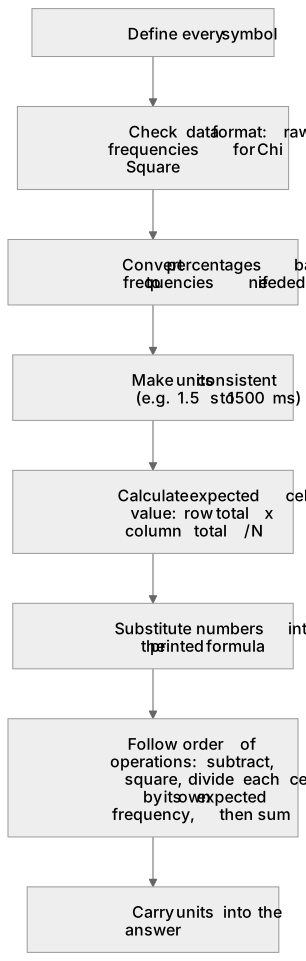
Put it in order
Put these steps in the order they happen.
- 1. Calculate expected cell value: row total x column total / N
- 2. Carry units into the answer
- 3. Substitute numbers into the printed formula
- 4. Define every symbol
- 5. Check data format: raw frequencies for Chi Square
- 6. Follow order of operations: subtract, square, divide each cell by its own expected frequency, then sum
- 7. Convert percentages back to frequencies if needed
- 8. Make units consistent (e.g. 1.5 s to 1500 ms)
Key words
Say what each word means before you turn the card.
Substitution into formulae
Try answering aloud or in your head before turning the card.
Units and physical quantities
Try answering aloud or in your head before turning the card.
Statistical calculations
Try answering aloud or in your head before turning the card.
See every definition
- Substitution into formulae
- Inserting the appropriate values from a given set of data into the formula for a statistical test, such as inserting the N value into the Chi Square formula.
- Units and physical quantities
- Keeping units consistent and carrying them into the answer, so that times in seconds are not mixed with milliseconds.
- Statistical calculations
- Following the correct order of operations in statistical formulae, such as subtracting, squaring, and dividing before summing in Chi Square.
Label the diagram
Some boxes have lost their names. Pick the right name for each number.
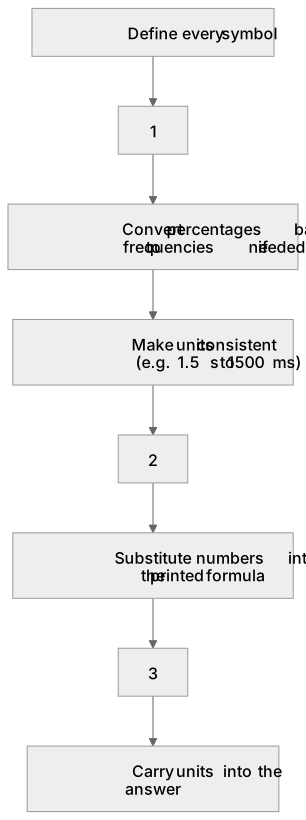
1Box 1
2Box 2
3Box 3
There is more to this lesson
The full lesson goes on to check your understanding and help you earn the marks. Create a free account to carry on, with your progress saved.
A week of Premium from your first lesson · Then the free plan continues · No card, no charge
Test your understanding of D.2 – algebra: Substitute numerical values into algebraic equations using appropriate units for physical quantities (to include: inserting the appropriate values from a given set of data into the formula for a statistical test e.g. inserting the N value (for the number of scores) into the Chi Square formula)
Active recall beats re-reading. Take an instant quiz now to test what you’ve learned and lock it into long-term memory.
A week of Premium from your first lesson · Then the free plan continues · No card, no charge