OCR · A-Level · Psychology
Course version: H567 · Version from Sept 2015
Learners should be aware of the nature and principles of scientific…
Full specification wording
How science works: Learners should be aware of the nature and principles of scientific enquiry through knowledge and understanding of the following concepts: the study of cause-and-effect; falsification; replicability; objectivity; induction; deduction; hypothesis testing; manipulation of variables; control and standardisation; quantifiable measurements.
These ideas describe how a discipline earns the word science.
- Point 2 of 2
- 4 key terms
Study notes
From the teaching notes for this specification point.
The idea
These ideas describe how a discipline earns the word science. Popper argued a theory counts only if it forbids something, so a prediction that cannot fail is unfalsifiable. Reasoning from observations up to a general claim is induction; reasoning down from a theory to a prediction is deduction. Objectivity means measurement does not depend on who took it. Quantifiable measurements provide numerical data (e.g. a score out of 10) to ensure this. Manipulation of variables involves deliberately changing an independent variable (e.g. drug vs placebo). Combined with control and standardisation of extraneous factors, this permits the study of cause-and-effect. Hypothesis testing compares data against a null hypothesis. Replication is the public test: a finding seen once has not yet earned belief.
What earns the marks
- Define each principle with a concrete example attached; a manipulated independent variable plus controlled extraneous variables is what permits a cause-and-effect statement in a laboratory memory experiment.
- Say what falsification demands, which is that a hypothesis be stated so that some outcome could refute it, and contrast that with a claim which accommodates every possible result.
- Distinguish induction from deduction plainly: observation first and theory afterwards is induction, theory first and a testable hypothesis afterwards is deduction.
- Tie objectivity to concrete controls such as standardised instructions, operationalised measures, double blind procedures and inter-rater reliability.
- Explain hypothesis testing as the comparison of a calculated value against a critical value at a stated level of significance, followed by retaining or rejecting the null hypothesis.
Common mistakes and how to put them right
Treating replication as repeating your own study.
Put it right: The replication that counts is an independent team obtaining the same result by the same method.
Saying a theory is unscientific because it turned out to be wrong.
Put it right: Falsification is about whether a claim could be shown wrong, not about whether it has been.
Confusing objectivity with holding no opinions.
Put it right: It is a property of the measuring procedure, and quantifiable measures exist precisely to supply it.
Claiming cause from a study with nothing manipulated, which is the single commonest error in this part of the paper.
Exam tips
- Short definitions carry marks here, so learn a one sentence version of each principle with a short example clause ready to attach.
- Longer items ask whether psychology can be considered a science, so structure the answer around these principles and then bring in the counter-argument from qualitative and idiographic work.
- Where a scenario lacks control or standardisation, name the principle that is threatened and say what the researcher should have done instead.
Try the lesson
The start of the How science works: Learners should be aware of the nature and principles of scientific enquiry through knowledge and understanding of the following concepts: the study of cause-and-effect; falsification; replicability; objectivity; induction; deduction; hypothesis testing; manipulation of variables; control and standardisation; quantifiable measurements. lesson, made from teaching notes for this specification point.
Have a go first
Which of the following best describes the principle of falsification in scientific enquiry?
Listen
These ideas describe how a discipline earns the word science. Popper argued a theory counts only if it forbids something, so a prediction that cannot fail is unfalsifiable. Reasoning from observations up to a general claim is induction; reasoning down from a theory to a prediction is deduction. Objectivity means measurement does not depend on who took it. Quantifiable measurements provide numerical data (e.g. a score out of 10) to ensure this. Manipulation of variables involves deliberately changing an independent variable (e.g. drug vs placebo). Combined with control and standardisation of extraneous factors, this permits the study of cause-and-effect. Hypothesis testing compares data against a null hypothesis. Replication is the public test: a finding seen once has not yet earned belief. A strong answer earns marks for these points. Define each principle with a concrete example attached; a manipulated independent variable plus controlled extraneous variables is what permits a cause-and-effect statement in a laboratory memory experiment. Say what falsification demands, which is that a hypothesis be stated so that some outcome could refute it, and contrast that with a claim which accommodates every possible result. Distinguish induction from deduction plainly: observation first and theory afterwards is induction, theory first and a testable hypothesis afterwards is deduction. Tie objectivity to concrete controls such as standardised instructions, operationalised measures, double blind procedures and inter-rater reliability. Exam tip: Short definitions carry marks here, so learn a one sentence version of each principle with a short example clause ready to attach.
See it
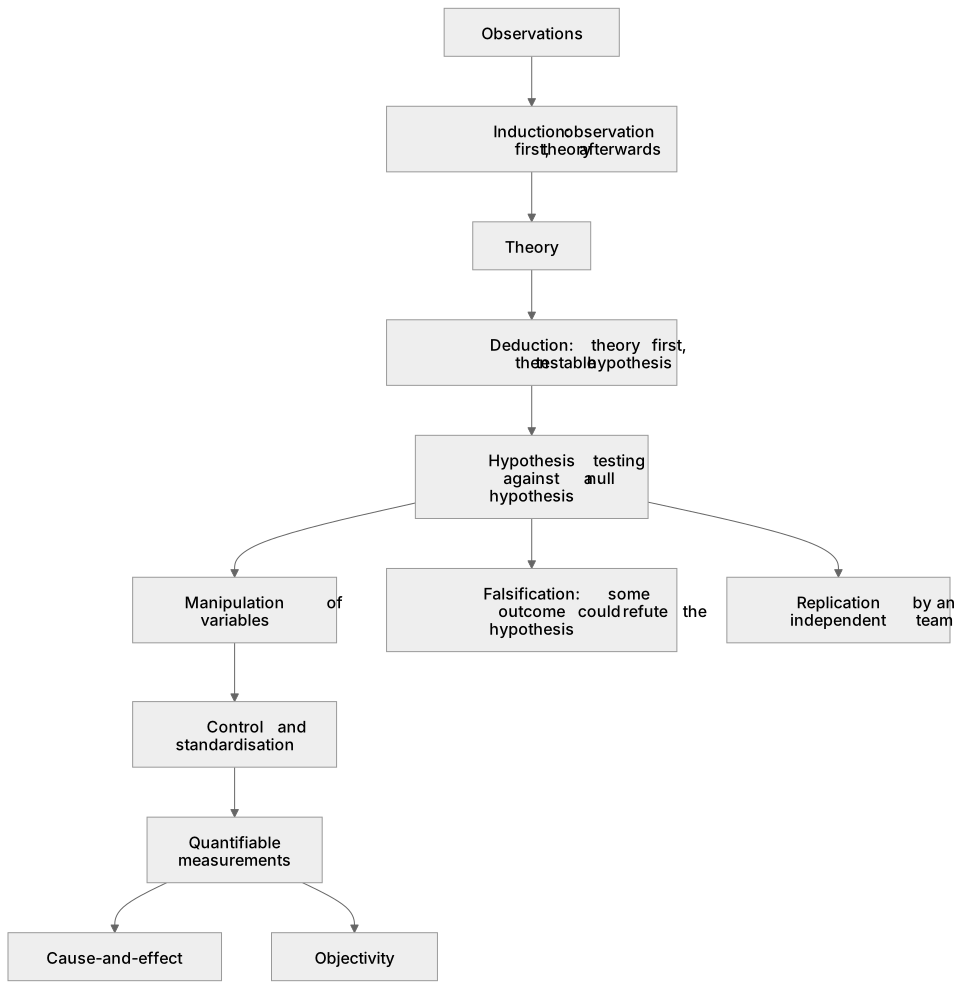
Key words
Say what each word means before you turn the card.
falsification
Try answering aloud or in your head before turning the card.
objectivity and control
Try answering aloud or in your head before turning the card.
induction and deduction
Try answering aloud or in your head before turning the card.
replicability
Try answering aloud or in your head before turning the card.
See every definition
- falsification
- A hypothesis must be stated so that some outcome could refute it, unlike a claim which accommodates every possible result.
- objectivity and control
- Measurement does not depend on who took it, supported by concrete controls such as standardised instructions, operationalised measures, double blind procedures and inter-rater reliability.
- induction and deduction
- Reasoning from observations up to a general claim is induction, while reasoning down from a theory to a prediction is deduction.
- replicability
- The public test in which an independent team obtains the same result by the same method, since a finding seen once has not yet earned belief.
Label the diagram
Some boxes have lost their names. Pick the right name for each number.
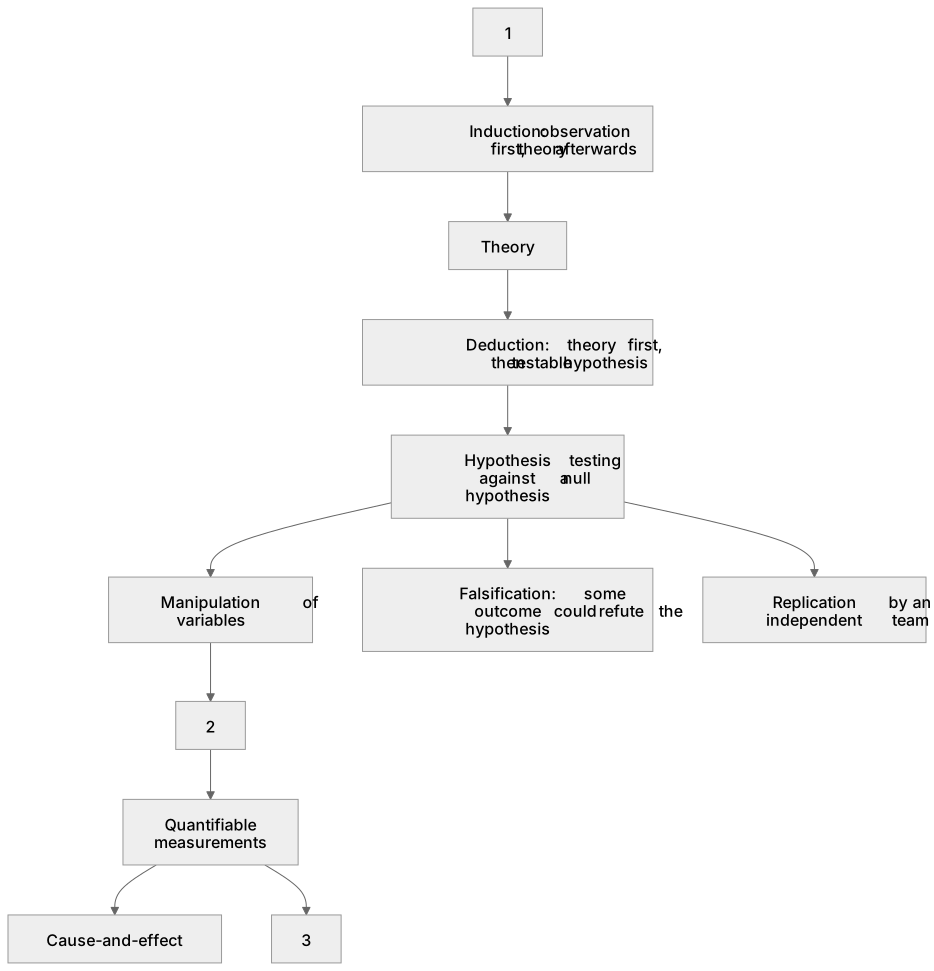
1Box 1
2Box 2
3Box 3
There is more to this lesson
The full lesson goes on to check your understanding and help you earn the marks. Create a free account to carry on, with your progress saved.
A week of Premium from your first lesson · Then the free plan continues · No card, no charge
Test your understanding of How science works: Learners should be aware of the nature and principles of scientific enquiry through knowledge and understanding of the following concepts: the study of cause-and-effect; falsification; replicability; objectivity; induction; deduction; hypothesis testing; manipulation of variables; control and standardisation; quantifiable measurements.
Active recall beats re-reading. Take an instant quiz now to test what you’ve learned and lock it into long-term memory.
A week of Premium from your first lesson · Then the free plan continues · No card, no charge