OCR · A-Level · Psychology
Course version: H567 · Version from Sept 2015
Learners should understand how society makes decisions about scientific…
Full specification wording
How science works: Learners should understand how society makes decisions about scientific issues and how psychology contributes to the success of the economy and society.
Psychology does not stay in the laboratory.
- Point 1 of 2
- 4 key terms
Study notes
From the teaching notes for this specification point.
The idea
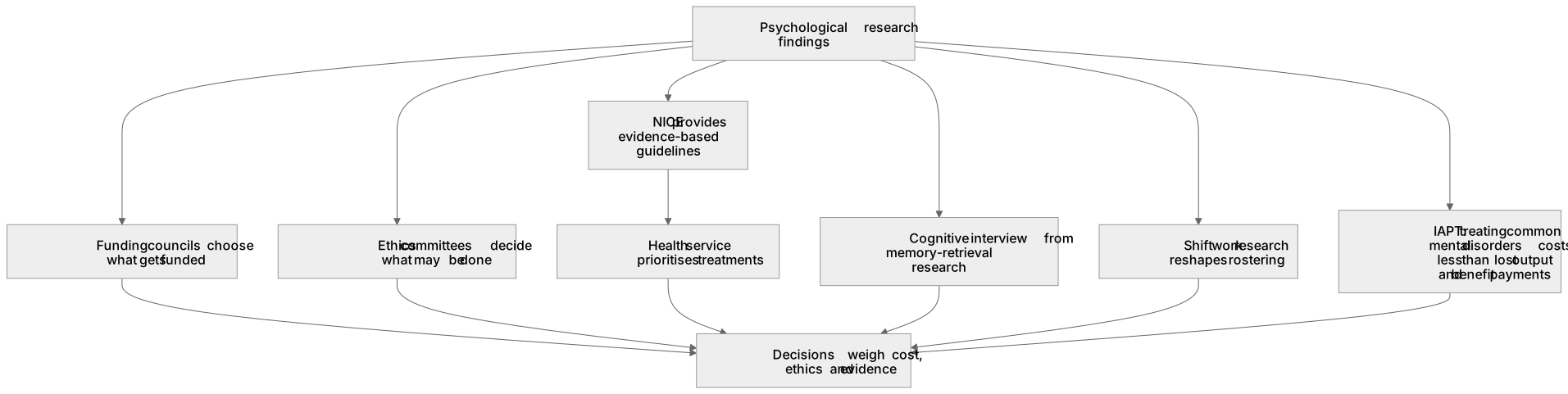
Psychology does not stay in the laboratory. Findings reach practice through bodies that weigh evidence in public to make decisions about scientific issues. Research councils choose what gets funded, ethics committees decide what may be done, and the National Institute for Health and Care Excellence (NICE) provides evidence-based guidelines that heavily influence which treatments the health service prioritises. Psychology contributes to the success of the economy and society: the Improving Access to Psychological Therapies programme argued that treating common mental disorders costs less than the lost output and benefit payments it prevents. Memory-retrieval research reshaped police interviewing via the cognitive interview, and shift work research reshaped rostering. Cost, ethics, and evidence are weighed together.
What earns the marks
- Give a worked economic example, such as treatment that returns people to work reducing benefit payments and lost output, and note that absence caused by untreated mental ill health is an economic cost.
- Give an application with its research origin attached: the cognitive interview grew out of memory-retrieval research (such as context reinstatement), and it increases the amount of accurate detail a witness provides.
- Evaluate through socially sensitive research, since findings about groups can be used well beyond the intention of the researcher, so how conclusions will be applied matters as much as whether they are valid.
Common mistakes and how to put them right
Listing economic benefits with no psychology in them.
Put it right: The mark is for the link from a specific finding or therapy to the saving, not for general remarks about the economy.
Assuming evidence alone decides policy, when cost, public opinion, ethical acceptability, and press coverage all shape what is actually adopted.
Ignoring the harm side altogether.
Put it right: Psychological research has been used to support discriminatory policy, so an answer treating every application as beneficial is one-sided.
Exam tips
- This content turns up as an extended item asking you to discuss the contribution of psychology to the economy or to society, so prepare two applications in depth rather than six in a list.
- Bring in issues and debates, especially ethical implications and socially sensitive research, to earn the evaluation marks in a discuss question.
Try the lesson
The start of the How science works: Learners should understand how society makes decisions about scientific issues and how psychology contributes to the success of the economy and society. lesson, made from teaching notes for this specification point.
Have a go first
Which of the following is a direct way that psychological research into mental health treatments contributes to the success of the economy?
Listen
Psychology does not stay in the laboratory. Findings reach practice through bodies that weigh evidence in public to make decisions about scientific issues. Research councils choose what gets funded, ethics committees decide what may be done, and the National Institute for Health and Care Excellence (NICE) provides evidence-based guidelines that heavily influence which treatments the health service prioritises. Psychology contributes to the success of the economy and society: the Improving Access to Psychological Therapies programme argued that treating common mental disorders costs less than the lost output and benefit payments it prevents. Memory-retrieval research reshaped police interviewing via the cognitive interview, and shift work research reshaped rostering. Cost, ethics, and evidence are weighed together. A strong answer earns marks for these points. Name a mechanism rather than saying the government decides: funding councils, ethics committees, clinical guideline bodies (like NICE), government advisers, and media reporting each play a distinct part in turning findings into policy. Give a worked economic example, such as treatment that returns people to work reducing benefit payments and lost output, and note that absence caused by untreated mental ill health is an economic cost. Give an application with its research origin attached: the cognitive interview grew out of memory-retrieval research (such as context reinstatement), and it increases the amount of accurate detail a witness provides. Evaluate through socially sensitive research, since findings about groups can be used well beyond the intention of the researcher, so how conclusions will be applied matters as much as whether they are valid. Exam tip: This content turns up as an extended item asking you to discuss the contribution of psychology to the economy or to society, so prepare two applications in depth rather than six in a list.
See it
Key words
Say what each word means before you turn the card.
evidence and policy
Try answering aloud or in your head before turning the card.
economic implications
Try answering aloud or in your head before turning the card.
applications of psychology
Try answering aloud or in your head before turning the card.
socially sensitive research
Try answering aloud or in your head before turning the card.
See every definition
- evidence and policy
- Bodies such as research councils, ethics committees and clinical guideline bodies weigh evidence in public to make decisions about scientific issues, with cost, ethics and evidence weighed together.
- economic implications
- Treating common mental disorders costs less than the lost output and benefit payments it prevents, and absence caused by untreated mental ill health is an economic cost.
- applications of psychology
- Memory-retrieval research reshaped police interviewing via the cognitive interview, and shift work research reshaped rostering.
- socially sensitive research
- Findings about groups can be used well beyond the intention of the researcher, so how conclusions will be applied matters as much as whether they are valid.
Label the diagram
Some boxes have lost their names. Pick the right name for each number.
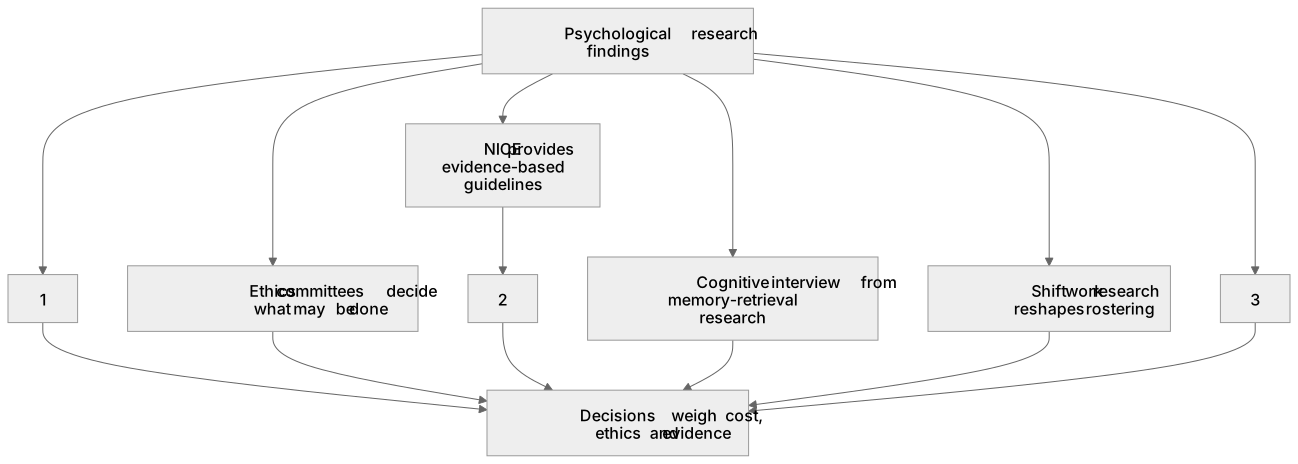
1Box 1
2Box 2
3Box 3
There is more to this lesson
The full lesson goes on to check your understanding and help you earn the marks. Create a free account to carry on, with your progress saved.
A week of Premium from your first lesson · Then the free plan continues · No card, no charge
Test your understanding of How science works: Learners should understand how society makes decisions about scientific issues and how psychology contributes to the success of the economy and society.
Active recall beats re-reading. Take an instant quiz now to test what you’ve learned and lock it into long-term memory.
A week of Premium from your first lesson · Then the free plan continues · No card, no charge