OCR · A-Level · Psychology
Course version: H567 · Version from Sept 2015
Aims and hypotheses and how to formulate: research aim; research question;…
Full specification wording
Planning and conducting research: Aims and hypotheses and how to formulate: research aim; research question; null hypotheses; alternative hypotheses; one-tailed (directional) hypotheses; two-tailed (non-directional) hypotheses.
A research aim states the study's purpose, whereas a research question phrases this as a specific query.
- Point 2 of 7
- 2 key terms
Study notes
From the teaching notes for this specification point.
The idea
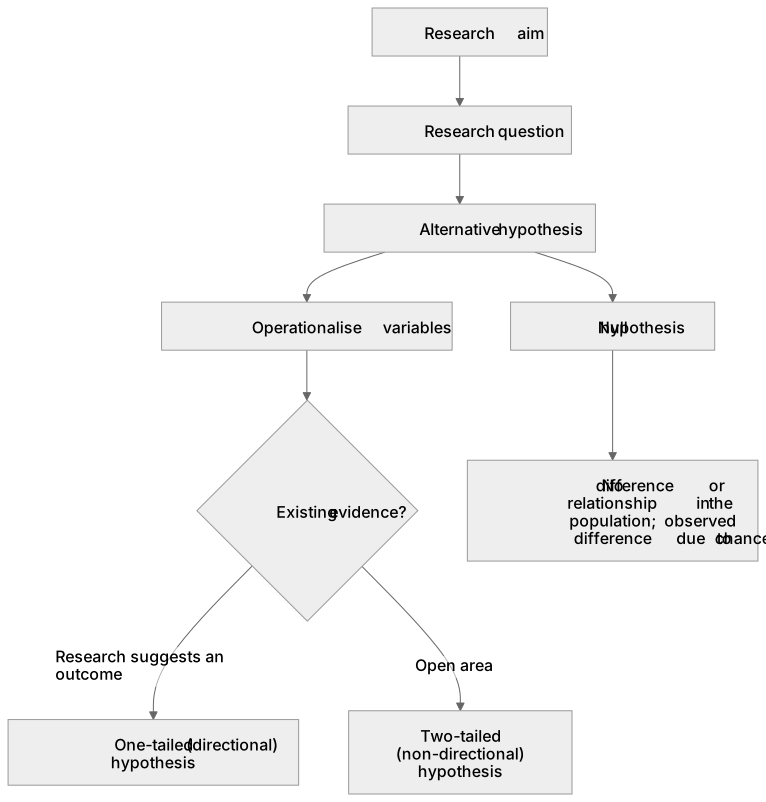
A research aim states the study's purpose, whereas a research question phrases this as a specific query. An alternative hypothesis is a testable prediction. Operationalisation is crucial: predicting participants will recall more words when tested in their learning environment can be scored. The alternative hypothesis's form depends on existing evidence. If research suggests an outcome, a one-tailed (directional) hypothesis is defensible; an open area requires a two-tailed (non-directional) hypothesis. The null hypothesis is the position that there is no difference or relationship in the population, and any observed difference is due to chance.
What earns the marks
- A credited alternative hypothesis names both conditions or co-variables and states the measure, so a marker can see what counts as evidence against it.
- A one-tailed (directional) hypothesis uses comparative words like more, fewer, or faster; a two-tailed (non-directional) hypothesis states there will be a difference but refuses to specify the direction.
- The null hypothesis must be written for the same operationalised variables, stating that there is no difference or relationship in the population and any observed difference is due to chance.
- Justifying the choice of a one-tailed or two-tailed hypothesis by citing previous findings, or the absence of them, is where justification marks are awarded.
Common mistakes and how to put them right
Writing the research aim in the form of an alternative hypothesis, or writing a hypothesis that is really a description of the procedure.
Put it right: Ensure aims state intentions (e.g., 'To investigate...') and hypotheses state testable predictions.
Treating the null hypothesis as a real-world forecast that nothing will happen.
Put it right: The null hypothesis is a statistical baseline stating there is no difference or relationship in the population, and any observed difference is due to chance.
Leaving the measure out, so a claim that boys will be more aggressive has no stated way of being scored.
Put it right: Operationalise the dependent variable in the hypothesis.
Exam tips
- When writing an alternative hypothesis from an unseen scenario, ensure you include both conditions and the operationalised dependent variable, adding a direction only if a one-tailed hypothesis is required.
- If the stem says previous research found an effect, write a one-tailed (directional) hypothesis; if findings are mixed or absent, write a two-tailed (non-directional) hypothesis.
Try the lesson
The start of the Planning and conducting research: Aims and hypotheses and how to formulate: research aim; research question; null hypotheses; alternative hypotheses; one-tailed (directional) hypotheses; two-tailed (non-directional) hypotheses. lesson, made from teaching notes for this specification point.
Have a go first
A researcher formulates the following statement for their study: "There will be a difference in the number of words recalled between participants who listen to classical music and those who study in silence." Which of the following best describes this statement?
Listen
A research aim states the study's purpose, whereas a research question phrases this as a specific query. An alternative hypothesis is a testable prediction. Operationalisation is crucial: predicting participants will recall more words when tested in their learning environment can be scored. The alternative hypothesis's form depends on existing evidence. If research suggests an outcome, a one-tailed (directional) hypothesis is defensible; an open area requires a two-tailed (non-directional) hypothesis. The null hypothesis is the position that there is no difference or relationship in the population, and any observed difference is due to chance. A strong answer earns marks for these points. A credited alternative hypothesis names both conditions or co-variables and states the measure, so a marker can see what counts as evidence against it. A one-tailed (directional) hypothesis uses comparative words like more, fewer, or faster; a two-tailed (non-directional) hypothesis states there will be a difference but refuses to specify the direction. The null hypothesis must be written for the same operationalised variables, stating that there is no difference or relationship in the population and any observed difference is due to chance. Justifying the choice of a one-tailed or two-tailed hypothesis by citing previous findings, or the absence of them, is where justification marks are awarded. A common slip: Writing the research aim in the form of an alternative hypothesis, or writing a hypothesis that is really a description of the procedure. Instead, Ensure aims state intentions (e.g., 'To investigate...') and hypotheses state testable predictions. Exam tip: When writing an alternative hypothesis from an unseen scenario, ensure you include both conditions and the operationalised dependent variable, adding a direction only if a one-tailed hypothesis is required.
See it
Key words
Say what each word means before you turn the card.
directional and non-directional hypotheses
Try answering aloud or in your head before turning the card.
the null hypothesis
Try answering aloud or in your head before turning the card.
See every definition
- directional and non-directional hypotheses
- A one-tailed (directional) hypothesis uses comparative words like more, fewer, or faster, while a two-tailed (non-directional) hypothesis states there will be a difference but refuses to specify the direction.
- the null hypothesis
- The position that there is no difference or relationship in the population, and any observed difference is due to chance.
There is more to this lesson
The full lesson goes on to check your understanding and help you earn the marks. Create a free account to carry on, with your progress saved.
A week of Premium from your first lesson · Then the free plan continues · No card, no charge
Test your understanding of Planning and conducting research: Aims and hypotheses and how to formulate: research aim; research question; null hypotheses; alternative hypotheses; one-tailed (directional) hypotheses; two-tailed (non-directional) hypotheses.
Active recall beats re-reading. Take an instant quiz now to test what you’ve learned and lock it into long-term memory.
A week of Premium from your first lesson · Then the free plan continues · No card, no charge