OCR · A-Level · Psychology
Course version: H567 · Version from Sept 2015
Populations, samples and sampling techniques: target population and…
Full specification wording
Planning and conducting research: Populations, samples and sampling techniques: target population and sample; random sampling; snowball sampling; opportunity sampling; self-selected sampling.
Recruitment bridges the sample tested and the target population a conclusion is about.
- Point 3 of 7
- 4 key terms
Study notes
From the teaching notes for this specification point.
The idea
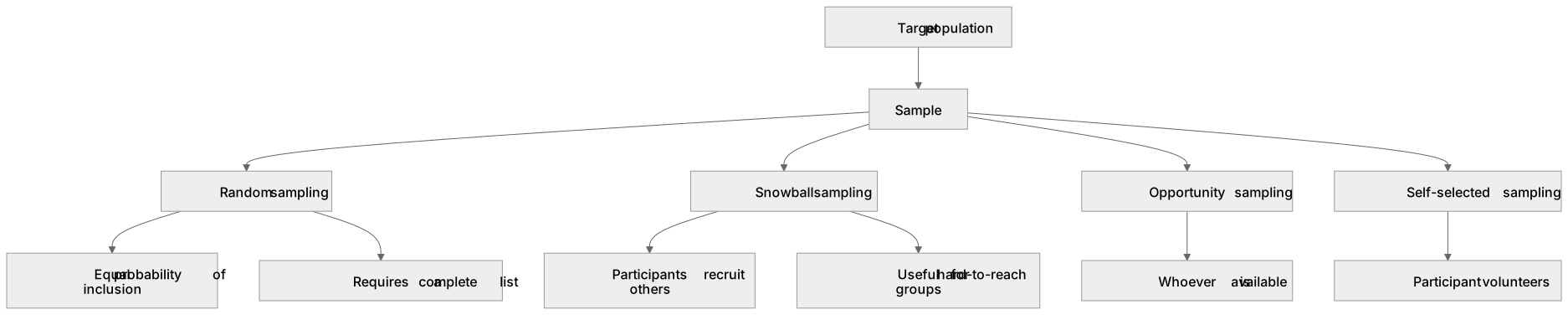
Recruitment bridges the sample tested and the target population a conclusion is about. Every technique is judged on who could never be included. Milgram (1963) advertised for men who chose to reply; this self-selected sampling invites volunteer bias, as respondents may be unusually compliant. Opportunity sampling relies on whoever is available, such as Piliavin et al. (1969) studying subway passengers, which is quick but skews the sample. Snowball sampling relies on participants recruiting others, useful for hard-to-reach groups. Random sampling gives every member of the target population an equal probability of inclusion. It requires a complete list of that group.
What earns the marks
- Name the target population the study wants to describe before criticising the sample, because a criticism only works against a stated population.
- Random sampling means a procedure giving everyone an equal probability, such as numbering a full list and drawing with a random number generator; it is not haphazard selection.
- Snowball sampling earns credit for reaching groups with no available list, but loses representativeness because participants recruit people similar to themselves.
- Arguments about generalisability are stronger when the limit is named, for example, an all-male sample or participants from a single city.
Common mistakes and how to put them right
Using the word random for opportunity sampling, so stopping whoever walks past in a corridor gets described as random selection.
Put it right: Use 'opportunity sampling' for selecting available people; reserve 'random' for mathematical probability methods.
Saying a sample is too small with no reference to how variable the measure is or how wide the target population is. Correction: Link sample size criticisms to the specific target population and the risk of anomalies skewing the data.
Confusing self-selected sampling with opportunity sampling.
Put it right: The difference is who made the first approach; self-selected means the participant volunteered, whereas opportunity means the researcher approached them.
Exam tips
- When asked to identify the sampling technique used in an unseen study and justify that from the stem, quote the specific recruiting detail provided in the text.
- If asked to suggest another way of obtaining the sample and one advantage of it, give a method plus a benefit specific to this target population.
Try the lesson
The start of the Planning and conducting research: Populations, samples and sampling techniques: target population and sample; random sampling; snowball sampling; opportunity sampling; self-selected sampling. lesson, made from teaching notes for this specification point.
Have a go first
A researcher wants to study the experiences of people with a rare medical condition. They find one participant who has the condition and ask them to recommend other individuals with the same condition to take part in the study. Which sampling technique is being used?
Listen
Recruitment bridges the sample tested and the target population a conclusion is about. Every technique is judged on who could never be included. Milgram (1963) advertised for men who chose to reply; this self-selected sampling invites volunteer bias, as respondents may be unusually compliant. Opportunity sampling relies on whoever is available, such as Piliavin et al. (1969) studying subway passengers, which is quick but skews the sample. Snowball sampling relies on participants recruiting others, useful for hard-to-reach groups. Random sampling gives every member of the target population an equal probability of inclusion. It requires a complete list of that group. A strong answer earns marks for these points. Name the target population the study wants to describe before criticising the sample, because a criticism only works against a stated population. Random sampling means a procedure giving everyone an equal probability, such as numbering a full list and drawing with a random number generator; it is not haphazard selection. Snowball sampling earns credit for reaching groups with no available list, but loses representativeness because participants recruit people similar to themselves. Arguments about generalisability are stronger when the limit is named, for example, an all-male sample or participants from a single city. A common slip: Using the word random for opportunity sampling, so stopping whoever walks past in a corridor gets described as random selection. Instead, Use 'opportunity sampling' for selecting available people; reserve 'random' for mathematical probability methods. Exam tip: When asked to identify the sampling technique used in an unseen study and justify that from the stem, quote the specific recruiting detail provided in the text.
See it
Key words
Say what each word means before you turn the card.
target population
Try answering aloud or in your head before turning the card.
representativeness
Try answering aloud or in your head before turning the card.
volunteer bias
Try answering aloud or in your head before turning the card.
generalisability
Try answering aloud or in your head before turning the card.
See every definition
- target population
- The group a conclusion is about, which the sample tested is recruited from.
- representativeness
- Lost when participants recruit people similar to themselves, as in snowball sampling.
- volunteer bias
- Invited when self-selected sampling means respondents may be unusually compliant.
- generalisability
- Judged stronger when the limit is named, such as an all-male sample or participants from a single city.
Label the diagram
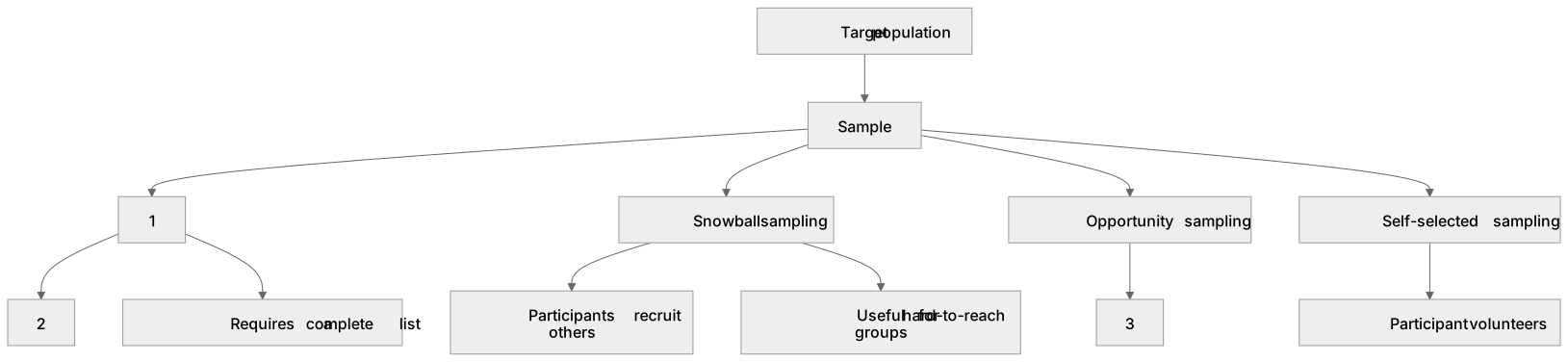
Some boxes have lost their names. Pick the right name for each number.
1Box 1
2Box 2
3Box 3
There is more to this lesson
The full lesson goes on to check your understanding and help you earn the marks. Create a free account to carry on, with your progress saved.
A week of Premium from your first lesson · Then the free plan continues · No card, no charge
Test your understanding of Planning and conducting research: Populations, samples and sampling techniques: target population and sample; random sampling; snowball sampling; opportunity sampling; self-selected sampling.
Active recall beats re-reading. Take an instant quiz now to test what you’ve learned and lock it into long-term memory.
A week of Premium from your first lesson · Then the free plan continues · No card, no charge