OCR · A-Level · Psychology
Course version: H567 · Version from Sept 2015
Designing self-reports: open questions; closed questions; rating scales:…
Full specification wording
Planning and conducting research: Designing self-reports: open questions; closed questions; rating scales: Likert rating scale, Semantic differential rating scale.
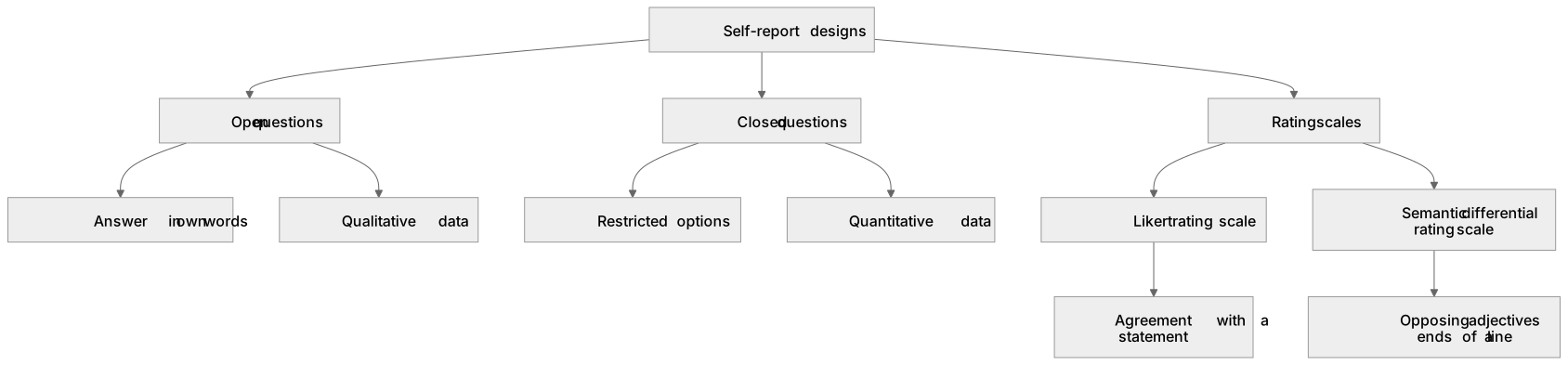
Open questions allow respondents to answer in their own words, yielding qualitative data.
- Point 7 of 7
- 4 key terms
Study notes
From the teaching notes for this specification point.
The idea
Open questions allow respondents to answer in their own words, yielding qualitative data. Closed questions restrict options, producing quantitative data for easy comparison. A Likert rating scale pairs a statement with an agreement scale (e.g., strongly agree to strongly disagree), summing scores across items. A semantic differential rating scale places opposing adjectives at either end of a line, asking respondents to mark a position between them. Chaney et al. (2004) used closed questions to compare the Funhaler with a standard spacer, finding more parents reported medicating their child the previous day. Wording is crucial; Loftus and Palmer (1974) demonstrated how changing one verb alters responses.
What earns the marks
- Contrast open questions, which provide depth but are harder to analyse, with closed questions, which yield easily tallied quantitative data but restrict respondent choices.
- Define a Likert rating scale as measuring agreement with a statement on a scale (e.g., strongly agree to strongly disagree), producing ordinal data.
- Define a semantic differential rating scale as measuring the connotation of a concept by placing opposing adjectives at the ends of a scale and asking for a position between them.
- Explain how to reduce social desirability bias using anonymous completion or filler items, and distinguish this from reversing item direction, which detects acquiescence or response bias.
- Use evidence: Chaney et al. (2004) collected parental self-reports on the Funhaler, showing self-report can detect real behavioural changes despite relying on truthful responses.
Common mistakes and how to put them right
Calling any numbered scale a Likert scale.
Put it right: A Likert scale specifically measures the level of agreement with a statement, not just any numerical rating.
Conflating social desirability bias with response bias.
Put it right: Reversing the direction of statements detects acquiescence (response bias), whereas anonymity reduces social desirability bias.
Writing leading or double-barrelled questions in design answers.
Put it right: Ensure questions ask only one thing and do not suggest a preferred answer.
Treating rating scale totals as interval data.
Put it right: Rating scales produce ordinal data because the intervals between points are not guaranteed to be equal.
Exam tips
- When asked to design open and closed questions, ensure both are directly answerable by the specific participants described in the scenario.
- If evaluating self-reports, explicitly name a bias (e.g., social desirability), explain why it occurs in the specific context, and describe its impact on validity.
Try the lesson
The start of the Planning and conducting research: Designing self-reports: open questions; closed questions; rating scales: Likert rating scale, Semantic differential rating scale. lesson, made from teaching notes for this specification point.
Have a go first
A questionnaire asks participants to rate their agreement with the statement "I enjoy studying psychology" on a scale from "Strongly agree" to "Strongly disagree". Which type of rating scale is being used?
Listen
Open questions allow respondents to answer in their own words, yielding qualitative data. Closed questions restrict options, producing quantitative data for easy comparison. A Likert rating scale pairs a statement with an agreement scale (e.g., strongly agree to strongly disagree), summing scores across items. A semantic differential rating scale places opposing adjectives at either end of a line, asking respondents to mark a position between them. Chaney et al. (2004) used closed questions to compare the Funhaler with a standard spacer, finding more parents reported medicating their child the previous day. Wording is crucial; Loftus and Palmer (1974) demonstrated how changing one verb alters responses. A strong answer earns marks for these points. Contrast open questions, which provide depth but are harder to analyse, with closed questions, which yield easily tallied quantitative data but restrict respondent choices. Define a Likert rating scale as measuring agreement with a statement on a scale (e.g., strongly agree to strongly disagree), producing ordinal data. Define a semantic differential rating scale as measuring the connotation of a concept by placing opposing adjectives at the ends of a scale and asking for a position between them. Explain how to reduce social desirability bias using anonymous completion or filler items, and distinguish this from reversing item direction, which detects acquiescence or response bias. A common slip: Calling any numbered scale a Likert scale. Instead, A Likert scale specifically measures the level of agreement with a statement, not just any numerical rating. Exam tip: When asked to design open and closed questions, ensure both are directly answerable by the specific participants described in the scenario.
See it
Key words
Say what each word means before you turn the card.
question design
Try answering aloud or in your head before turning the card.
rating scales
Try answering aloud or in your head before turning the card.
qualitative and quantitative data
Try answering aloud or in your head before turning the card.
social desirability
Try answering aloud or in your head before turning the card.
See every definition
- question design
- Open questions allow respondents to answer in their own words, yielding qualitative data, whereas closed questions restrict options, producing quantitative data for easy comparison.
- rating scales
- A Likert rating scale pairs a statement with an agreement scale, while a semantic differential rating scale places opposing adjectives at either end of a line for respondents to mark a position between.
- qualitative and quantitative data
- Open questions yield qualitative data, while closed questions produce quantitative data for easy comparison.
- social desirability
- A bias reduced by anonymous completion or filler items, and distinguished from reversing item direction, which detects acquiescence or response bias.
Label the diagram
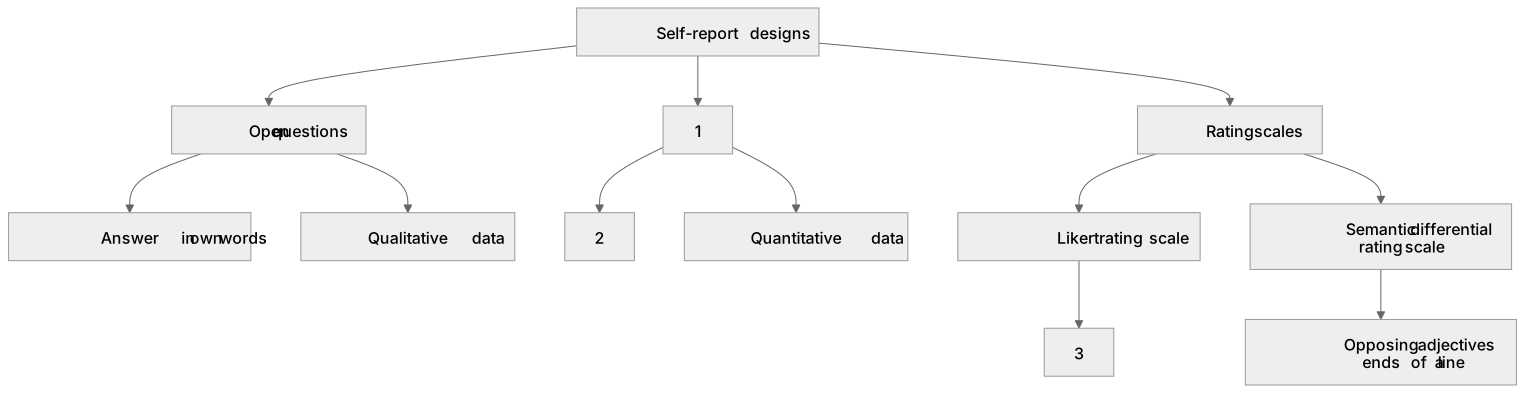
Some boxes have lost their names. Pick the right name for each number.
1Box 1
2Box 2
3Box 3
There is more to this lesson
The full lesson goes on to check your understanding and help you earn the marks. Create a free account to carry on, with your progress saved.
A week of Premium from your first lesson · Then the free plan continues · No card, no charge
Test your understanding of Planning and conducting research: Designing self-reports: open questions; closed questions; rating scales: Likert rating scale, Semantic differential rating scale.
Active recall beats re-reading. Take an instant quiz now to test what you’ve learned and lock it into long-term memory.
A week of Premium from your first lesson · Then the free plan continues · No card, no charge