OCR · A-Level · Psychology
Course version: H567 · Version from Sept 2015
Designing observations: behavioural categories; coding frames; time…
Full specification wording
Planning and conducting research: Designing observations: behavioural categories; coding frames; time sampling; event sampling.
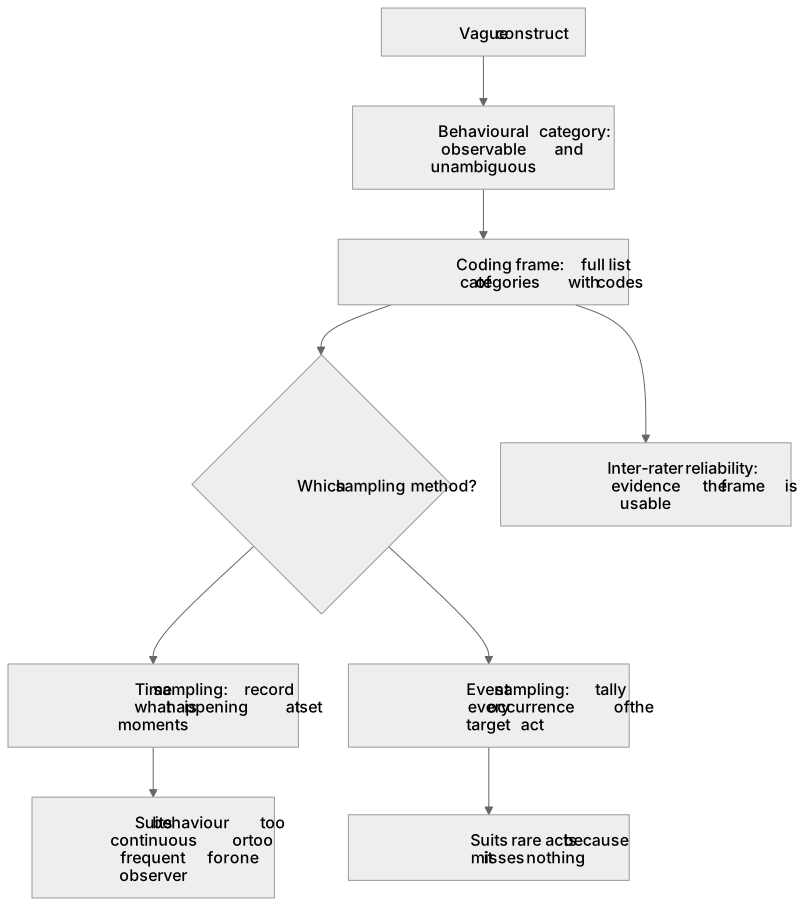
A behavioural category turns a vague construct into something two observers can agree on, and a coding frame is the full list of those categories with the codes used to record them; categories…
- Point 6 of 7
- 4 key terms
Study notes
From the teaching notes for this specification point.
The idea
A behavioural category turns a vague construct into something two observers can agree on, and a coding frame is the full list of those categories with the codes used to record them; categories have to be observable, mutually exclusive and wide enough to cover what is likely to happen. Time sampling records whatever is occurring at set moments, as when Bandura et al. (1961) scored each child through a one way mirror in five second intervals across a twenty minute session, while event sampling tallies every occurrence of a target act, as when Piliavin et al. (1969) logged each instance of help and the delay before it on New York subway trains. Bandura reported observer agreement of about 0.89, which is the evidence that a frame works rather than merely exists.
What earns the marks
- A behavioural category earns credit when it is observable and unambiguous, so pushes another child is creditworthy and is being naughty is not, and categories together should not overlap.
- Describe time sampling as recording what is happening at set moments, using Bandura et al. (1961), who scored each child in five second intervals across a twenty minute session behind a one way mirror.
- Link the method to the behaviour: event sampling suits rare acts because it misses nothing, and time sampling suits behaviour too continuous or too frequent for one observer to keep up with.
- Inter-rater reliability is the evidence a coding frame is usable, and Bandura reported agreement of about 0.89 between observers scoring the same children.
Common mistakes and how to put them right
Offering categories that are really inferences about intention, such as feeling anxious or trying to be helpful, which two observers will score differently.
Describing time sampling as watching for a set time and event sampling as counting events, which fails to separate them, since both involve watching for a set time.
Claiming a covert observation raises no ethical problem because nobody was upset, when consent, the right to withdraw and privacy are all compromised by it.
Writing so many categories that no observer could hold them in mind, which destroys the reliability the frame was meant to create.
Exam tips
- The design question frequently asks you to suggest two behavioural categories, and each must be written as an observable act rather than as a label for a state of mind.
- Where you have to justify a sampling method, write about the frequency of the behaviour you chose, because frequency is what decides between the two.
- Strengths and weaknesses of observation are usually asked against a named core study, so keep Bandura and Piliavin ready as the worked examples.
Try the lesson
The start of the Planning and conducting research: Designing observations: behavioural categories; coding frames; time sampling; event sampling. lesson, made from teaching notes for this specification point.
Have a go first
A researcher decides to record a tally mark every time a participant bites their nails during a 30-minute observation. Which of the following best describes this specific technique of recording data?
Listen
A behavioural category turns a vague construct into something two observers can agree on, and a coding frame is the full list of those categories with the codes used to record them; categories have to be observable, mutually exclusive and wide enough to cover what is likely to happen. Time sampling records whatever is occurring at set moments, as when Bandura et al. (1961) scored each child through a one way mirror in five second intervals across a twenty minute session, while event sampling tallies every occurrence of a target act, as when Piliavin et al. (1969) logged each instance of help and the delay before it on New York subway trains. Bandura reported observer agreement of about 0.89, which is the evidence that a frame works rather than merely exists. A strong answer earns marks for these points. A behavioural category earns credit when it is observable and unambiguous, so pushes another child is creditworthy and is being naughty is not, and categories together should not overlap. Describe time sampling as recording what is happening at set moments, using Bandura et al. (1961), who scored each child in five second intervals across a twenty minute session behind a one way mirror. Describe event sampling as tallying every occurrence of the target behaviour, using Piliavin et al. (1969), who recorded whether help was given, how long it took and who gave it, with the victim carrying a cane helped on far more trials than the apparently drunk victim. Link the method to the behaviour: event sampling suits rare acts because it misses nothing, and time sampling suits behaviour too continuous or too frequent for one observer to keep up with. Exam tip: The design question frequently asks you to suggest two behavioural categories, and each must be written as an observable act rather than as a label for a state of mind.
See it
Key words
Say what each word means before you turn the card.
behavioural category
Try answering aloud or in your head before turning the card.
coding frame
Try answering aloud or in your head before turning the card.
time sampling
Try answering aloud or in your head before turning the card.
event sampling
Try answering aloud or in your head before turning the card.
See every definition
- behavioural category
- Turns a vague construct into something two observers can agree on, and has to be observable, mutually exclusive and wide enough to cover what is likely to happen.
- coding frame
- The full list of behavioural categories with the codes used to record them.
- time sampling
- Records whatever is occurring at set moments, as when each child was scored in five second intervals across a twenty minute session.
- event sampling
- Tallies every occurrence of a target act, as when each instance of help and the delay before it were logged.
Label the diagram
Some boxes have lost their names. Pick the right name for each number.
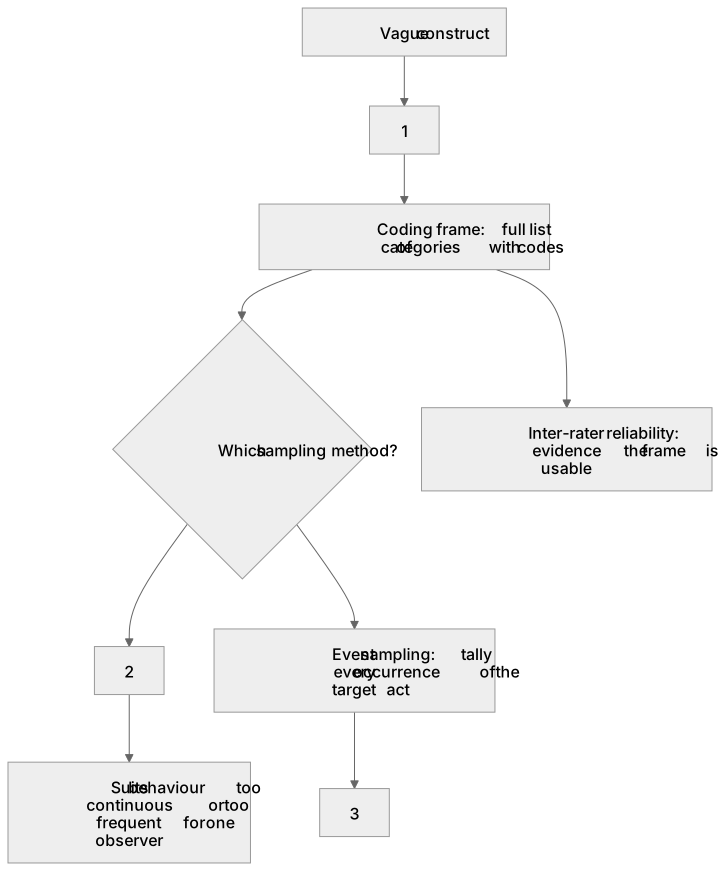
1Box 1
2Box 2
3Box 3
There is more to this lesson
The full lesson goes on to check your understanding and help you earn the marks. Create a free account to carry on, with your progress saved.
A week of Premium from your first lesson · Then the free plan continues · No card, no charge
Test your understanding of Planning and conducting research: Designing observations: behavioural categories; coding frames; time sampling; event sampling.
Active recall beats re-reading. Take an instant quiz now to test what you’ve learned and lock it into long-term memory.
A week of Premium from your first lesson · Then the free plan continues · No card, no charge