OCR · A-Level · Psychology
Course version: H567 · Version from Sept 2015
Variables and how they are operationalised: independent variable (IV);…
Full specification wording
Planning and conducting research: Variables and how they are operationalised: independent variable (IV); dependent variable (DV); control of extraneous variables.
The independent variable (IV) is what a researcher manipulates or selects, the dependent variable (DV) is measured, and operationalising means defining each precisely enough for replication.
- Point 5 of 7
- 3 key terms
Study notes
From the teaching notes for this specification point.
The idea
The independent variable (IV) is what a researcher manipulates or selects, the dependent variable (DV) is measured, and operationalising means defining each precisely enough for replication. In Loftus and Palmer (1974), the IV was the verb in the critical question, and the DV was speed in miles per hour; the mean estimate fell from 40.8 after 'smashed' to 31.8 after 'contacted'. Bandura et al. (1961) operationalised aggression by counting imitative acts in fixed intervals. Extraneous variables are factors other than the IV that could affect the DV. They become confounding if they vary systematically with the IV. Standardised instructions, counterbalancing, and random allocation help control them.
What earns the marks
- Define the IV as the variable manipulated or selected by the researcher, and state its conditions (e.g., the verb in Loftus and Palmer with 'smashed', 'collided', 'bumped', 'hit', 'contacted').
- Define the DV with its unit, such as a speed estimate in miles per hour rather than just 'memory', or counting imitative aggressive acts in fixed intervals.
- Operationalise variables by providing a measurable indicator, unit, or scale, ensuring another researcher could replicate the procedure exactly.
- Distinguish an extraneous variable (which could affect the DV) from a confounding variable (which varies systematically with the IV conditions, offering a rival explanation).
Common mistakes and how to put them right
Writing the DV as a broad concept like 'memory' or 'aggression' instead of the specific measurement taken.
Put it right: Include the unit or method of measurement, such as 'speed estimates in mph'.
Stating that quasi-experiments do not have an IV.
Put it right: Quasi-experiments do have an IV, but it is naturally occurring or pre-existing (a quasi-IV) rather than directly manipulated by the researcher.
Listing controls without linking them to a specific extraneous variable.
Put it right: Explain what the control removes or prevents, such as using random allocation to control for participant variables.
Exam tips
- In Section B or C of the research methods paper, you may be asked to identify or operationalise variables from a scenario; ensure your wording is specific to the context provided.
- When asked to explain how a variable was controlled, use the pattern: name the variable, name the control method, and explain what would have happened without it.
Try the lesson
The start of the Planning and conducting research: Variables and how they are operationalised: independent variable (IV); dependent variable (DV); control of extraneous variables. lesson, made from teaching notes for this specification point.
Have a go first
A study investigates whether drinking coffee before an exam improves test scores. What is the dependent variable in this study?
Listen
The independent variable (IV) is what a researcher manipulates or selects, the dependent variable (DV) is measured, and operationalising means defining each precisely enough for replication. In Loftus and Palmer (1974), the IV was the verb in the critical question, and the DV was speed in miles per hour; the mean estimate fell from 40.8 after 'smashed' to 31.8 after 'contacted'. Bandura et al. (1961) operationalised aggression by counting imitative acts in fixed intervals. Extraneous variables are factors other than the IV that could affect the DV. They become confounding if they vary systematically with the IV. Standardised instructions, counterbalancing, and random allocation help control them. A strong answer earns marks for these points. Define the IV as the variable manipulated or selected by the researcher, and state its conditions (e.g., the verb in Loftus and Palmer with 'smashed', 'collided', 'bumped', 'hit', 'contacted'). Define the DV with its unit, such as a speed estimate in miles per hour rather than just 'memory', or counting imitative aggressive acts in fixed intervals. Operationalise variables by providing a measurable indicator, unit, or scale, ensuring another researcher could replicate the procedure exactly. Distinguish an extraneous variable (which could affect the DV) from a confounding variable (which varies systematically with the IV conditions, offering a rival explanation). A common slip: Writing the DV as a broad concept like 'memory' or 'aggression' instead of the specific measurement taken. Instead, include the unit or method of measurement, such as 'speed estimates in mph'. Exam tip: In Section B or C of the research methods paper, you may be asked to identify or operationalise variables from a scenario; ensure your wording is specific to the context provided.
See it
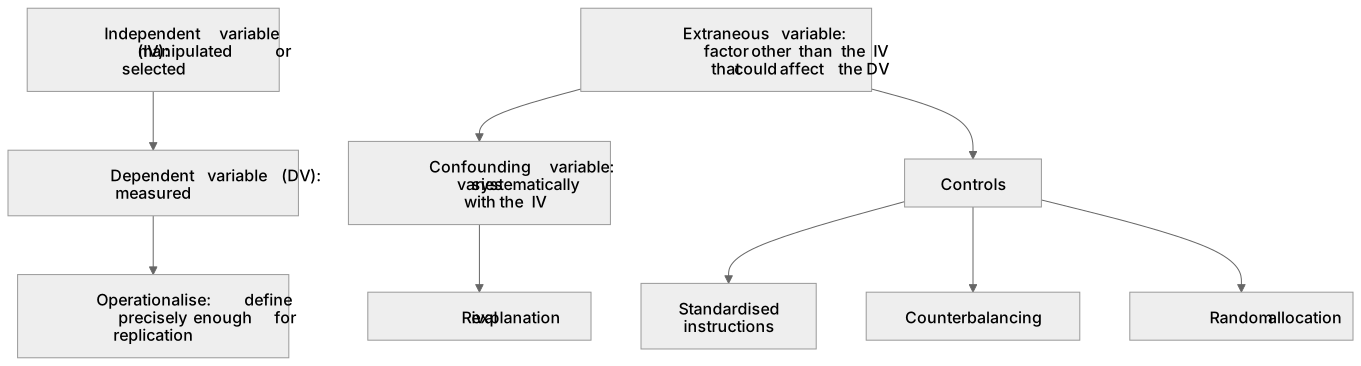
Key words
Say what each word means before you turn the card.
operationalisation
Try answering aloud or in your head before turning the card.
experimental control
Try answering aloud or in your head before turning the card.
confounding variables
Try answering aloud or in your head before turning the card.
See every definition
- operationalisation
- Defining each variable precisely enough for replication, by providing a measurable indicator, unit, or scale.
- experimental control
- Using techniques such as standardised instructions, counterbalancing, and random allocation to control extraneous variables.
- confounding variables
- Factors other than the IV that could affect the DV and that vary systematically with the IV, offering a rival explanation.
Label the diagram
Some boxes have lost their names. Pick the right name for each number.
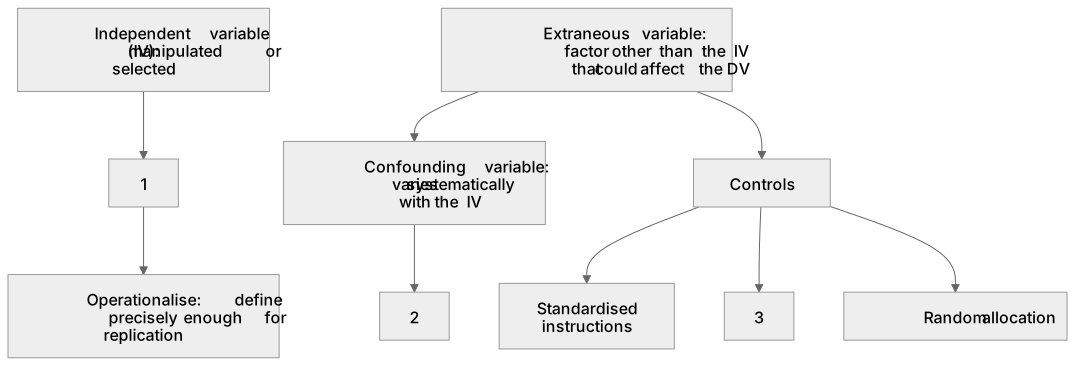
1Box 1
2Box 2
3Box 3
There is more to this lesson
The full lesson goes on to check your understanding and help you earn the marks. Create a free account to carry on, with your progress saved.
A week of Premium from your first lesson · Then the free plan continues · No card, no charge
Test your understanding of Planning and conducting research: Variables and how they are operationalised: independent variable (IV); dependent variable (DV); control of extraneous variables.
Active recall beats re-reading. Take an instant quiz now to test what you’ve learned and lock it into long-term memory.
A week of Premium from your first lesson · Then the free plan continues · No card, no charge