OCR · A-Level · Psychology
Course version: H567 · Version from Sept 2015
Learners should have knowledge of the conventions of reporting research in…
Full specification wording
Report writing: Learners should have knowledge of the conventions of reporting research in a practical report and demonstrate understanding of the role and purpose of each of the main sections and sub-sections.
A journal article follows a fixed running order because each part answers a different question for the reader.
- Point 1 of 4
- 3 key terms
Study notes
From the teaching notes for this specification point.
The idea
A journal article follows a fixed running order because each part answers a different question for the reader. The abstract tells you what was found in miniature, the introduction argues from existing theory to a testable prediction, the method tells you exactly what was done and to whom, then the results arrive stripped of interpretation, and the discussion says what it all means and what was wrong with it. References allow readers to trace cited works, and appendices provide full materials, raw data, or calculations that would clutter the main text. Milgram published his obedience work in 1963 in exactly this shape, which is why any reader can still check it. Learn the order as a chain of purposes rather than as a list of headings.
What earns the marks
- Say what each part is for rather than what it is called; credit comes from wording such as the abstract lets a reader decide whether the full paper is worth reading, not from calling it a summary.
- Use the technical vocabulary a marker is looking for when describing a part of the report, including operationalised hypothesis, directional or non-directional, significance level and critical value.
Common mistakes and how to put them right
Writing the abstract as an introduction.
Put it right: It is written last and reports aim, method, findings and conclusion in a few sentences, so a candidate who previews the study without giving the findings loses the mark.
Describing the sample inside the procedure.
Put it right: Sample is its own sub-section, so sampling technique, number of participants and how they were obtained belong there.
Interpreting data in the results.
Put it right: A sentence beginning this shows that memory is reconstructive belongs in the discussion, not underneath a table of means.
Treating the reference list as decoration.
Put it right: Without it a reader cannot trace the studies the introduction argues from, so the report fails its own purpose.
Placing raw data or full questionnaires in the method section rather than correctly locating them in the appendices.
Exam tips
- Component one often gives a short scenario and asks which part of the report a given piece of information would appear in, worth one or two marks each, so practise sorting statements into parts against the clock.
- An instruction to outline what a researcher should include in the procedure is typically worth three or four marks, so give that many separate scenario-specific details rather than one general sentence.
- When asked to justify a choice, name the part and the reason together, for example that standardised instructions sit in the procedure because they let a reader judge how well the study was controlled.
Try the lesson
The start of the Report writing: Learners should have knowledge of the conventions of reporting research in a practical report and demonstrate understanding of the role and purpose of each of the main sections and sub-sections. lesson, made from teaching notes for this specification point.
Have a go first
What is the primary purpose of the abstract in a psychological practical report?
Listen
A journal article follows a fixed running order because each part answers a different question for the reader. The abstract tells you what was found in miniature, the introduction argues from existing theory to a testable prediction, the method tells you exactly what was done and to whom, then the results arrive stripped of interpretation, and the discussion says what it all means and what was wrong with it. References allow readers to trace cited works, and appendices provide full materials, raw data, or calculations that would clutter the main text. Milgram published his obedience work in 1963 in exactly this shape, which is why any reader can still check it. Learn the order as a chain of purposes rather than as a list of headings. A strong answer earns marks for these points. Say what each part is for rather than what it is called; credit comes from wording such as the abstract lets a reader decide whether the full paper is worth reading, not from calling it a summary. Name the four sub-sections of the method as design, sample, materials or apparatus, and procedure, and tie them to replication: written in enough detail that another researcher could repeat the study and obtain comparable results. Put interpretation where it belongs; results carry descriptive and inferential outcomes only, while the discussion explains them, relates them back to the research reviewed earlier, evaluates the method and suggests further study. Treat the reference list as essential for tracing the studies the introduction argues from, and recognise that appendices hold raw data, full stimulus materials, and statistical calculations to keep the main report concise. Exam tip: Component one often gives a short scenario and asks which part of the report a given piece of information would appear in, worth one or two marks each, so practise sorting statements into parts against the clock.
See it
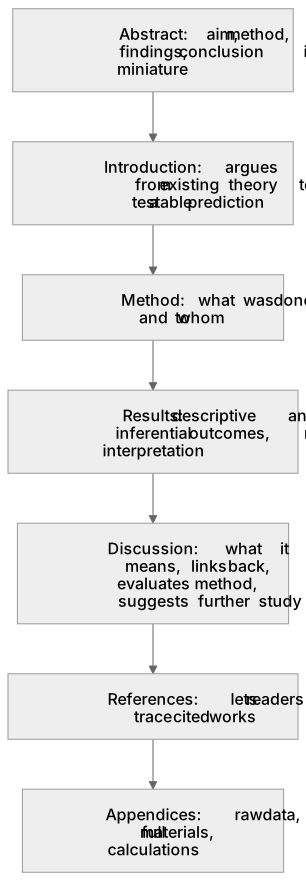
Put it in order
Put these steps in the order they happen.
- 1. Appendices: raw data, full materials, calculations
- 2. References: lets readers trace cited works
- 3. Method: what was done and to whom
- 4. Discussion: what it means, links back, evaluates method, suggests further study
- 5. Abstract: aim, method, findings, conclusion in miniature
- 6. Introduction: argues from existing theory to a testable prediction
- 7. Results: descriptive and inferential outcomes, no interpretation
Key words
Say what each word means before you turn the card.
report conventions
Try answering aloud or in your head before turning the card.
purpose of each section
Try answering aloud or in your head before turning the card.
replication
Try answering aloud or in your head before turning the card.
See every definition
- report conventions
- The fixed running order that a journal article follows because each part answers a different question for the reader.
- purpose of each section
- The role a part of the report plays, learned as a chain of purposes rather than as a list of headings.
- replication
- Writing the method in enough detail that another researcher could repeat the study and obtain comparable results.
Label the diagram
Some boxes have lost their names. Pick the right name for each number.
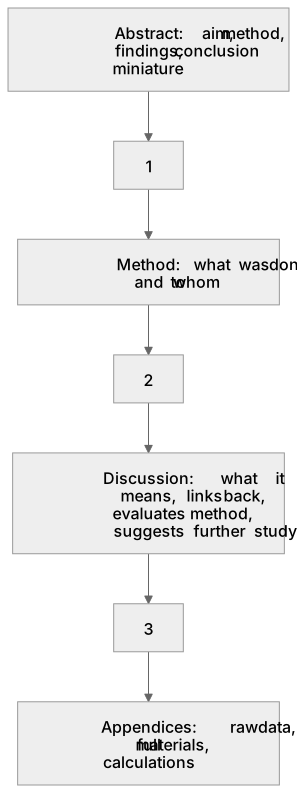
1Box 1
2Box 2
3Box 3
There is more to this lesson
The full lesson goes on to check your understanding and help you earn the marks. Create a free account to carry on, with your progress saved.
A week of Premium from your first lesson · Then the free plan continues · No card, no charge
Test your understanding of Report writing: Learners should have knowledge of the conventions of reporting research in a practical report and demonstrate understanding of the role and purpose of each of the main sections and sub-sections.
Active recall beats re-reading. Take an instant quiz now to test what you’ve learned and lock it into long-term memory.
A week of Premium from your first lesson · Then the free plan continues · No card, no charge