OCR · A-Level · Psychology
Course version: H567 · Version from Sept 2015
Sections and sub-sections of a practical report: abstract; introduction;…
Full specification wording
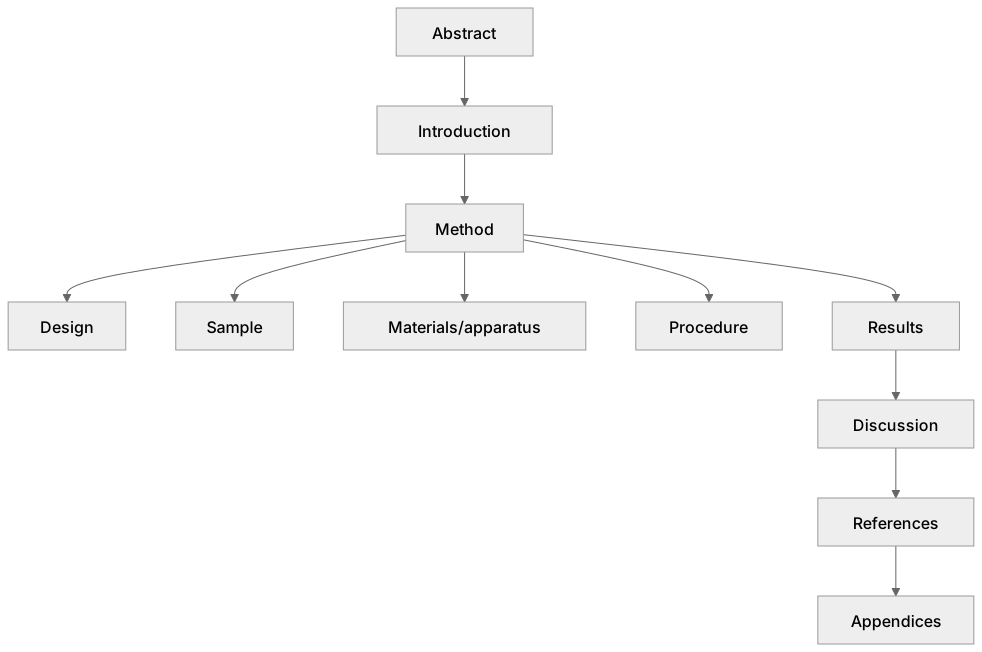
Report writing: Sections and sub-sections of a practical report: abstract; introduction; method (design, sample, materials/apparatus, procedure); results; discussion; references; appendices.
A practical report follows a standard running order.
- Point 2 of 4
- 3 key terms
Study notes
From the teaching notes for this specification point.
The idea
A practical report follows a standard running order. The abstract provides a brief summary of the entire study. The introduction reviews past literature to justify the aim. The method details the design, sample, materials/apparatus, and procedure. For example, Loftus and Palmer's method used an independent measures design, 45 students, seven film clips, and specific questionnaire wording. The results section houses descriptive statistics (like a mean speed of 40.8 mph for 'smashed' vs 31.8 mph for 'contacted') and inferential statistics. The discussion interprets these findings. The references list all cited sources, and the appendices hold raw data and blank questionnaires.
What earns the marks
- Define the abstract as a concise summary of the aim, method, results, and conclusions, placed at the very beginning of the report.
- Place raw data, blank consent forms, standardised instructions, and statistical workings in the appendices, and explain that this keeps the report readable while leaving the evidence checkable.
Common mistakes and how to put them right
Confusing materials with procedure.
Put it right: The questionnaire itself is listed under materials; what participants were asked to do with it belongs under procedure.
Graphing every participant separately in the results.
Put it right: The results summarise the data, so individual raw scores belong in an appendix.
Giving a hypothesis in the abstract and never stating it in the introduction.
Put it right: The operationalised hypothesis is expected at the end of the introduction.
Exam tips
- Questions often present a report with something in the wrong place and ask you to explain the error, so practise saying both where it currently is and where it should have gone.
- When an item asks you to suggest two things that would appear in the appendices, ensure you name scenario-specific items such as the consent form signed by these participants rather than generic ones to secure full credit.
Try the lesson
The start of the Report writing: Sections and sub-sections of a practical report: abstract; introduction; method (design, sample, materials/apparatus, procedure); results; discussion; references; appendices. lesson, made from teaching notes for this specification point.
Have a go first
According to the standard conventions of a psychological practical report, which of the following is a recognised sub-section of the Method section?
Listen
A practical report follows a standard running order. The abstract provides a brief summary of the entire study. The introduction reviews past literature to justify the aim. The method details the design, sample, materials/apparatus, and procedure. For example, Loftus and Palmer's method used an independent measures design, 45 students, seven film clips, and specific questionnaire wording. The results section houses descriptive statistics (like a mean speed of 40.8 mph for 'smashed' vs 31.8 mph for 'contacted') and inferential statistics. The discussion interprets these findings. The references list all cited sources, and the appendices hold raw data and blank questionnaires. A strong answer earns marks for these points. Define the abstract as a concise summary of the aim, method, results, and conclusions, placed at the very beginning of the report. Give the four method sub-sections by name with one decision each: design and why it was chosen, sample (target population, technique, and participant numbers), materials/apparatus (standardised stimuli), and procedure (an ordered account of what participants did). Say what the results may and may not contain: measures of central tendency and dispersion, an appropriate graph, and inferential tests with calculated and critical values (if used), but no explanation of why the results occurred. Place raw data, blank consent forms, standardised instructions, and statistical workings in the appendices, and explain that this keeps the report readable while leaving the evidence checkable. A common slip: Confusing materials with procedure. Instead, The questionnaire itself is listed under materials; what participants were asked to do with it belongs under procedure. Exam tip: Questions often present a report with something in the wrong place and ask you to explain the error, so practise saying both where it currently is and where it should have gone.
See it
Key words
Say what each word means before you turn the card.
method sub-sections
Try answering aloud or in your head before turning the card.
results without interpretation
Try answering aloud or in your head before turning the card.
appendices and raw data
Try answering aloud or in your head before turning the card.
See every definition
- method sub-sections
- The method details the design, sample, materials/apparatus, and procedure.
- results without interpretation
- The results section houses descriptive statistics and inferential statistics, but the discussion interprets these findings.
- appendices and raw data
- The appendices hold raw data and blank questionnaires.
Label the diagram
Some boxes have lost their names. Pick the right name for each number.
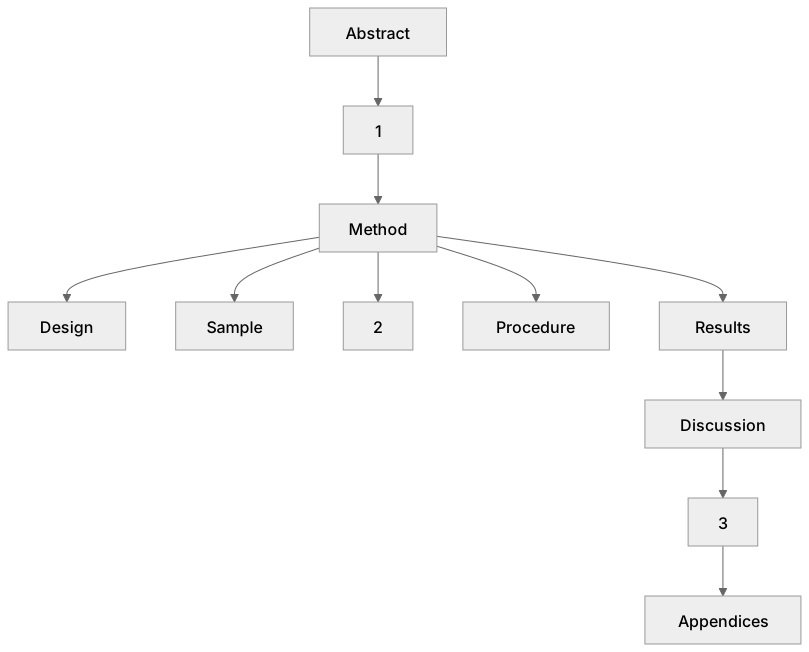
1Box 1
2Box 2
3Box 3
There is more to this lesson
The full lesson goes on to check your understanding and help you earn the marks. Create a free account to carry on, with your progress saved.
A week of Premium from your first lesson · Then the free plan continues · No card, no charge
Test your understanding of Report writing: Sections and sub-sections of a practical report: abstract; introduction; method (design, sample, materials/apparatus, procedure); results; discussion; references; appendices.
Active recall beats re-reading. Take an instant quiz now to test what you’ve learned and lock it into long-term memory.
A week of Premium from your first lesson · Then the free plan continues · No card, no charge