OCR · A-Level · Psychology
Course version: H567 · Version from Sept 2015
Experiment: laboratory experiment; field experiment; quasi experiment.
Full specification wording
Research methods and techniques: Experiment: laboratory experiment; field experiment; quasi experiment.
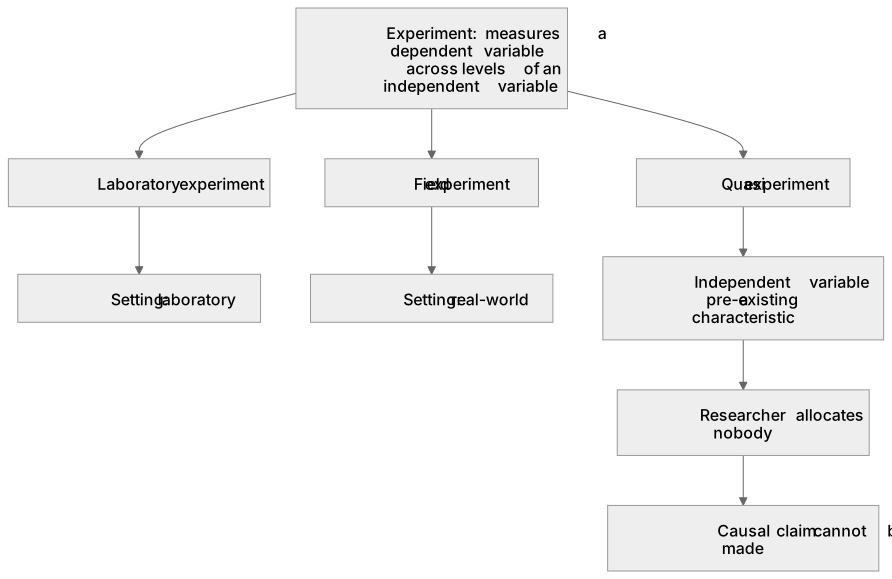
All three count as experiments because a dependent variable is measured across levels of an independent variable; what separates them is the setting and who decided which condition a person was in.
- Point 2 of 5
- 3 key terms
Study notes
From the teaching notes for this specification point.
The idea
All three count as experiments because a dependent variable is measured across levels of an independent variable; what separates them is the setting and who decided which condition a person was in. Loftus and Palmer (1974) changed a single verb in a question about a filmed collision, and mean speed estimates rose from about 31.8 mph for contacted to about 40.8 mph for smashed, a difference that reads as causal only because everything else was held constant. Piliavin et al. (1969) staged a collapse on a subway train, so the helping measured was real behaviour, but the make up of each carriage varied from trial to trial. Casey et al. (2011) compared adults who had delayed gratification as children with those who had not; that grouping existed long before the study began, so nothing in the design shows the delay caused the later difference.
What earns the marks
- Identify the independent and dependent variables in the words of the scenario, and say how the dependent variable was operationalised, because memory is not a measure whereas number of items correctly recalled is one.
- A study is quasi when the independent variable is a pre-existing characteristic such as age, sex, diagnosis or expertise, so the researcher allocates nobody and a causal claim cannot be made.
- Field experiments gain credit for reduced demand characteristics, since participants do not know they are taking part, and lose it for weaker control and for consent that cannot be sought beforehand.
- State what would have to be true for causation, namely manipulation of one variable plus control of the others, then judge the described study against that standard.
Common mistakes and how to put them right
Calling any study done outside a laboratory a field experiment even when nothing was manipulated.
Put it right: With no independent variable it is an observation or a correlational study.
Claiming a quasi experiment demonstrates cause and effect because it has two conditions and a significant difference between them.
Treating laboratory as a synonym for artificial task.
Put it right: The setting and the task are two separate judgements, and a laboratory study can use a lifelike task.
Exam tips
- A recurring question gives an unfamiliar study and asks why it is a quasi experiment; the answer is always about who or what decided which condition each participant was in.
- Asked to suggest how a study could be improved, name a change to a control, a measure or the recruitment, then say what problem the change removes.
- If told to compare field and laboratory experiments, structure by dimension rather than by method: control first, then realism, then ethics.
Try the lesson
The start of the Research methods and techniques: Experiment: laboratory experiment; field experiment; quasi experiment. lesson, made from teaching notes for this specification point.
Have a go first
What is the defining feature of a quasi-experiment?
Listen
All three count as experiments because a dependent variable is measured across levels of an independent variable; what separates them is the setting and who decided which condition a person was in. Loftus and Palmer (1974) changed a single verb in a question about a filmed collision, and mean speed estimates rose from about 31.8 mph for contacted to about 40.8 mph for smashed, a difference that reads as causal only because everything else was held constant. Piliavin et al. (1969) staged a collapse on a subway train, so the helping measured was real behaviour, but the make up of each carriage varied from trial to trial. Casey et al. (2011) compared adults who had delayed gratification as children with those who had not; that grouping existed long before the study began, so nothing in the design shows the delay caused the later difference. A strong answer earns marks for these points. Identify the independent and dependent variables in the words of the scenario, and say how the dependent variable was operationalised, because memory is not a measure whereas number of items correctly recalled is one. A study is quasi when the independent variable is a pre-existing characteristic such as age, sex, diagnosis or expertise, so the researcher allocates nobody and a causal claim cannot be made. Field experiments gain credit for reduced demand characteristics, since participants do not know they are taking part, and lose it for weaker control and for consent that cannot be sought beforehand. State what would have to be true for causation, namely manipulation of one variable plus control of the others, then judge the described study against that standard. Exam tip: A recurring question gives an unfamiliar study and asks why it is a quasi experiment; the answer is always about who or what decided which condition each participant was in.
See it
Key words
Say what each word means before you turn the card.
manipulation of an independent variable
Try answering aloud or in your head before turning the card.
control of extraneous variables
Try answering aloud or in your head before turning the card.
causal inference
Try answering aloud or in your head before turning the card.
See every definition
- manipulation of an independent variable
- Changing one variable across levels, which together with control of the others is what would have to be true for causation.
- control of extraneous variables
- Holding everything else constant, which is what allows a difference to read as causal.
- causal inference
- A claim that one variable caused another, which cannot be made when the independent variable is a pre-existing characteristic and the researcher allocates nobody.
Label the diagram
Some boxes have lost their names. Pick the right name for each number.
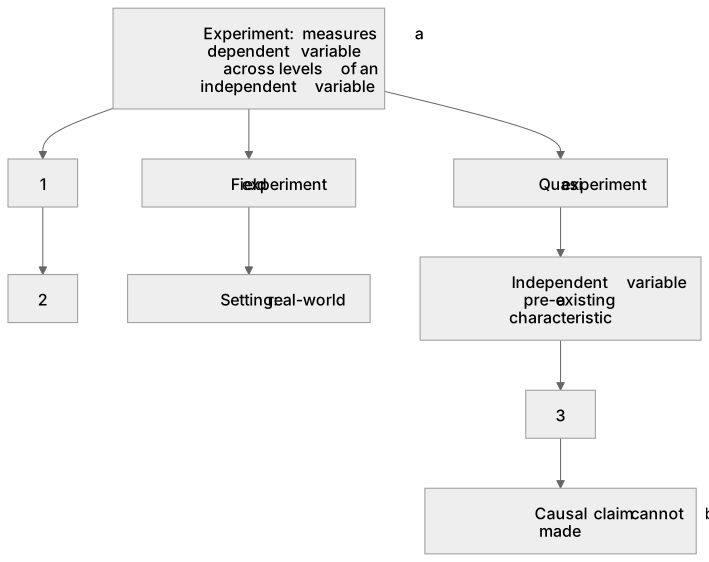
1Box 1
2Box 2
3Box 3
There is more to this lesson
The full lesson goes on to check your understanding and help you earn the marks. Create a free account to carry on, with your progress saved.
A week of Premium from your first lesson · Then the free plan continues · No card, no charge
Test your understanding of Research methods and techniques: Experiment: laboratory experiment; field experiment; quasi experiment.
Active recall beats re-reading. Take an instant quiz now to test what you’ve learned and lock it into long-term memory.
A week of Premium from your first lesson · Then the free plan continues · No card, no charge