OCR · A-Level · Psychology
Course version: H567 · Version from Sept 2015
Learners should have knowledge and understanding of the following research…
Full specification wording
Research methods and techniques: Learners should have knowledge and understanding of the following research methods and techniques and their associated strengths and weaknesses.
This is assessed as a skill rather than as a vocabulary test, so each technique has to be held three ways at once: what it is, when a researcher would choose it, and what choosing it costs.
- Point 1 of 5
Study notes
From the teaching notes for this specification point.
The idea
This is assessed as a skill rather than as a vocabulary test, so each technique has to be held three ways at once: what it is, when a researcher would choose it, and what choosing it costs. The trade off that organises the whole section is control against realism. Milgram (1963) ran his obedience procedure in a Yale laboratory, which let him standardise the prods, the shock generator and the learner's scripted protests, but bought that precision with a task nobody meets in ordinary life. Piliavin et al. (1969) staged a collapse on a moving New York subway train and recorded helping that nobody knew was being studied, while losing control over who happened to be in the carriage. Marks go to candidates who pick the strength or weakness that actually bites on the scenario in front of them, so revise every method with one real study attached to it.
What earns the marks
- Comparisons earn marks when the dimension being compared is named: control over extraneous variables, ecological validity, demand characteristics, or the ethics of consent and deception.
- Using a named study such as Milgram (1963) or Piliavin et al. (1969) as evidence about a method shows knowledge and evaluation in the same sentence, which is what the higher mark bands ask for.
Common mistakes and how to put them right
Treating ecological validity as a property of the setting alone, so a study done in the street is called high in ecological validity even when the task is contrived.
Offering evaluation that would fit any study at all, such as a bare claim that the findings cannot be generalised, with nothing about what in this task fails to transfer.
Confusing reliability with validity, then offering the fact that a procedure can be repeated as evidence that its findings are true.
Exam tips
- Questions on the research methods paper usually open with an unseen scenario and ask you to identify the method and then explain one strength and one weakness of using it here, so read the stem twice and underline what was manipulated and what was measured.
- Evaluation marks are awarded per developed point rather than per point named, so two criticisms taken through to their consequence beat five listed ones.
- The command word suggest tells you the marks are for applying methods knowledge to an unfamiliar situation, so write about that situation rather than about methods in general.
Try the lesson
The start of the Research methods and techniques: Learners should have knowledge and understanding of the following research methods and techniques and their associated strengths and weaknesses. lesson, made from teaching notes for this specification point.
Have a go first
Which of the following best describes a common weakness of highly controlled research methods?
Listen
This is assessed as a skill rather than as a vocabulary test, so each technique has to be held three ways at once: what it is, when a researcher would choose it, and what choosing it costs. The trade off that organises the whole section is control against realism. Milgram (1963) ran his obedience procedure in a Yale laboratory, which let him standardise the prods, the shock generator and the learner's scripted protests, but bought that precision with a task nobody meets in ordinary life. Piliavin et al. (1969) staged a collapse on a moving New York subway train and recorded helping that nobody knew was being studied, while losing control over who happened to be in the carriage. Marks go to candidates who pick the strength or weakness that actually bites on the scenario in front of them, so revise every method with one real study attached to it. A strong answer earns marks for these points. Naming the method scores little on its own; credit comes from identifying it out of the stem, by pointing to a variable the researcher manipulated, a setting the participants already belonged to, or a measure taken without any manipulation at all. A strength or weakness is only credited when it is tied to the study described, so write that this standardised procedure could be repeated by another researcher rather than writing that laboratory experiments are replicable. Comparisons earn marks when the dimension being compared is named: control over extraneous variables, ecological validity, demand characteristics, or the ethics of consent and deception. Using a named study such as Milgram (1963) or Piliavin et al. (1969) as evidence about a method shows knowledge and evaluation in the same sentence, which is what the higher mark bands ask for. Exam tip: Questions on the research methods paper usually open with an unseen scenario and ask you to identify the method and then explain one strength and one weakness of using it here, so read the stem twice and underline what was manipulated and what was measured.
See it
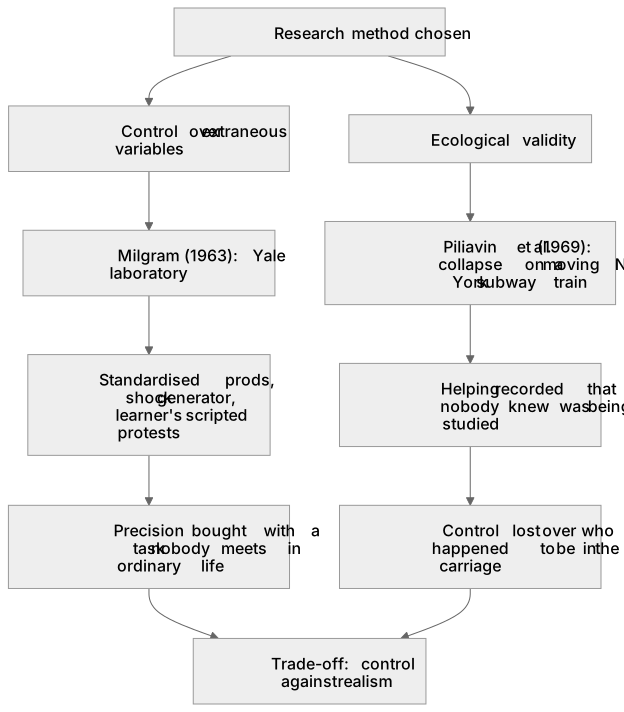
Label the diagram
Some boxes have lost their names. Pick the right name for each number.
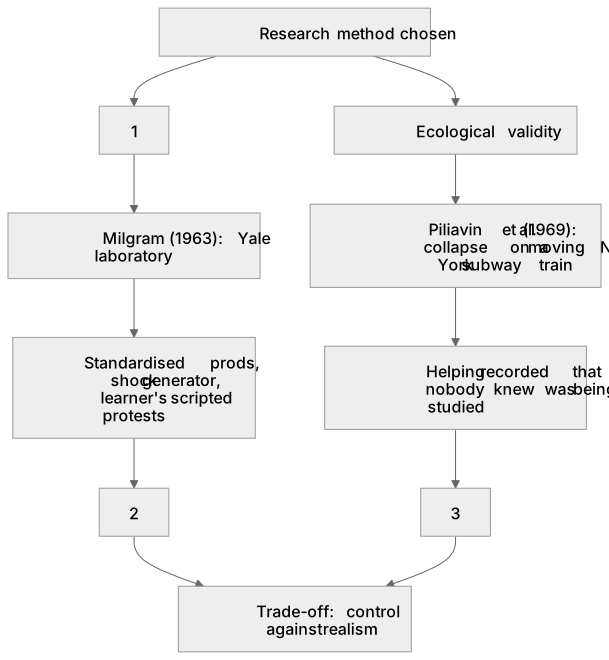
1Box 1
2Box 2
3Box 3
There is more to this lesson
The full lesson goes on to check your understanding and help you earn the marks. Create a free account to carry on, with your progress saved.
A week of Premium from your first lesson · Then the free plan continues · No card, no charge
Test your understanding of Research methods and techniques: Learners should have knowledge and understanding of the following research methods and techniques and their associated strengths and weaknesses.
Active recall beats re-reading. Take an instant quiz now to test what you’ve learned and lock it into long-term memory.
A week of Premium from your first lesson · Then the free plan continues · No card, no charge