OCR · A-Level · Psychology
Course version: H567 · Version from Sept 2015
Self-report: questionnaire; Interviews: structured, semi-structured,…
Full specification wording
Research methods and techniques: Self-report: questionnaire; Interviews: structured, semi-structured, unstructured.
Asking people reaches what watching them cannot, namely reasons, beliefs and private experience, and the whole evaluation turns on whether the respondent can and will tell you.
- Point 4 of 5
- 4 key terms
Study notes
From the teaching notes for this specification point.
The idea
Asking people reaches what watching them cannot, namely reasons, beliefs and private experience, and the whole evaluation turns on whether the respondent can and will tell you. Closed items and rating scales give numbers that compare easily across a large sample, at the cost of forcing an answer nobody actually holds; open items and a loose interview give depth that resists summary. Kohlberg (1968) put moral dilemmas to boys and scored the reasoning behind each answer rather than the answer itself, which needed an interviewer free to follow up. Hancock et al. (2011) asked convicted murderers to describe their offence in their own words, then ran the transcripts through text analysis software, finding that those scoring high on psychopathy used more cause and effect connectives and more talk of basic needs such as food and money. Social desirability threatens both.
What earns the marks
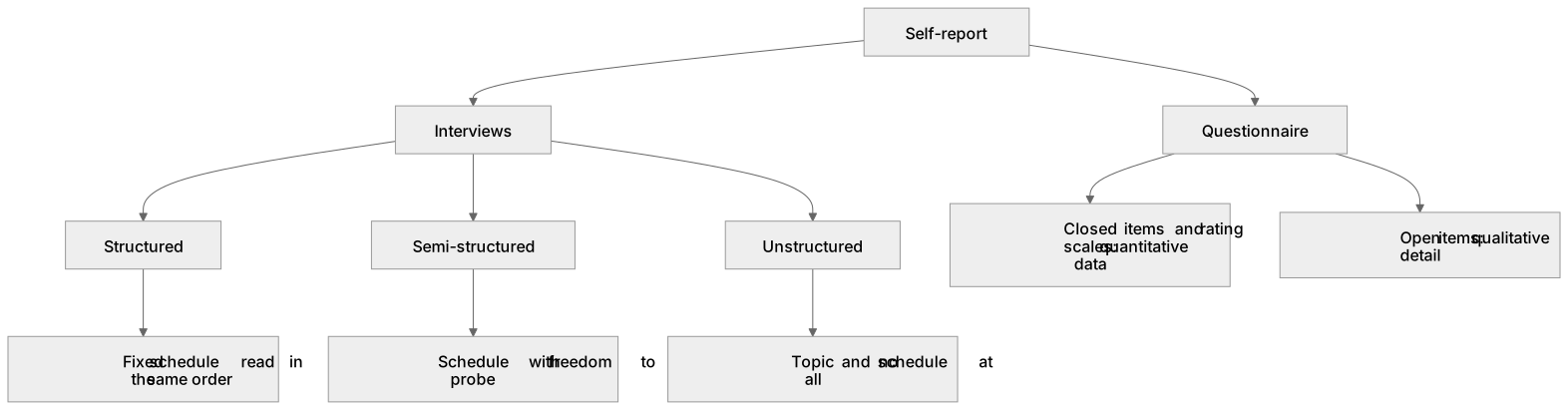
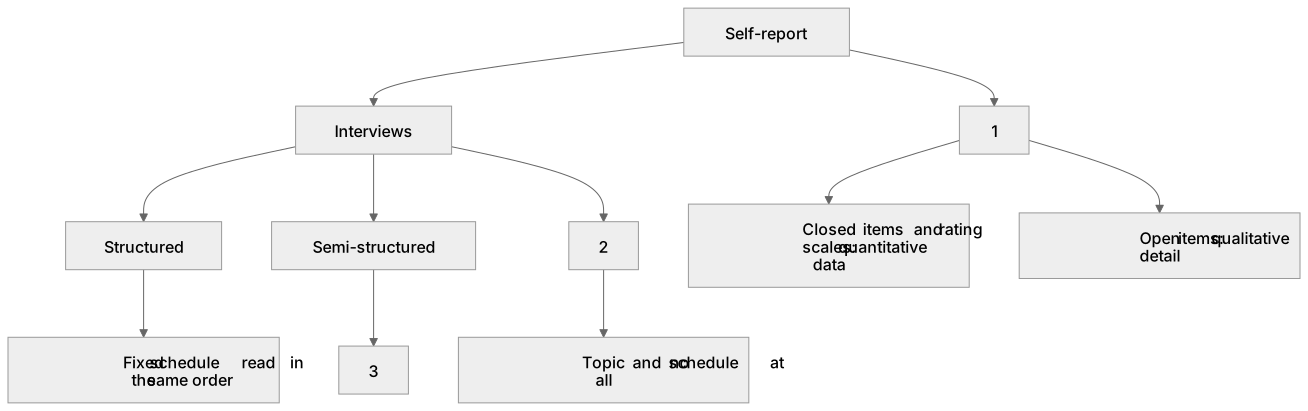
- Separate the three interview types by who controls the questions: a fixed schedule read in the same order, a schedule with freedom to probe, or a topic and no schedule at all.
- Credit comes from linking format to data, so closed items give quantitative data that can be compared across a large sample while open items give qualitative detail no fixed option would have caught.
- Name social desirability bias and say what it would do to this measure in particular, for example inflating reported medication use or reported willingness to help.
- A well written item carries one idea, no double negative, no leading wording, and a stated response format such as a five point scale.
Common mistakes and how to put them right
Calling a questionnaire unreliable when the point being made is about honesty, which is a validity problem rather than a consistency one.
Describing a structured interview as identical to a questionnaire.
Put it right: The difference is the live interviewer, who introduces interviewer effects but can clarify a misread question.
Writing a leading item into an answer that was supposed to demonstrate good question design, then losing the mark on the wording alone.
Offering the bare claim that people may lie, with no account of why they would lie in this particular study.
Exam tips
- You may be asked to write one closed and one open question on a given topic and then explain an advantage of each, so practise producing both quickly with the response format written in.
- A question about handling interview data usually wants thematic analysis described as coding transcripts into recurring themes, plus one problem of researcher subjectivity.
- Where the command word is justify, the marks are for the reason your format fits the aim, not for restating which format you picked.
Try the lesson
The start of the Research methods and techniques: Self-report: questionnaire; Interviews: structured, semi-structured, unstructured. lesson, made from teaching notes for this specification point.
Have a go first
A researcher conducts an interview using a strict, predetermined list of questions. They ask every participant exactly the same questions in the same order, without adding any extra questions or prompts. Which type of interview is this?
Listen
Asking people reaches what watching them cannot, namely reasons, beliefs and private experience, and the whole evaluation turns on whether the respondent can and will tell you. Closed items and rating scales give numbers that compare easily across a large sample, at the cost of forcing an answer nobody actually holds; open items and a loose interview give depth that resists summary. Kohlberg (1968) put moral dilemmas to boys and scored the reasoning behind each answer rather than the answer itself, which needed an interviewer free to follow up. Hancock et al. (2011) asked convicted murderers to describe their offence in their own words, then ran the transcripts through text analysis software, finding that those scoring high on psychopathy used more cause and effect connectives and more talk of basic needs such as food and money. Social desirability threatens both. A strong answer earns marks for these points. Separate the three interview types by who controls the questions: a fixed schedule read in the same order, a schedule with freedom to probe, or a topic and no schedule at all. Credit comes from linking format to data, so closed items give quantitative data that can be compared across a large sample while open items give qualitative detail no fixed option would have caught. Name social desirability bias and say what it would do to this measure in particular, for example inflating reported medication use or reported willingness to help. A well written item carries one idea, no double negative, no leading wording, and a stated response format such as a five point scale. Exam tip: You may be asked to write one closed and one open question on a given topic and then explain an advantage of each, so practise producing both quickly with the response format written in.
See it
Key words
Say what each word means before you turn the card.
open and closed questions
Try answering aloud or in your head before turning the card.
social desirability bias
Try answering aloud or in your head before turning the card.
qualitative and quantitative data
Try answering aloud or in your head before turning the card.
interviewer effects
Try answering aloud or in your head before turning the card.
See every definition
- open and closed questions
- Closed items and rating scales give numbers that compare easily across a large sample, while open items give depth that resists summary.
- social desirability bias
- A threat to both questionnaires and interviews, in which the respondent may not tell you honestly, for example inflating reported medication use or reported willingness to help.
- qualitative and quantitative data
- Closed items give quantitative data that can be compared across a large sample, while open items give qualitative detail no fixed option would have caught.
- interviewer effects
- Introduced by the live interviewer in a structured interview, who can clarify a misread question but also affects the respondent.
Label the diagram
Some boxes have lost their names. Pick the right name for each number.
1Box 1
2Box 2
3Box 3
There is more to this lesson
The full lesson goes on to check your understanding and help you earn the marks. Create a free account to carry on, with your progress saved.
A week of Premium from your first lesson · Then the free plan continues · No card, no charge
Test your understanding of Research methods and techniques: Self-report: questionnaire; Interviews: structured, semi-structured, unstructured.
Active recall beats re-reading. Take an instant quiz now to test what you’ve learned and lock it into long-term memory.
A week of Premium from your first lesson · Then the free plan continues · No card, no charge