OCR · A-Level · Psychology
Course version: H567 · Version from Sept 2015
Core studies: Key themes and areas of psychology: How each core study…
Full specification wording
Section A: Core studies: Key themes and areas of psychology: How each core study relates to its key theme. How each core study relates to the area of psychology it is placed within.
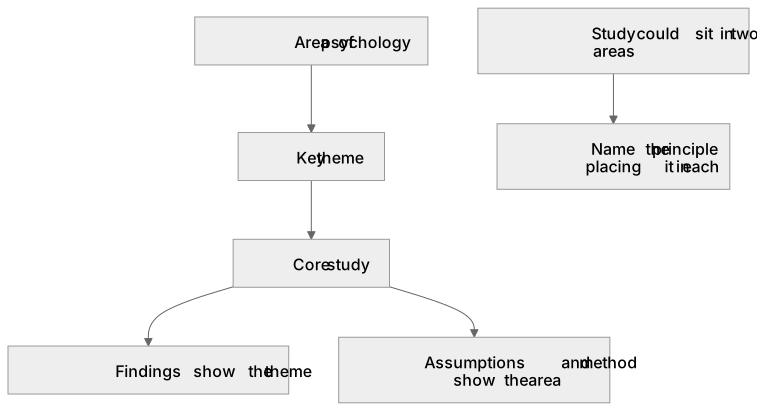
Every pairing sits under a theme, and every theme sits inside an area, so a complete answer travels down both.
- Point 14 of 14
- 4 key terms
Study notes
From the teaching notes for this specification point.
The idea
Every pairing sits under a theme, and every theme sits inside an area, so a complete answer travels down both. The social area treats behaviour as a product of the situation and of other people, which is where responses to authority and responses to people in need belong. The cognitive area treats the mind as a processor whose workings are inferred from performance, so memory and attention sit there. The developmental area asks how behaviour changes with age and experience, the biological area explains it through body and brain, and individual differences asks how and why people vary. A study earns theme marks by showing the theme in its findings, and area marks by showing that its assumptions and its method are the ones that area works with.
What earns the marks
- Theme credit comes from a finding, for example that the kittens Blakemore and Cooper reared seeing only vertical stripes behaved as though blind to horizontal ones, which is what makes the theme brain plasticity.
- Where a study could sit in two areas, say which principle places it in each, for example that Bandura is developmental through the age of the children and social through the influence of another person.
- Naming the pair as well as the theme shows that a theme is a category rather than a single study, which is what longer answers are rewarded for.
Common mistakes and how to put them right
Describing the area instead of the study, so the answer defines the cognitive area at length and never says what Moray's participants were asked to do.
Assuming the area is decided by the topic.
Put it right: It is decided by the kind of explanation offered, which is why a study of memory carried out with scans can be argued into the biological area.
Attaching the wrong theme to a pair, for example filing moral development under external influences on children's behaviour.
Exam tips
- Component two asks about themes and areas in the same question, so keep the pairs, their themes and their areas on a single sheet and learn it as a map.
- An explain question about an area wants two things, the principle and the evidence from the named study, so give both in the opening sentences.
- If you argue a study belongs in a different area, justify it with a principle of that area or the claim will read as a guess.
Try the lesson
The start of the Section A: Core studies: Key themes and areas of psychology: How each core study relates to its key theme. How each core study relates to the area of psychology it is placed within. lesson, made from teaching notes for this specification point.
Have a go first
Bandura et al.'s study on the transmission of aggression is placed within the developmental area of psychology. Which of the following best explains why this study is categorised in this area?
Listen
Every pairing sits under a theme, and every theme sits inside an area, so a complete answer travels down both. The social area treats behaviour as a product of the situation and of other people, which is where responses to authority and responses to people in need belong. The cognitive area treats the mind as a processor whose workings are inferred from performance, so memory and attention sit there. The developmental area asks how behaviour changes with age and experience, the biological area explains it through body and brain, and individual differences asks how and why people vary. A study earns theme marks by showing the theme in its findings, and area marks by showing that its assumptions and its method are the ones that area works with. A strong answer earns marks for these points. Theme credit comes from a finding, for example that the kittens Blakemore and Cooper reared seeing only vertical stripes behaved as though blind to horizontal ones, which is what makes the theme brain plasticity. Area credit comes from assumptions and method together, so say that Maguire's use of structural scans to relate posterior hippocampal volume to years of taxi driving is biological because the explanation offered is physical. Where a study could sit in two areas, say which principle places it in each, for example that Bandura is developmental through the age of the children and social through the influence of another person. Naming the pair as well as the theme shows that a theme is a category rather than a single study, which is what longer answers are rewarded for. Exam tip: Component two asks about themes and areas in the same question, so keep the pairs, their themes and their areas on a single sheet and learn it as a map.
See it
Key words
Say what each word means before you turn the card.
areas of psychology
Try answering aloud or in your head before turning the card.
key themes
Try answering aloud or in your head before turning the card.
classification by explanation
Try answering aloud or in your head before turning the card.
evidence for a theme
Try answering aloud or in your head before turning the card.
See every definition
- areas of psychology
- The categories, such as social, cognitive, developmental, biological and individual differences, within which each theme sits and which are defined by their assumptions and methods.
- key themes
- The categories under which each core study is paired, shown in a study's findings rather than named as a single study.
- classification by explanation
- Placing a study in an area by the kind of explanation offered, so that a study of memory carried out with scans can be argued into the biological area.
- evidence for a theme
- A finding that shows the theme, for example that the kittens reared seeing only vertical stripes behaved as though blind to horizontal ones, which makes the theme brain plasticity.
Label the diagram
Some boxes have lost their names. Pick the right name for each number.
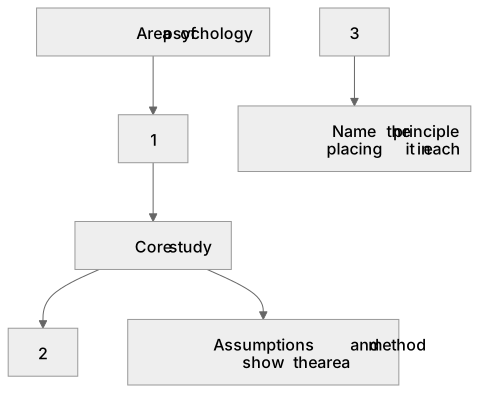
1Box 1
2Box 2
3Box 3
There is more to this lesson
The full lesson goes on to check your understanding and help you earn the marks. Create a free account to carry on, with your progress saved.
A week of Premium from your first lesson · Then the free plan continues · No card, no charge
Test your understanding of Section A: Core studies: Key themes and areas of psychology: How each core study relates to its key theme. How each core study relates to the area of psychology it is placed within.
Active recall beats re-reading. Take an instant quiz now to test what you’ve learned and lock it into long-term memory.
A week of Premium from your first lesson · Then the free plan continues · No card, no charge