OCR · A-Level · Psychology
Course version: H567 · Version from Sept 2015
Core studies: Methodological issues: The strengths and weaknesses of the…
Full specification wording
Section A: Core studies: Methodological issues: The strengths and weaknesses of the different research methods and techniques. The strengths and weaknesses of different types of data. Ethical considerations. Validity. Reliability. Sampling bias. Ethnocentrism.
Each of these ideas is examined through the studies, so the reliable way to revise is to attach every issue to a study where it goes well and one where it goes badly.
- Point 13 of 14
- 3 key terms
Study notes
From the teaching notes for this specification point.
The idea
Each of these ideas is examined through the studies, so the reliable way to revise is to attach every issue to a study where it goes well and one where it goes badly. Piliavin, Rodin and Piliavin (1969) staged collapses on a New York subway train, which buys real behaviour from real passengers at the cost of consent and debriefing; Moray (1959) controlled his shadowing conditions precisely and paid for it with a task nobody performs outside a laboratory. Sperry (1968) worked with about a dozen people whose corpus callosum had already been cut to control epilepsy, so the sample can never be reassembled. Levine, Norenzayan and Philbrick (2001) ran the same three helping measures in large cities across twenty three countries, which is the practical answer to a measure built around one culture.
What earns the marks
- A strength of a method counts when it is shown happening in the study, for example that a field experiment keeps the independent variable under the researcher's control while the behaviour stays natural.
- Types of data are credited by consequence, so say that numbers allow conditions to be compared and tested statistically, while a case record keeps the meaning that an average removes.
- Split reliability into internal and external, for example standardised instructions and identical verbal prods for every participant, against whether a repeat of the whole study gives the same result.
- Ethics answers score most when the guideline and the study detail arrive together, such as deception and the right to withdraw in a study where participants believed the shocks were real.
Common mistakes and how to put them right
Confusing reliability with validity, so the answer argues that a consistent measure must therefore be measuring the right thing.
Calling a sample biased without saying what the bias does, when the mark is for naming the group the finding may not extend to.
Describing ethnocentrism as simple prejudice.
Put it right: It is the use of one culture's norms as the yardstick for everyone, which is a fault in the design before it is an attitude in the researcher.
Exam tips
- These marks are usually collected in short answers, so one precise sentence carrying a study detail beats a paragraph of general method knowledge.
- Where a question names a study and asks for a weakness, the weakness has to be one that really applies to that study rather than one copied from a general list.
- If asked to suggest how validity could be improved, give a change to the procedure and say what that change would control.
Try the lesson
The start of the Section A: Core studies: Methodological issues: The strengths and weaknesses of the different research methods and techniques. The strengths and weaknesses of different types of data. Ethical considerations. Validity. Reliability. Sampling bias. Ethnocentrism. lesson, made from teaching notes for this specification point.
Have a go first
A researcher uses a newly developed questionnaire to measure aggression. They find that participants score consistently across multiple testing sessions, but later discover the questionnaire actually measures assertiveness rather than aggression. How would the methodological properties of this questionnaire be described?
Listen
Each of these ideas is examined through the studies, so the reliable way to revise is to attach every issue to a study where it goes well and one where it goes badly. Piliavin, Rodin and Piliavin (1969) staged collapses on a New York subway train, which buys real behaviour from real passengers at the cost of consent and debriefing; Moray (1959) controlled his shadowing conditions precisely and paid for it with a task nobody performs outside a laboratory. Sperry (1968) worked with about a dozen people whose corpus callosum had already been cut to control epilepsy, so the sample can never be reassembled. Levine, Norenzayan and Philbrick (2001) ran the same three helping measures in large cities across twenty three countries, which is the practical answer to a measure built around one culture. A strong answer earns marks for these points. A strength of a method counts when it is shown happening in the study, for example that a field experiment keeps the independent variable under the researcher's control while the behaviour stays natural. Types of data are credited by consequence, so say that numbers allow conditions to be compared and tested statistically, while a case record keeps the meaning that an average removes. Split reliability into internal and external, for example standardised instructions and identical verbal prods for every participant, against whether a repeat of the whole study gives the same result. Ethics answers score most when the guideline and the study detail arrive together, such as deception and the right to withdraw in a study where participants believed the shocks were real. Exam tip: These marks are usually collected in short answers, so one precise sentence carrying a study detail beats a paragraph of general method knowledge.
See it

Put the events in order
Put these events in the order they happened, earliest first.
- 1. Levine, Norenzayan and Philbrick ran helping measures in cities across many countries
- 2. Moray controlled shadowing conditions precisely in a laboratory task
- 3. Piliavin, Rodin and Piliavin staged collapses on a New York subway train
- 4. Sperry studied people whose corpus callosum had been cut to control epilepsy
Key words
Say what each word means before you turn the card.
strengths and weaknesses of methods
Try answering aloud or in your head before turning the card.
types of data
Try answering aloud or in your head before turning the card.
ethical considerations
Try answering aloud or in your head before turning the card.
See every definition
- strengths and weaknesses of methods
- A strength of a method counts when it is shown happening in the study, for example a field experiment keeping the independent variable under the researcher's control while the behaviour stays natural.
- types of data
- Credited by consequence, so numbers allow conditions to be compared and tested statistically, while a case record keeps the meaning that an average removes.
- ethical considerations
- Guidelines such as deception and the right to withdraw, which score most when the guideline and the study detail arrive together.
Label the diagram
Some boxes have lost their names. Pick the right name for each number.
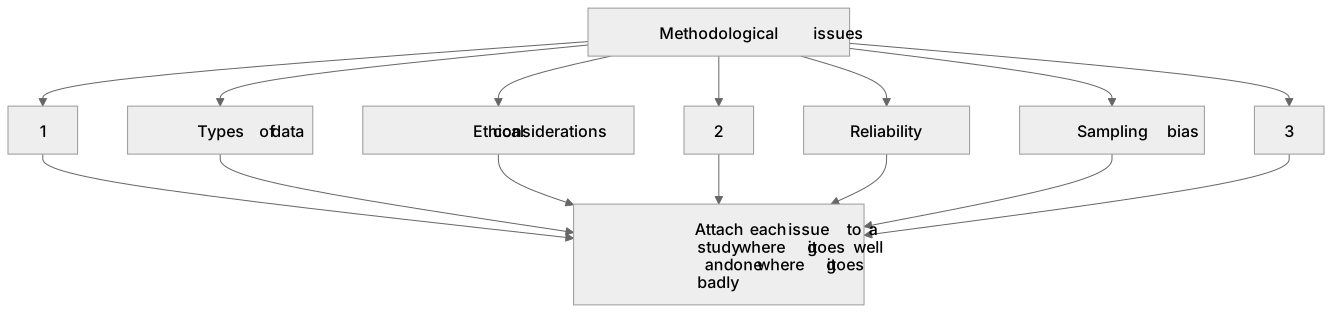
1Box 1
2Box 2
3Box 3
There is more to this lesson
The full lesson goes on to check your understanding and help you earn the marks. Create a free account to carry on, with your progress saved.
A week of Premium from your first lesson · Then the free plan continues · No card, no charge
Test your understanding of Section A: Core studies: Methodological issues: The strengths and weaknesses of the different research methods and techniques. The strengths and weaknesses of different types of data. Ethical considerations. Validity. Reliability. Sampling bias. Ethnocentrism.
Active recall beats re-reading. Take an instant quiz now to test what you’ve learned and lock it into long-term memory.
A week of Premium from your first lesson · Then the free plan continues · No card, no charge