OCR · A-Level · Psychology
Course version: H567 · Version from Sept 2015
Issues in mental health: Alternatives to the medical model – The…
Full specification wording
Section A: Issues in mental health: Alternatives to the medical model – The behaviourist explanation of mental illness; The cognitive explanation of mental illness; One from: the humanistic explanation of mental illness, the psychodynamic explanation of mental illness, the cognitive neuroscience explanation of mental illness. Szasz (2011) The myth of mental illness: 50 years later. Non-biological treatment of one specific disorder.
Alternatives to the medical model propose that mental illness stems from learning, faulty thinking, unconscious conflict, blocked growth, or neural dysfunction.
- Point 3 of 3
- 4 key terms
Study notes
From the teaching notes for this specification point.
The idea
Alternatives to the medical model propose that mental illness stems from learning, faulty thinking, unconscious conflict, blocked growth, or neural dysfunction. Behaviourists treat symptoms as conditioned responses acquired by association. Cognitive accounts locate problems in faulty thinking, like Beck's negative triad. Szasz (2011) argues mental illness is a metaphor for problems in living, criticising coercive psychiatry. Non-biological treatments apply these theories, such as using cognitive behavioural therapy to challenge irrational beliefs in depression.
What earns the marks
- Szasz (2011) stated as a claim with reasons: illness properly names bodily pathology, so mental illness is a metaphor taken literally, and psychiatric diagnosis judges behaviour against social norms rather than a lesion.
- A behaviourist explanation with a mechanism, such as Watson and Rayner conditioning fear by pairing a rat with a loud noise, extended by Mowrer's two-process account where avoidance maintains fear.
- A cognitive explanation using terms precisely: the cognitive triad, faulty information processing, or the activating event, irrational belief and consequence.
Common mistakes and how to put them right
Treating Szasz (2011) as an empirical study with a sample and results.
Put it right: It is an essay/argument, evaluated on its reasoning and ethical implications.
Collapsing the behaviourist and cognitive explanations into a single therapy without ever stating a cognitive cause of the disorder.
Choosing a treatment and describing only its aims without specifying the disorder.
Put it right: Credit comes from linking the procedure (e.g., thought records) to a specific disorder like depression.
Exam tips
- You need only one of the three optional explanations, so learn the psychodynamic, humanistic, or cognitive neuroscience explanation thoroughly with a mechanism attached.
- Questions often ask you to compare an alternative with the medical model, so hold one prepared line on cause and one on treatment so the comparison is explicit.
Try the lesson
The start of the Section A: Issues in mental health: Alternatives to the medical model – The behaviourist explanation of mental illness; The cognitive explanation of mental illness; One from: the humanistic explanation of mental illness, the psychodynamic explanation of mental illness, the cognitive neuroscience explanation of mental illness. Szasz (2011) The myth of mental illness: 50 years later. Non-biological treatment of one specific disorder. lesson, made from teaching notes for this specification point.
Have a go first
What is the central argument made by Thomas Szasz (2011) regarding the concept of mental illness?
Listen
Alternatives to the medical model propose that mental illness stems from learning, faulty thinking, unconscious conflict, blocked growth, or neural dysfunction. Behaviourists treat symptoms as conditioned responses acquired by association. Cognitive accounts locate problems in faulty thinking, like Beck's negative triad. Szasz (2011) argues mental illness is a metaphor for problems in living, criticising coercive psychiatry. Non-biological treatments apply these theories, such as using cognitive behavioural therapy to challenge irrational beliefs in depression. A strong answer earns marks for these points. Szasz (2011) stated as a claim with reasons: illness properly names bodily pathology, so mental illness is a metaphor taken literally, and psychiatric diagnosis judges behaviour against social norms rather than a lesion. a behaviourist explanation with a mechanism, such as Watson and Rayner conditioning fear by pairing a rat with a loud noise, extended by Mowrer's two-process account where avoidance maintains fear. a cognitive explanation using terms precisely: the cognitive triad, faulty information processing, or the activating event, irrational belief and consequence. the chosen optional explanation: psychodynamic (unconscious conflicts between id, ego, and superego), humanistic (conditions of worth blocking self-actualisation), or cognitive neuroscience (neural correlates of cognitive deficits). Exam tip: You need only one of the three optional explanations, so learn the psychodynamic, humanistic, or cognitive neuroscience explanation thoroughly with a mechanism attached.
See it

Key words
Say what each word means before you turn the card.
behaviourist explanation
Try answering aloud or in your head before turning the card.
cognitive explanation
Try answering aloud or in your head before turning the card.
myth of mental illness
Try answering aloud or in your head before turning the card.
psychological therapies
Try answering aloud or in your head before turning the card.
See every definition
- behaviourist explanation
- Proposes that mental illness stems from learning, with symptoms treated as conditioned responses acquired by association.
- cognitive explanation
- Locates problems in faulty thinking, such as Beck's negative triad.
- myth of mental illness
- Szasz's argument that mental illness is a metaphor for problems in living, criticising coercive psychiatry.
- psychological therapies
- Non-biological treatments that apply these theories, such as using cognitive behavioural therapy to challenge irrational beliefs in depression.
Label the diagram
Some boxes have lost their names. Pick the right name for each number.
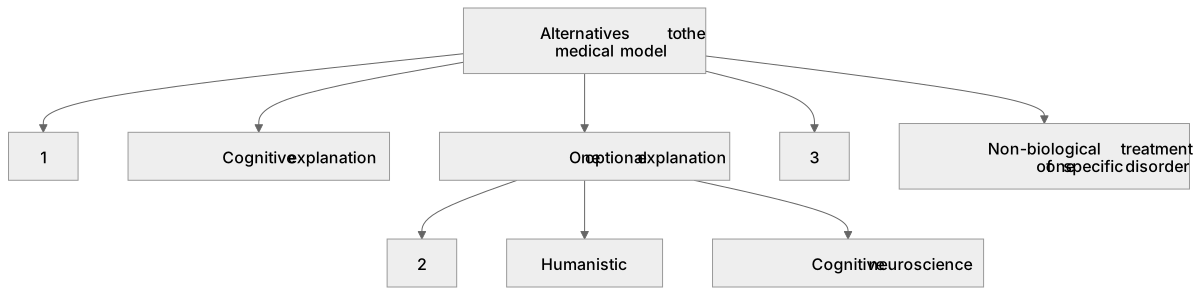
1Box 1
2Box 2
3Box 3
There is more to this lesson
The full lesson goes on to check your understanding and help you earn the marks. Create a free account to carry on, with your progress saved.
A week of Premium from your first lesson · Then the free plan continues · No card, no charge
Test your understanding of Section A: Issues in mental health: Alternatives to the medical model – The behaviourist explanation of mental illness; The cognitive explanation of mental illness; One from: the humanistic explanation of mental illness, the psychodynamic explanation of mental illness, the cognitive neuroscience explanation of mental illness. Szasz (2011) The myth of mental illness: 50 years later. Non-biological treatment of one specific disorder.
Active recall beats re-reading. Take an instant quiz now to test what you’ve learned and lock it into long-term memory.
A week of Premium from your first lesson · Then the free plan continues · No card, no charge