OCR · A-Level · Psychology
Course version: H567 · Version from Sept 2015
Issues in mental health: The medical model – The biochemical explanation…
Full specification wording
Section A: Issues in mental health: The medical model – The biochemical explanation of mental illness; The genetic explanation of mental illness; Brain abnormality as an explanation of mental illness. Gottesman et al. (2010) Disorders in offspring with two psychiatrically ill parents. Biological treatment of one specific disorder.
The medical model treats mental illness as having physical causes.
- Point 2 of 3
- 4 key terms
Study notes
From the teaching notes for this specification point.
The idea
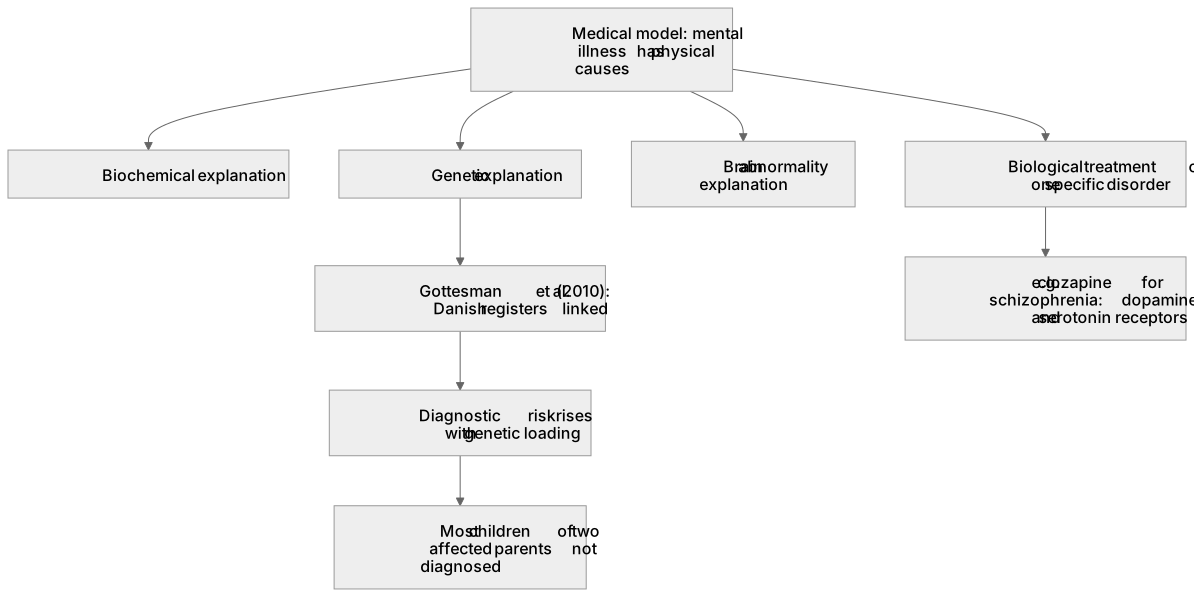
The medical model treats mental illness as having physical causes. The key research is Gottesman et al. (2010) 'Disorders in offspring with two psychiatrically ill parents', a Danish register study showing that genetic loading increases diagnostic risk for schizophrenia and bipolar disorder.
What earns the marks
- Biochemical evidence handled as evidence: amphetamine, which raises dopamine activity, can produce psychotic symptoms, and drugs blocking dopamine receptors reduce them.
Common mistakes and how to put them right
Reporting register figures as though they showed the disorder to be inherited outright.
Put it right: A rate of 27.3% means nearly three quarters of the highest risk group were not diagnosed with that disorder; frame it as an increased risk or vulnerability.
Confusing a correlate with a cause.
Put it right: Enlarged ventricles are found in patients who have usually been medicated for years, so the abnormality may follow the illness or its treatment rather than produce it.
Naming a drug without saying what it does at the synapse or specifying the disorder it treats.
Put it right: Specify the neurotransmitter mechanism and the specific disorder to provide a basis for evaluation.
Exam tips
- Key research questions reward design detail, so be able to say that this evidence came from whole population registers and why that beats a clinic sample recruited after diagnosis.
- Treatment questions expect you to say what the treatment does not do, so keep a line ready that medication manages symptoms but leaves the circumstances a person returns to untouched.
Try the lesson
The start of the Section A: Issues in mental health: The medical model – The biochemical explanation of mental illness; The genetic explanation of mental illness; Brain abnormality as an explanation of mental illness. Gottesman et al. (2010) Disorders in offspring with two psychiatrically ill parents. Biological treatment of one specific disorder. lesson, made from teaching notes for this specification point.
Have a go first
In Gottesman et al.'s (2010) study on disorders in offspring, what was found regarding the risk of mental illness when both parents are psychiatrically ill?
Listen
The medical model treats mental illness as having physical causes. The key research is Gottesman et al. (2010) 'Disorders in offspring with two psychiatrically ill parents', a Danish register study showing that genetic loading increases diagnostic risk for schizophrenia and bipolar disorder. A strong answer earns marks for these points. Gottesman et al. (2010) described as a design: Danish national psychiatric and civil registers were linked so that over two million people could be followed, allowing researchers to identify cohorts based on parental diagnoses and track offspring diagnoses without relying on volunteers. reading the figures correctly: where both parents had been admitted with schizophrenia, 27.3% of their children were diagnosed with schizophrenia, falling to 7% with one affected parent and 0.86% where neither parent was affected, with a comparable gradient for bipolar disorder. the conclusion the numbers support: risk rises steeply with genetic loading, but most children of two affected parents never received that diagnosis. This indicates genetic vulnerability, though the study measures diagnostic risk rather than environmental stressors. biochemical evidence handled as evidence: amphetamine, which raises dopamine activity, can produce psychotic symptoms, and drugs blocking dopamine receptors reduce them. A common slip: Reporting register figures as though they showed the disorder to be inherited outright. Instead, A rate of 27.3% means nearly three quarters of the highest risk group were not diagnosed with that disorder; frame it as an increased risk or vulnerability. Exam tip: Key research questions reward design detail, so be able to say that this evidence came from whole population registers and why that beats a clinic sample recruited after diagnosis.
See it
Key words
Say what each word means before you turn the card.
biochemical explanation
Try answering aloud or in your head before turning the card.
genetic explanation
Try answering aloud or in your head before turning the card.
brain abnormality
Try answering aloud or in your head before turning the card.
drug treatment
Try answering aloud or in your head before turning the card.
See every definition
- biochemical explanation
- An explanation of mental illness that treats it as having physical causes, supported by evidence that amphetamine, which raises dopamine activity, can produce psychotic symptoms and drugs blocking dopamine receptors reduce them.
- genetic explanation
- An explanation of mental illness in which genetic loading increases diagnostic risk, as shown by Gottesman et al. (2010) using Danish national psychiatric and civil registers.
- brain abnormality
- An explanation of mental illness in which an abnormality such as enlarged ventricles is found in patients, though it may follow the illness or its treatment rather than produce it.
- drug treatment
- A biological treatment of one specific disorder, such as the atypical drug clozapine for schizophrenia acting on dopamine and serotonin receptors, requiring regular blood monitoring.
Label the diagram
Some boxes have lost their names. Pick the right name for each number.
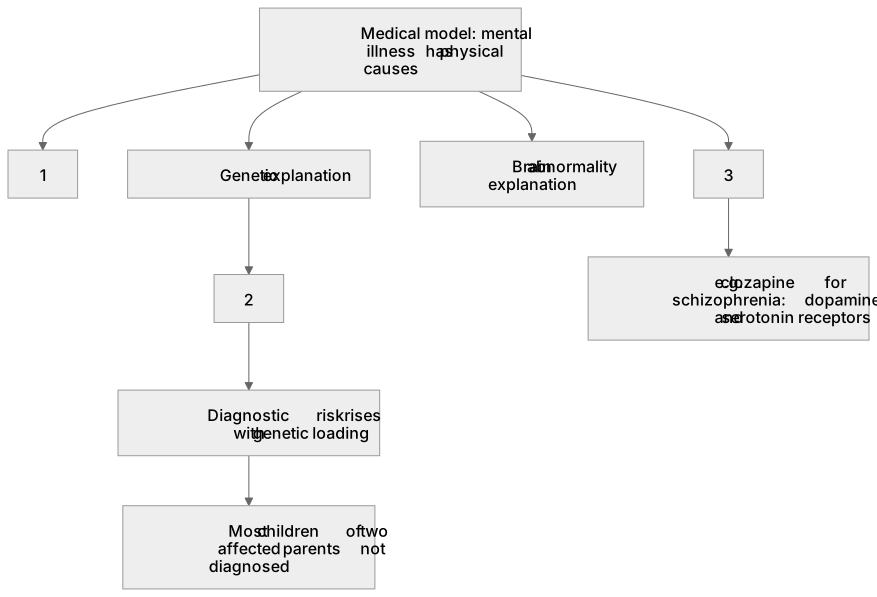
1Box 1
2Box 2
3Box 3
There is more to this lesson
The full lesson goes on to check your understanding and help you earn the marks. Create a free account to carry on, with your progress saved.
A week of Premium from your first lesson · Then the free plan continues · No card, no charge
Test your understanding of Section A: Issues in mental health: The medical model – The biochemical explanation of mental illness; The genetic explanation of mental illness; Brain abnormality as an explanation of mental illness. Gottesman et al. (2010) Disorders in offspring with two psychiatrically ill parents. Biological treatment of one specific disorder.
Active recall beats re-reading. Take an instant quiz now to test what you’ve learned and lock it into long-term memory.
A week of Premium from your first lesson · Then the free plan continues · No card, no charge