OCR · A-Level · Psychology
Course version: H567 · Version from Sept 2015
Issues in mental health: The historical context of mental health –…
Full specification wording
Section A: Issues in mental health: The historical context of mental health – Historical views of mental illness; Defining abnormality; Categorising mental disorders. Rosenhan (1973) On being sane in insane places. Characteristics of an affective disorder, a psychotic disorder and an anxiety disorder.
This section covers the historical context of mental health, including historical views of mental illness like demonic possession.
- Point 1 of 3
- 4 key terms
Study notes
From the teaching notes for this specification point.
The idea
This section covers the historical context of mental health, including historical views of mental illness like demonic possession. Defining abnormality involves four definitions: statistical infrequency, deviation from social norms, failure to function adequately, and deviation from ideal mental health. Categorising mental disorders relies on diagnostic manuals to standardise criteria. Rosenhan (1973) 'On being sane in insane places' investigated the validity of psychiatric diagnosis by sending pseudopatients into hospitals.
What earns the marks
- Definitions of abnormality evaluated rather than listed, such as statistical infrequency classifying a very high reasoning score as abnormal, or deviation from social norms shifting with culture and era.
- Stating what categorising mental disorders is for, that agreed criteria raise agreement between clinicians, while the key study attacks validity, which is a separate claim about whether the label describes anything real.
Common mistakes and how to put them right
Saying the study proved psychiatrists are incompetent.
Put it right: The pseudopatients lied about a symptom, and a clinician who cannot verify a reported voice is behaving reasonably in admitting.
Writing that the pseudopatients were discharged as cured.
Put it right: They were discharged with their admission diagnosis in remission (e.g., schizophrenia in remission), which leaves the label in place.
Describing depression in everyday words such as feeling sad, when the marks come from clinical features plus the requirement that they persist and impair functioning.
Exam tips
- Questions here often ask you to outline one definition of abnormality and then evaluate it, so pair every definition with a single limitation you can state in one sentence.
- Where a short case is given, name the family of disorder and justify it from the symptoms printed in the stimulus rather than asserting the diagnosis.
Try the lesson
The start of the Section A: Issues in mental health: The historical context of mental health – Historical views of mental illness; Defining abnormality; Categorising mental disorders. Rosenhan (1973) On being sane in insane places. Characteristics of an affective disorder, a psychotic disorder and an anxiety disorder. lesson, made from teaching notes for this specification point.
Have a go first
In Rosenhan's (1973) study 'On being sane in insane places', what was the specific symptom that the pseudopatients reported to gain admission to the psychiatric hospitals?
Listen
This section covers the historical context of mental health, including historical views of mental illness like demonic possession. Defining abnormality involves four definitions: statistical infrequency, deviation from social norms, failure to function adequately, and deviation from ideal mental health. Categorising mental disorders relies on diagnostic manuals to standardise criteria. Rosenhan (1973) 'On being sane in insane places' investigated the validity of psychiatric diagnosis by sending pseudopatients into hospitals. A strong answer earns marks for these points. Rosenhan (1973) described with its procedure and numbers: eight pseudopatients presented at twelve hospitals reporting a voice saying empty, hollow and thud, all were admitted, and they remained on average 19 days although they behaved normally from admission onwards. the finding that staff reinterpreted ordinary behaviour to fit the label, recording note taking as writing behaviour, and for the follow up in which a hospital warned to expect pseudopatients judged 41 of 193 real referrals to be fakes when none had been sent. definitions of abnormality evaluated rather than listed, such as statistical infrequency classifying a very high reasoning score as abnormal, or deviation from social norms shifting with culture and era. symptom pictures given in clinical language: persistent low mood and loss of interest for an affective disorder; positive symptoms like hallucinations beside negative symptoms like avolition for a psychotic disorder; and marked, persistent fear with avoidance for an anxiety disorder. Exam tip: Questions here often ask you to outline one definition of abnormality and then evaluate it, so pair every definition with a single limitation you can state in one sentence.
See it
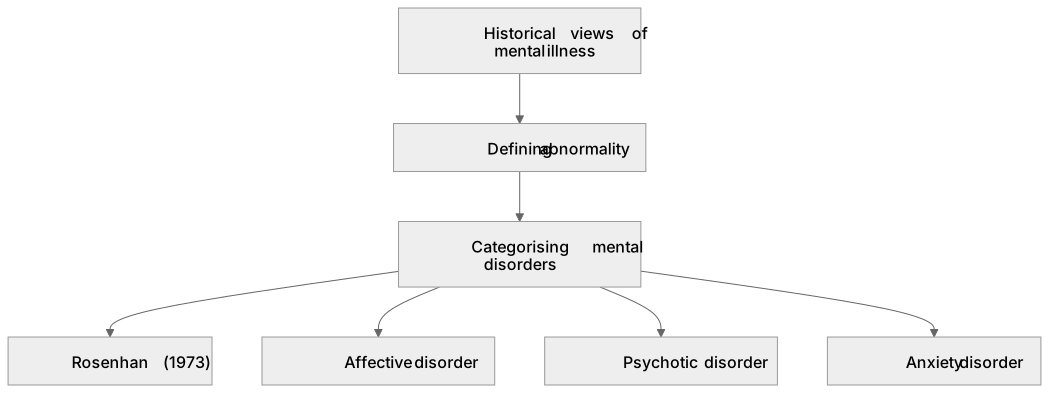
Key words
Say what each word means before you turn the card.
historical views of mental illness
Try answering aloud or in your head before turning the card.
defining abnormality
Try answering aloud or in your head before turning the card.
categorising mental disorders
Try answering aloud or in your head before turning the card.
characteristics of disorders
Try answering aloud or in your head before turning the card.
See every definition
- historical views of mental illness
- Views of mental illness in the past, including demonic possession.
- defining abnormality
- Involves four definitions: statistical infrequency, deviation from social norms, failure to function adequately, and deviation from ideal mental health.
- categorising mental disorders
- Relies on diagnostic manuals to standardise criteria, so that agreed criteria raise agreement between clinicians.
- characteristics of disorders
- The specific clinical symptoms of an affective disorder, a psychotic disorder and an anxiety disorder.
Label the diagram
Some boxes have lost their names. Pick the right name for each number.
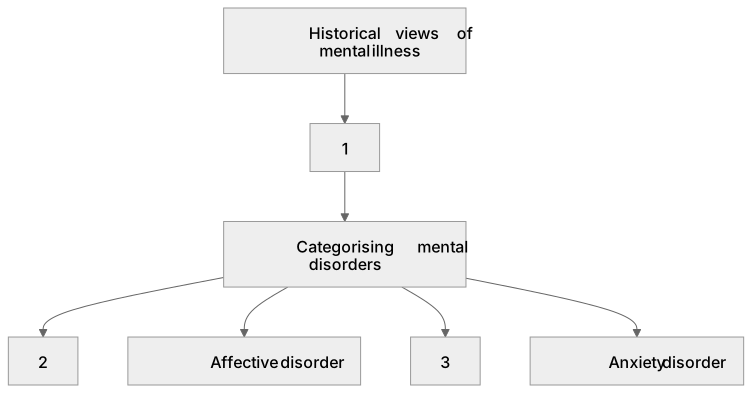
1Box 1
2Box 2
3Box 3
There is more to this lesson
The full lesson goes on to check your understanding and help you earn the marks. Create a free account to carry on, with your progress saved.
A week of Premium from your first lesson · Then the free plan continues · No card, no charge
Test your understanding of Section A: Issues in mental health: The historical context of mental health – Historical views of mental illness; Defining abnormality; Categorising mental disorders. Rosenhan (1973) On being sane in insane places. Characteristics of an affective disorder, a psychotic disorder and an anxiety disorder.
Active recall beats re-reading. Take an instant quiz now to test what you’ve learned and lock it into long-term memory.
A week of Premium from your first lesson · Then the free plan continues · No card, no charge