OCR · A-Level · Psychology
Course version: H567 · Version from Sept 2015
Option 1 Child psychology: Cognitive development and education (Cognitive)…
Full specification wording
Section B: Option 1 Child psychology: Cognitive development and education (Cognitive) – Cognitive development in children and the impact of this on education. Wood et al. (1976) The role of tutoring in problem-solving. At least one cognitive strategy to improve revision or learning.
Two cognitive accounts influence education.
- Point 4 of 6
- 3 key terms
Study notes
From the teaching notes for this specification point.
The idea
Two cognitive accounts influence education. Piaget describes children revising schemas through assimilation and accommodation, passing through stages characterised by object permanence, egocentrism, conservation, and abstract reasoning. His legacy emphasises readiness and discovery learning. Vygotsky views development as social, proposing the zone of proximal development—the gap between independent and assisted performance—as the optimal space for teaching. Wood et al. (1976) operationalised this gap into observable tutor actions, introducing the concept of scaffolding in problem-solving. The application requires suggesting a cognitive strategy to improve revision or learning, providing a theoretical justification for the technique.
What earns the marks
- Wood et al. (1976) procedure: 30 children aged 3, 4, and 5 were tutored individually to build a pyramid from interlocking wooden blocks. The tutor followed a graded sequence from verbal hints to direct demonstration.
- Scaffolding functions: recruiting interest, reducing the number of choices, keeping the child on task, marking critical features, controlling frustration, and demonstrating an idealised solution.
- Educational application of theories: Piaget implies waiting for readiness and facilitating discovery, whereas Vygotsky implies teaching just ahead of the child's current ability with support that is gradually withdrawn.
Common mistakes and how to put them right
Using the zone of proximal development and scaffolding as exact synonyms.
Put it right: The zone is the conceptual space between independent and assisted performance; scaffolding refers to the specific actions the tutor takes within it.
Listing Piaget's stages with ages but omitting the cognitive characteristics.
Put it right: Credit requires describing the reasoning typical of each stage, such as failing conservation tasks because appearance dominates logic.
Recommending highlighting or rereading as effective revision strategies.
Put it right: Evidence suggests these methods feel fluent but produce less durable learning compared to retrieval practice.
Exam tips
- For 'suggest' questions, provide the strategy, outline the procedure, and explicitly link it to cognitive theory using three distinct points.
- When comparing Piaget and Vygotsky, prepare one clear point of agreement (e.g., both see children as active learners) and two distinct differences (e.g., the role of social interaction).
Try the lesson
The start of the Section B: Option 1 Child psychology: Cognitive development and education (Cognitive) – Cognitive development in children and the impact of this on education. Wood et al. (1976) The role of tutoring in problem-solving. At least one cognitive strategy to improve revision or learning. lesson, made from teaching notes for this specification point.
Have a go first
In the study by Wood et al. (1976), what task were the children required to complete with the help of a tutor?
Listen
Two cognitive accounts influence education. Piaget describes children revising schemas through assimilation and accommodation, passing through stages characterised by object permanence, egocentrism, conservation, and abstract reasoning. His legacy emphasises readiness and discovery learning. Vygotsky views development as social, proposing the zone of proximal development—the gap between independent and assisted performance—as the optimal space for teaching. Wood et al. (1976) operationalised this gap into observable tutor actions, introducing the concept of scaffolding in problem-solving. The application requires suggesting a cognitive strategy to improve revision or learning, providing a theoretical justification for the technique. A strong answer earns marks for these points. Wood et al. (1976) procedure: 30 children aged 3, 4, and 5 were tutored individually to build a pyramid from interlocking wooden blocks. The tutor followed a graded sequence from verbal hints to direct demonstration. Wood et al. (1976) findings: 3-year-olds largely ignored verbal prompts and needed blocks placed for them; 4-year-olds acted on verbal direction but needed assembly help; 5-year-olds mostly needed confirmation. This indicates support must match the learner's level. scaffolding functions: recruiting interest, reducing the number of choices, keeping the child on task, marking critical features, controlling frustration, and demonstrating an idealised solution. educational application of theories: Piaget implies waiting for readiness and facilitating discovery, whereas Vygotsky implies teaching just ahead of the child's current ability with support that is gradually withdrawn. Exam tip: For 'suggest' questions, provide the strategy, outline the procedure, and explicitly link it to cognitive theory using three distinct points.
See it

Key words
Say what each word means before you turn the card.
schemas and stages
Try answering aloud or in your head before turning the card.
scaffolding and the zone of proximal development
Try answering aloud or in your head before turning the card.
application to education
Try answering aloud or in your head before turning the card.
See every definition
- schemas and stages
- Piaget describes children revising schemas through assimilation and accommodation, passing through stages characterised by object permanence, egocentrism, conservation, and abstract reasoning.
- scaffolding and the zone of proximal development
- Vygotsky proposed the zone of proximal development, the gap between independent and assisted performance, and Wood et al. (1976) operationalised this gap into observable tutor actions, introducing scaffolding in problem-solving.
- application to education
- Piaget implies waiting for readiness and facilitating discovery, whereas Vygotsky implies teaching just ahead of the child's current ability with support that is gradually withdrawn.
Label the diagram
Some boxes have lost their names. Pick the right name for each number.
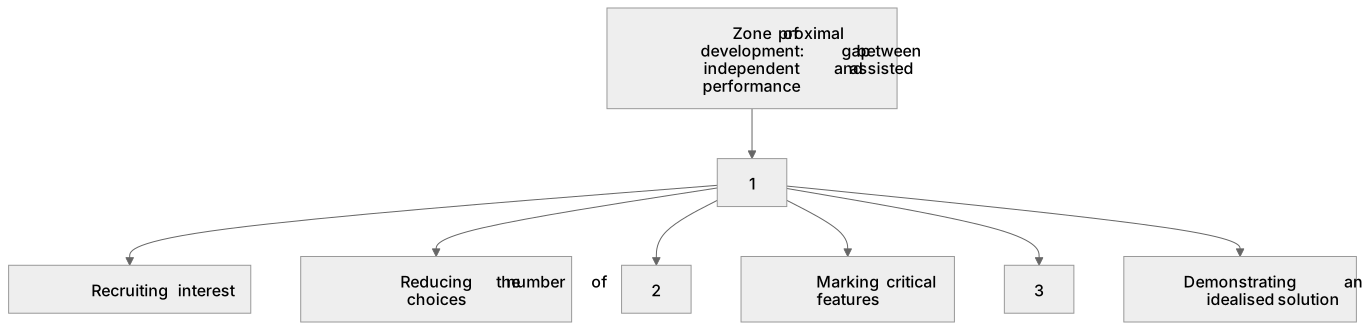
1Box 1
2Box 2
3Box 3
There is more to this lesson
The full lesson goes on to check your understanding and help you earn the marks. Create a free account to carry on, with your progress saved.
A week of Premium from your first lesson · Then the free plan continues · No card, no charge
Test your understanding of Section B: Option 1 Child psychology: Cognitive development and education (Cognitive) – Cognitive development in children and the impact of this on education. Wood et al. (1976) The role of tutoring in problem-solving. At least one cognitive strategy to improve revision or learning.
Active recall beats re-reading. Take an instant quiz now to test what you’ve learned and lock it into long-term memory.
A week of Premium from your first lesson · Then the free plan continues · No card, no charge