OCR · A-Level · Psychology
Course version: H567 · Version from Sept 2015
Option 1 Child psychology: Development of attachment (Social) – The…
Full specification wording
Section B: Option 1 Child psychology: Development of attachment (Social) – The development of attachment in babies and the impact of failure to develop attachments. Ainsworth and Bell (1970) Attachment, Exploration and Separation: Illustrated by the Behavior of One-year-olds in a Strange Situation. At least one strategy to develop an attachment friendly environment.
Attachment is the enduring emotional tie turning a caregiver into a secure base, developing from indiscriminate responsiveness to separation anxiety.
- Point 5 of 6
- 3 key terms
Study notes
From the teaching notes for this specification point.
The idea
Attachment is the enduring emotional tie turning a caregiver into a secure base, developing from indiscriminate responsiveness to separation anxiety. Ainsworth and Bell (1970) supplied the standardised laboratory procedure making individual differences measurable, using short separation and reunion episodes to observe if a baby uses the caregiver as a base for exploration. The impact of failure to develop attachments is studied through delinquency research and institutionalised children. The applied question asks what a nursery, hospital ward or foster placement should do differently to create an attachment friendly environment once this evidence is applied.
Common mistakes and how to put them right
Writing that the procedure measures how much a baby loves its mother.
Put it right: It classifies the pattern of one relationship, and the same child can be classified differently with a different caregiver.
Reading avoidant behaviour as no attachment at all, when it is interpreted as an organised strategy for managing a caregiver who has been consistently unresponsive to distress.
Confusing deprivation, which is the loss of an attachment already formed, with privation, which is never having formed one.
Exam tips
- Where the stimulus describes a nursery, a hospital ward or a foster home, suggestion marks need details of that setting rather than a general list of good practice.
- Learn the reunion behaviour for each pattern, because questions ask you to classify a described infant and the reunion is what separates the types.
Try the lesson
The start of the Section B: Option 1 Child psychology: Development of attachment (Social) – The development of attachment in babies and the impact of failure to develop attachments. Ainsworth and Bell (1970) Attachment, Exploration and Separation: Illustrated by the Behavior of One-year-olds in a Strange Situation. At least one strategy to develop an attachment friendly environment. lesson, made from teaching notes for this specification point.
Have a go first
In Ainsworth and Bell's (1970) 'Strange Situation' study, which specific infant behaviour was primarily used to assess the presence of separation anxiety?
Listen
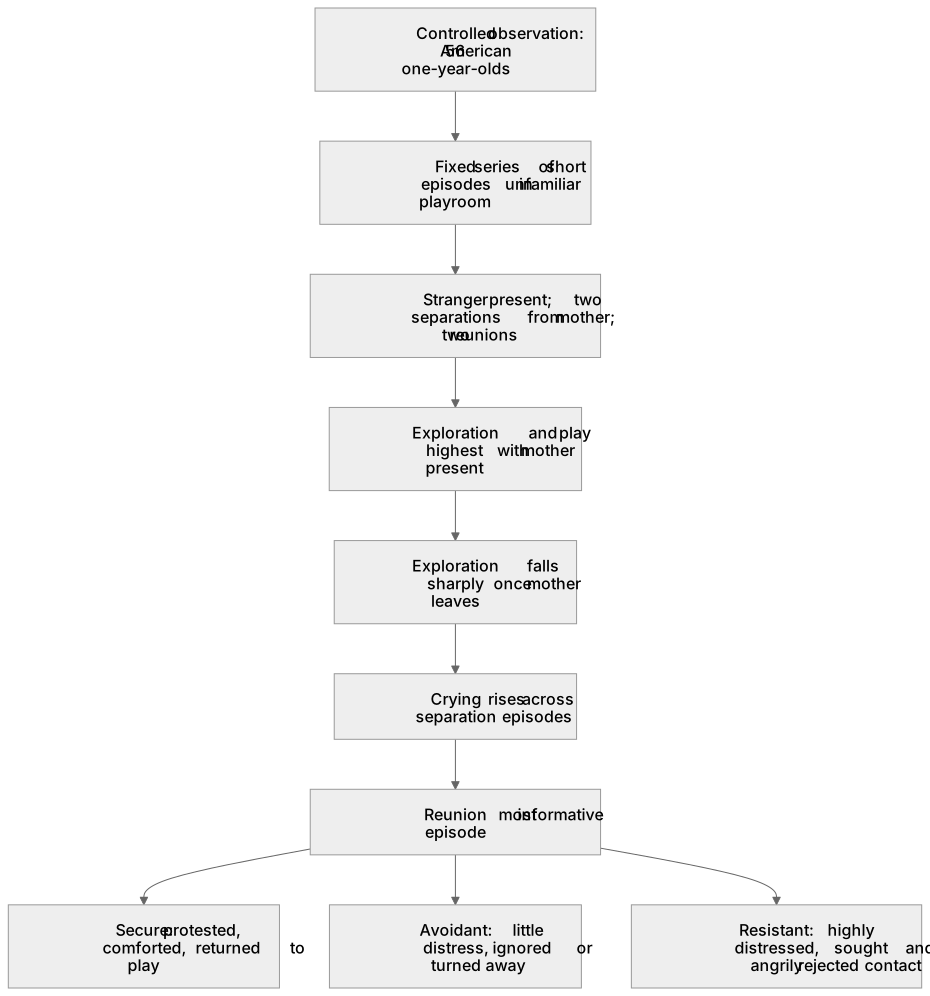
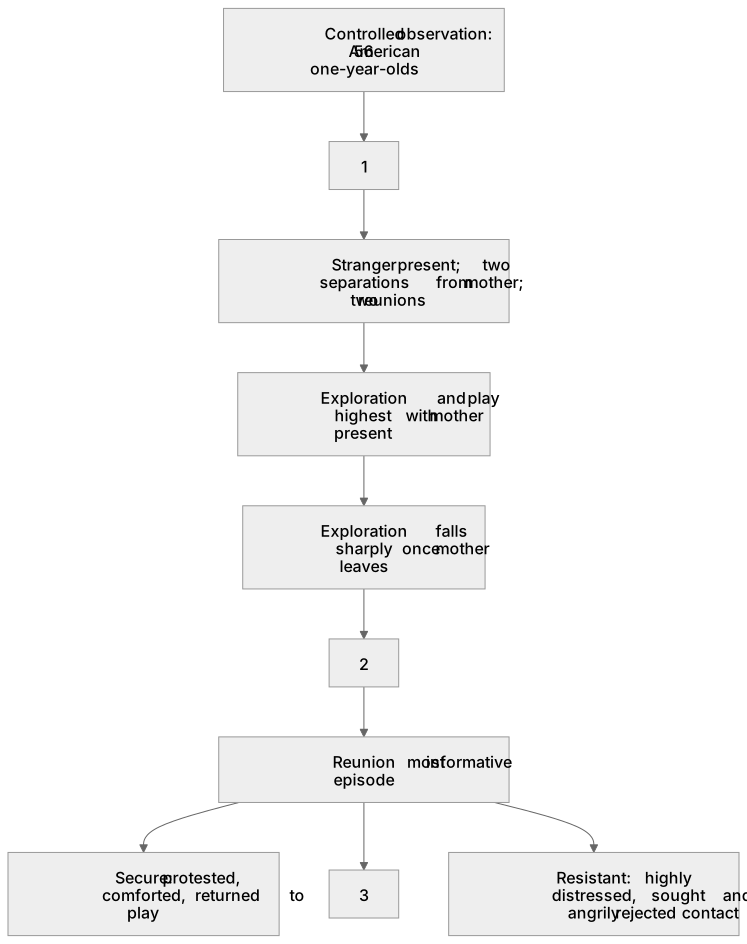
Attachment is the enduring emotional tie turning a caregiver into a secure base, developing from indiscriminate responsiveness to separation anxiety. Ainsworth and Bell (1970) supplied the standardised laboratory procedure making individual differences measurable, using short separation and reunion episodes to observe if a baby uses the caregiver as a base for exploration. The impact of failure to develop attachments is studied through delinquency research and institutionalised children. The applied question asks what a nursery, hospital ward or foster placement should do differently to create an attachment friendly environment once this evidence is applied. A strong answer earns marks for these points. Ainsworth and Bell (1970) described as a controlled observation: 56 American one-year-olds from middle-class Baltimore families were observed through a fixed series of short episodes in an unfamiliar playroom involving a stranger, two separations from the mother and two reunions. the behaviours coded and the overall pattern, that exploration and play were highest while the mother was present and fell sharply once she left, that crying rose across the separation episodes, and that the reunion proved the most informative episode of all. the three patterns described through reunion behaviour: secure infants protested but were comforted and went back to play, avoidant infants showed little distress and ignored or turned away from the mother, and resistant infants were highly distressed and then both sought and angrily rejected contact. evidence on failure to attach, such as Bowlby's juvenile thieves, in which the small group he called affectionless were overwhelmingly those who had experienced prolonged early separation, and the Romanian adoptee research, in which children adopted after about six months in institutional care showed persisting difficulties including indiscriminate friendliness. Exam tip: Where the stimulus describes a nursery, a hospital ward or a foster home, suggestion marks need details of that setting rather than a general list of good practice.
See it
Key words
Say what each word means before you turn the card.
development of attachment
Try answering aloud or in your head before turning the card.
secure base behaviour
Try answering aloud or in your head before turning the card.
deprivation and privation
Try answering aloud or in your head before turning the card.
See every definition
- development of attachment
- The process in babies by which an enduring emotional tie turns a caregiver into a secure base, developing from indiscriminate responsiveness to separation anxiety.
- secure base behaviour
- Using the caregiver as a base for exploration, observed through whether a baby does so in the short separation and reunion episodes.
- deprivation and privation
- Deprivation is the loss of an attachment already formed, while privation is never having formed one.
Label the diagram
Some boxes have lost their names. Pick the right name for each number.
1Box 1
2Box 2
3Box 3
There is more to this lesson
The full lesson goes on to check your understanding and help you earn the marks. Create a free account to carry on, with your progress saved.
A week of Premium from your first lesson · Then the free plan continues · No card, no charge
Test your understanding of Section B: Option 1 Child psychology: Development of attachment (Social) – The development of attachment in babies and the impact of failure to develop attachments. Ainsworth and Bell (1970) Attachment, Exploration and Separation: Illustrated by the Behavior of One-year-olds in a Strange Situation. At least one strategy to develop an attachment friendly environment.
Active recall beats re-reading. Take an instant quiz now to test what you’ve learned and lock it into long-term memory.
A week of Premium from your first lesson · Then the free plan continues · No card, no charge