OCR · A-Level · Psychology
Course version: H567 · Version from Sept 2015
Option 1 Child psychology: Impact of advertising on children (Social) –…
Full specification wording
Section B: Option 1 Child psychology: Impact of advertising on children (Social) – The influence of television advertising on children and the stereotyping in such advertising. Johnson and Young (2002) Gendered voices in children’s advertising. At least one strategy to reduce impact of advertising which is aimed at children.
Behaviourists suggest commercials influence young viewers through modelling; children below eight rarely recognise persuasive intent.
- Point 6 of 6
- 4 key terms
Study notes
From the teaching notes for this specification point.
The idea
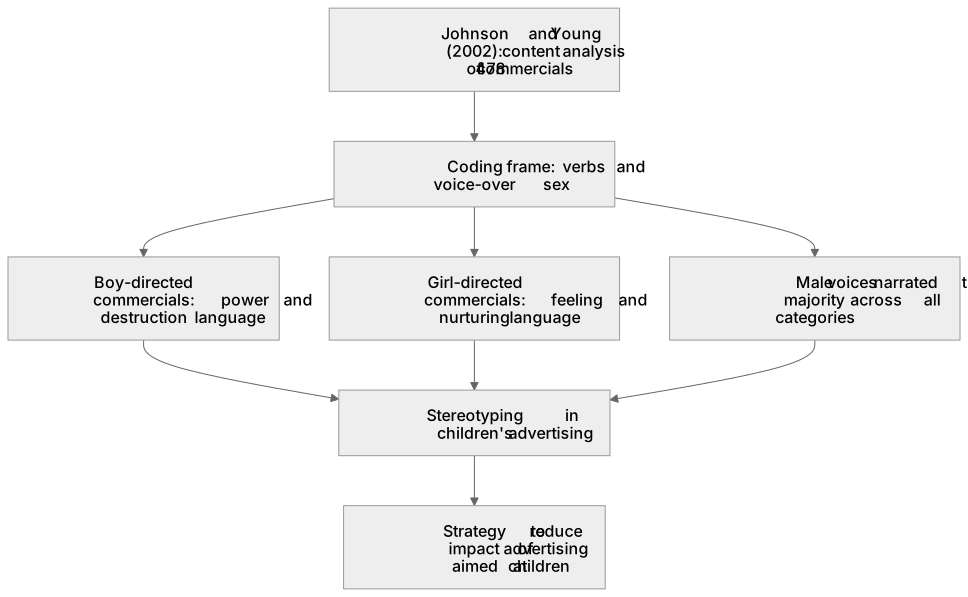
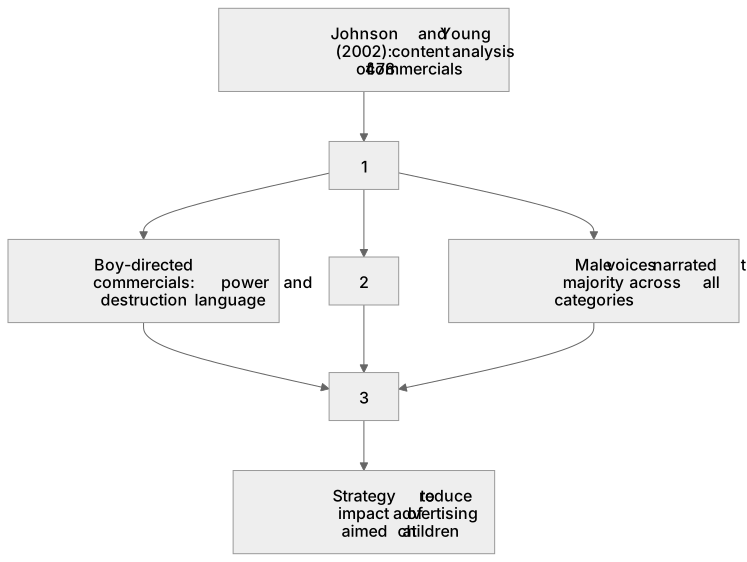
Behaviourists suggest commercials influence young viewers through modelling; children below eight rarely recognise persuasive intent. Johnson and Young (2002) content analysed 478 commercials broadcast during American children's programming, coding verbs and voice-over sex to examine stereotyping. Boy-directed commercials featured power and destruction language; girl-directed ones used feeling and nurturing language. Male voices narrated the majority across all categories. Pine and Nash found children watching more commercial television requested more branded items. Marks require judging the method, linking stereotyping to social learning, and suggesting at least one strategy to reduce the impact of advertising aimed at children.
What earns the marks
- Naming Johnson and Young and giving the method as a content analysis of 478 broadcast commercials, with verb categories and voice-over sex as the coding frame, rather than a vague claim that they watched adverts.
- The direction of the results: power and destruction verbs clustered in boy-oriented commercials, feeling and nurturing language in girl-oriented ones, and predominantly male voices across both.
- Explaining influence through a named theoretical mechanism, such as vicarious reinforcement in social learning, the limited grasp of persuasive intent before about the age of eight, and pester power exerted on parents.
Common mistakes and how to put them right
Describing the research as an experiment with an independent variable.
Put it right: Nothing was manipulated; the category of commercial was an observation, so no cause and effect statement is available.
Writing that the study proved advertising makes children sexist.
Put it right: A content analysis shows what is in the message, not what it does to the viewer, so effects evidence has to be brought in from elsewhere.
Offering 'parents should monitor viewing' as the whole strategy.
Put it right: A strategy needs a mechanism and some evidence, such as why a broadcasting restriction changes what children request.
Exam tips
- Questions name the key research and ask for procedure and results as separate demands, so rehearse the coding categories and the voice-over result as two distinct chunks.
- Application stems put a toy company, a broadcaster or a school in front of you; quote a finding and then say what that organisation should do differently.
Try the lesson
The start of the Section B: Option 1 Child psychology: Impact of advertising on children (Social) – The influence of television advertising on children and the stereotyping in such advertising. Johnson and Young (2002) Gendered voices in children’s advertising. At least one strategy to reduce impact of advertising which is aimed at children. lesson, made from teaching notes for this specification point.
Have a go first
According to Johnson and Young's (2002) study on gendered voices in children's advertising, which pattern of voice-over use was most frequently observed in the commercials analysed?
Listen
Behaviourists suggest commercials influence young viewers through modelling; children below eight rarely recognise persuasive intent. Johnson and Young (2002) content analysed 478 commercials broadcast during American children's programming, coding verbs and voice-over sex to examine stereotyping. Boy-directed commercials featured power and destruction language; girl-directed ones used feeling and nurturing language. Male voices narrated the majority across all categories. Pine and Nash found children watching more commercial television requested more branded items. Marks require judging the method, linking stereotyping to social learning, and suggesting at least one strategy to reduce the impact of advertising aimed at children. A strong answer earns marks for these points. naming Johnson and Young and giving the method as a content analysis of 478 broadcast commercials, with verb categories and voice-over sex as the coding frame, rather than a vague claim that they watched adverts. the direction of the results: power and destruction verbs clustered in boy-oriented commercials, feeling and nurturing language in girl-oriented ones, and predominantly male voices across both. explaining influence through a named theoretical mechanism, such as vicarious reinforcement in social learning, the limited grasp of persuasive intent before about the age of eight, and pester power exerted on parents. one strategy worked through, for example a statutory ban on commercials aimed at under-thirteens as in Quebec, restricting food high in fat, salt and sugar around children's programmes, or teaching advertising literacy so children can name the techniques being used on them. Exam tip: Questions name the key research and ask for procedure and results as separate demands, so rehearse the coding categories and the voice-over result as two distinct chunks.
See it
Key words
Say what each word means before you turn the card.
content analysis
Try answering aloud or in your head before turning the card.
gender stereotyping
Try answering aloud or in your head before turning the card.
social learning
Try answering aloud or in your head before turning the card.
persuasive intent
Try answering aloud or in your head before turning the card.
See every definition
- content analysis
- A method in which commercials are coded using a coding frame of verb categories and voice-over sex, as in Johnson and Young's study of 478 broadcast commercials.
- gender stereotyping
- The pattern in which boy-directed commercials featured power and destruction language and girl-directed ones used feeling and nurturing language, with male voices narrating the majority across all categories.
- social learning
- A theoretical mechanism by which commercials influence young viewers through modelling, such as vicarious reinforcement.
- persuasive intent
- Something children below eight rarely recognise in commercials.
Label the diagram
Some boxes have lost their names. Pick the right name for each number.
1Box 1
2Box 2
3Box 3
There is more to this lesson
The full lesson goes on to check your understanding and help you earn the marks. Create a free account to carry on, with your progress saved.
A week of Premium from your first lesson · Then the free plan continues · No card, no charge
Test your understanding of Section B: Option 1 Child psychology: Impact of advertising on children (Social) – The influence of television advertising on children and the stereotyping in such advertising. Johnson and Young (2002) Gendered voices in children’s advertising. At least one strategy to reduce impact of advertising which is aimed at children.
Active recall beats re-reading. Take an instant quiz now to test what you’ve learned and lock it into long-term memory.
A week of Premium from your first lesson · Then the free plan continues · No card, no charge