OCR · A-Level · Psychology
Course version: H567 · Version from Sept 2015
Option 2 Criminal psychology: Psychology and the courtroom (Cognitive) –…
Full specification wording
Section B: Option 2 Criminal psychology: Psychology and the courtroom (Cognitive) – How juries can be persuaded by the characteristics of witnesses and defendants. Dixon et al. (2002) The Role of Accent and Context in Perceptions of Guilt. At least one strategy to influence jury decision making.
Jurors are meant to weigh evidence, yet characteristics with no evidential value move their judgements, among them attractiveness, confident delivery, race and how a speaker sounds.
- Point 4 of 6
- 2 key terms
Study notes
From the teaching notes for this specification point.
The idea
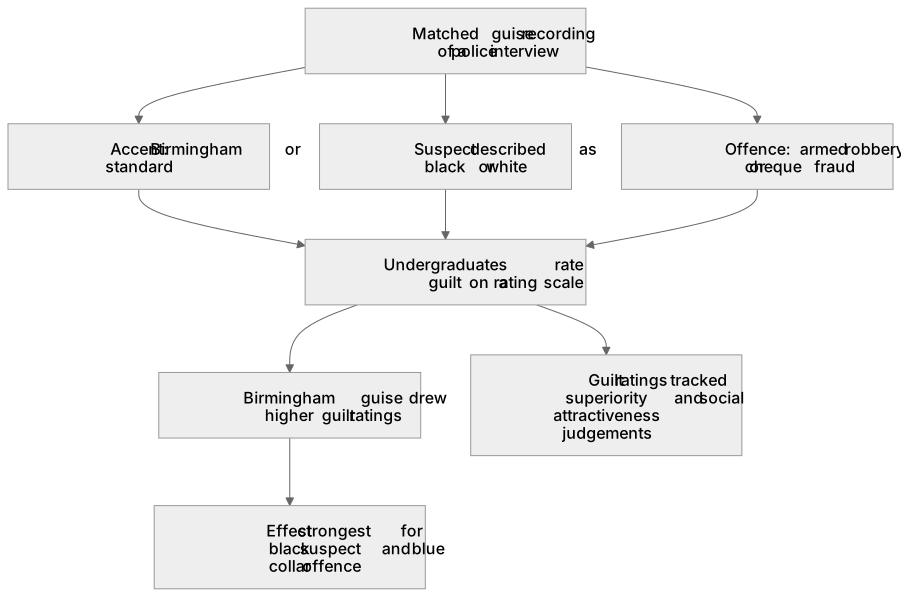
Jurors are meant to weigh evidence, yet characteristics with no evidential value move their judgements, among them attractiveness, confident delivery, race and how a speaker sounds. Dixon and colleagues used a matched guise recording of a police interview in which one actor spoke either with a Birmingham accent or with a standard accent, while the suspect was described as black or white and the alleged offence was armed robbery or cheque fraud. Undergraduates rated how guilty the suspect seemed on a rating scale. The Birmingham guise drew significantly higher guilt ratings than the standard guise, the effect was strongest for a black suspect accused of the blue collar offence, and guilt ratings tracked judgements of the speaker's superiority and social attractiveness.
What earns the marks
- Explaining the matched guise technique as the control that matters, since one actor and one script mean the content of the speech cannot be responsible for the difference.
- All three manipulated variables with their levels, and for the interaction, because the accent effect was concentrated in one particular combination.
- The mediating measure, that guilt ratings moved with ratings of status and social attractiveness, which is the stereotype doing the work.
- Further evidence on defendant and witness characteristics, such as attractive defendants attracting fewer guilty verdicts, or witness confidence predicting believability rather than accuracy.
- Evaluation credit for the artificiality of an audio clip with no evidence, no judge and no deliberation, for a student sample, and for the accent stereotype being specific to one culture.
Common mistakes and how to put them right
Calling the participants jurors.
Put it right: They were students rating guilt alone, whereas a real jury decides together after days of evidence, which is the strongest limitation on offer.
Reporting that the accent changed the verdict.
Put it right: No verdict was reached; the dependent variable was a rating, so write it accurately.
Ignoring the interaction and asserting that the accent effect appeared in every condition.
Exam tips
- The study carries several variables, so a procedure question is straightforward marks if you can state each one with its levels.
- Evaluate questions reward a judgement about generalisation, so decide whether an accent stereotype travels beyond the culture that holds it, and commit to an answer.
- Strategy questions expect the strategy named, the psychology behind it explained, and one limitation given, in that order.
Try the lesson
The start of the Section B: Option 2 Criminal psychology: Psychology and the courtroom (Cognitive) – How juries can be persuaded by the characteristics of witnesses and defendants. Dixon et al. (2002) The Role of Accent and Context in Perceptions of Guilt. At least one strategy to influence jury decision making. lesson, made from teaching notes for this specification point.
Have a go first
In Dixon et al.'s (2002) study on perceptions of guilt, which combination of independent variables resulted in the highest ratings of guilt from the participants?
Listen
Jurors are meant to weigh evidence, yet characteristics with no evidential value move their judgements, among them attractiveness, confident delivery, race and how a speaker sounds. Dixon and colleagues used a matched guise recording of a police interview in which one actor spoke either with a Birmingham accent or with a standard accent, while the suspect was described as black or white and the alleged offence was armed robbery or cheque fraud. Undergraduates rated how guilty the suspect seemed on a rating scale. The Birmingham guise drew significantly higher guilt ratings than the standard guise, the effect was strongest for a black suspect accused of the blue collar offence, and guilt ratings tracked judgements of the speaker's superiority and social attractiveness. A strong answer earns marks for these points. explaining the matched guise technique as the control that matters, since one actor and one script mean the content of the speech cannot be responsible for the difference. all three manipulated variables with their levels, and for the interaction, because the accent effect was concentrated in one particular combination. the mediating measure, that guilt ratings moved with ratings of status and social attractiveness, which is the stereotype doing the work. further evidence on defendant and witness characteristics, such as attractive defendants attracting fewer guilty verdicts, or witness confidence predicting believability rather than accuracy. Exam tip: The study carries several variables, so a procedure question is straightforward marks if you can state each one with its levels.
See it
Key words
Say what each word means before you turn the card.
matched guise technique
Try answering aloud or in your head before turning the card.
accent stereotypes
Try answering aloud or in your head before turning the card.
See every definition
- matched guise technique
- A recording in which one actor and one script are used, so the content of the speech cannot be responsible for any difference.
- accent stereotypes
- Judgements of a speaker's superiority and social attractiveness that track guilt ratings, with the stereotype doing the work.
Label the diagram
Some boxes have lost their names. Pick the right name for each number.
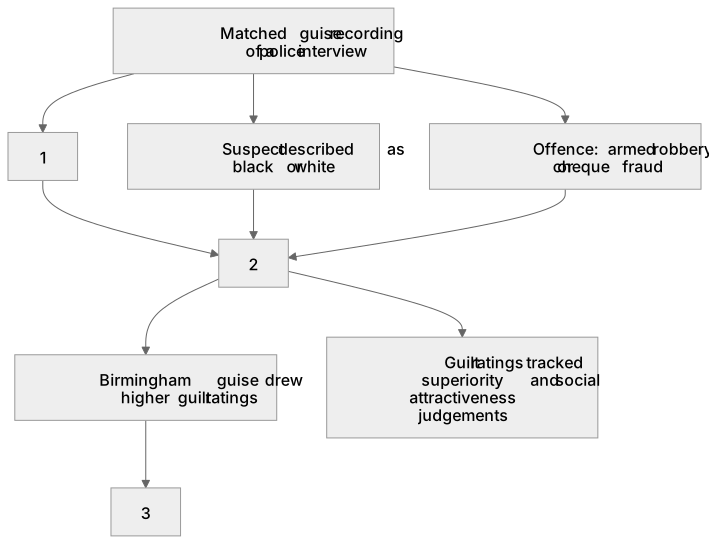
1Box 1
2Box 2
3Box 3
There is more to this lesson
The full lesson goes on to check your understanding and help you earn the marks. Create a free account to carry on, with your progress saved.
A week of Premium from your first lesson · Then the free plan continues · No card, no charge
Test your understanding of Section B: Option 2 Criminal psychology: Psychology and the courtroom (Cognitive) – How juries can be persuaded by the characteristics of witnesses and defendants. Dixon et al. (2002) The Role of Accent and Context in Perceptions of Guilt. At least one strategy to influence jury decision making.
Active recall beats re-reading. Take an instant quiz now to test what you’ve learned and lock it into long-term memory.
A week of Premium from your first lesson · Then the free plan continues · No card, no charge