OCR · A-Level · Psychology
Course version: H567 · Version from Sept 2015
Option 2 Criminal psychology: Collection of evidence (Cognitive) –…
Full specification wording
Section B: Option 2 Criminal psychology: Collection of evidence (Cognitive) – Collection and use of evidence from witnesses and suspects. Memon, A. and Higham, P. A. (1999) A review of the cognitive interview. Psychology, Crime and Law. 5, (1–2), 177–196. At least one strategy for police interviews.
The cognitive interview rests on encoding specificity and on giving memory several routes back to the event: report everything, mentally reinstate the context, recall in a changed order and…
- Point 3 of 6
- 3 key terms
Study notes
From the teaching notes for this specification point.
The idea
The cognitive interview rests on encoding specificity and on giving memory several routes back to the event: report everything, mentally reinstate the context, recall in a changed order and describe the scene from another perspective, with the enhanced version adding rapport, open questions and witness-led pacing. Memon and Higham reviewed the literature and set out four reasons the technique is hard to judge, namely separating the contribution of each component, the choice of comparison interview, wide variation in interviewer training, and how outcomes are scored as correct details, errors and confabulations. Their verdict is that the technique reliably yields more correct information than a standard interview, but that extra correct detail can arrive alongside extra incorrect detail.
What earns the marks
- The four components named and tied to their memory principle, so context reinstatement is explained through encoding specificity and change of order through disruption of schema-driven reconstruction.
- Treating this as a review rather than an experiment, so its evidence is other researchers' data and its contribution is methodological critique.
- The four problems raised, especially the point that comparing against a structured interview rather than a standard one shrinks the apparent advantage.
- The accuracy argument: more correct details but also more errors, so the proportion correct may hardly move and is the figure worth checking.
Common mistakes and how to put them right
Describing the cognitive interview as a way of detecting lies or of questioning suspects.
Put it right: It was designed to enhance recall from a cooperative witness.
Writing that it improves the accuracy of memory.
Put it right: It increases the quantity recalled, and the proportion that is correct is a separate measure, which is precisely the distinction the review insists on.
Crediting the review with findings it never collected.
Put it right: Attribute the numbers to the original studies and use this source for the critique.
Exam tips
- Because the key research is a review, questions ask for its conclusions and the issues it raises, so prepare the four problems as your description.
- Application stems hand you a witness with a particular difficulty, such as a young child or a distressed adult; name the component you would change and justify the change.
- Discuss questions on this topic usually turn on practical usefulness, so budget a paragraph on time, training and real police conditions.
Try the lesson
The start of the Section B: Option 2 Criminal psychology: Collection of evidence (Cognitive) – Collection and use of evidence from witnesses and suspects. Memon, A. and Higham, P. A. (1999) A review of the cognitive interview. Psychology, Crime and Law. 5, (1–2), 177–196. At least one strategy for police interviews. lesson, made from teaching notes for this specification point.
Have a go first
According to Memon and Higham's (1999) review of the cognitive interview, why is the standard police interview considered an inappropriate comparison group in experimental research?
Listen
The cognitive interview rests on encoding specificity and on giving memory several routes back to the event: report everything, mentally reinstate the context, recall in a changed order and describe the scene from another perspective, with the enhanced version adding rapport, open questions and witness-led pacing. Memon and Higham reviewed the literature and set out four reasons the technique is hard to judge, namely separating the contribution of each component, the choice of comparison interview, wide variation in interviewer training, and how outcomes are scored as correct details, errors and confabulations. Their verdict is that the technique reliably yields more correct information than a standard interview, but that extra correct detail can arrive alongside extra incorrect detail. A strong answer earns marks for these points. the four components named and tied to their memory principle, so context reinstatement is explained through encoding specificity and change of order through disruption of schema-driven reconstruction. treating this as a review rather than an experiment, so its evidence is other researchers' data and its contribution is methodological critique. the four problems raised, especially the point that comparing against a structured interview rather than a standard one shrinks the apparent advantage. the accuracy argument: more correct details but also more errors, so the proportion correct may hardly move and is the figure worth checking. Exam tip: Because the key research is a review, questions ask for its conclusions and the issues it raises, so prepare the four problems as your description.
See it
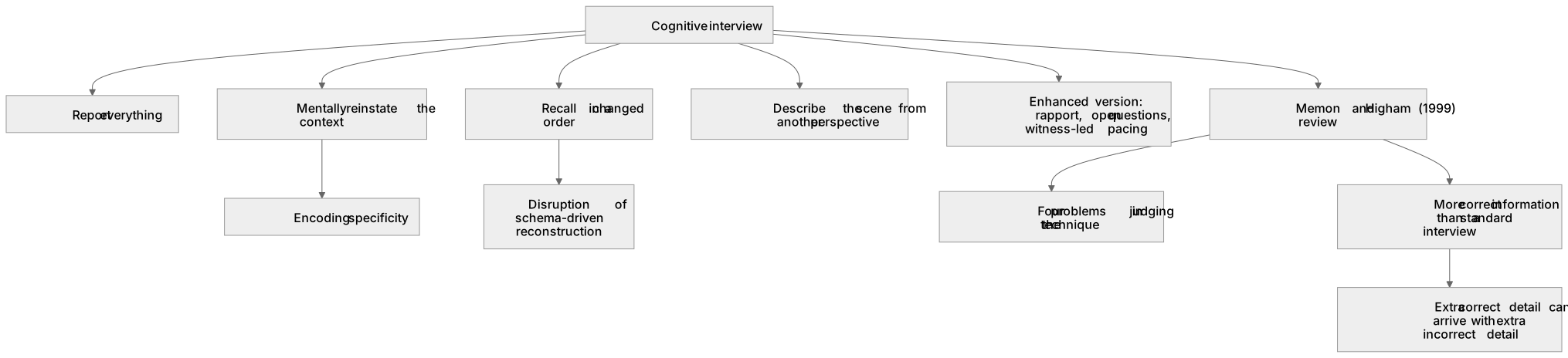
Key words
Say what each word means before you turn the card.
encoding specificity
Try answering aloud or in your head before turning the card.
review evidence
Try answering aloud or in your head before turning the card.
interviewer training
Try answering aloud or in your head before turning the card.
See every definition
- encoding specificity
- The memory principle on which the cognitive interview rests, and through which context reinstatement is explained.
- review evidence
- Other researchers' data rather than an experiment, so the contribution of the source is methodological critique.
- interviewer training
- One of the four reasons the technique is hard to judge, because of wide variation in it.
Label the diagram
Some boxes have lost their names. Pick the right name for each number.
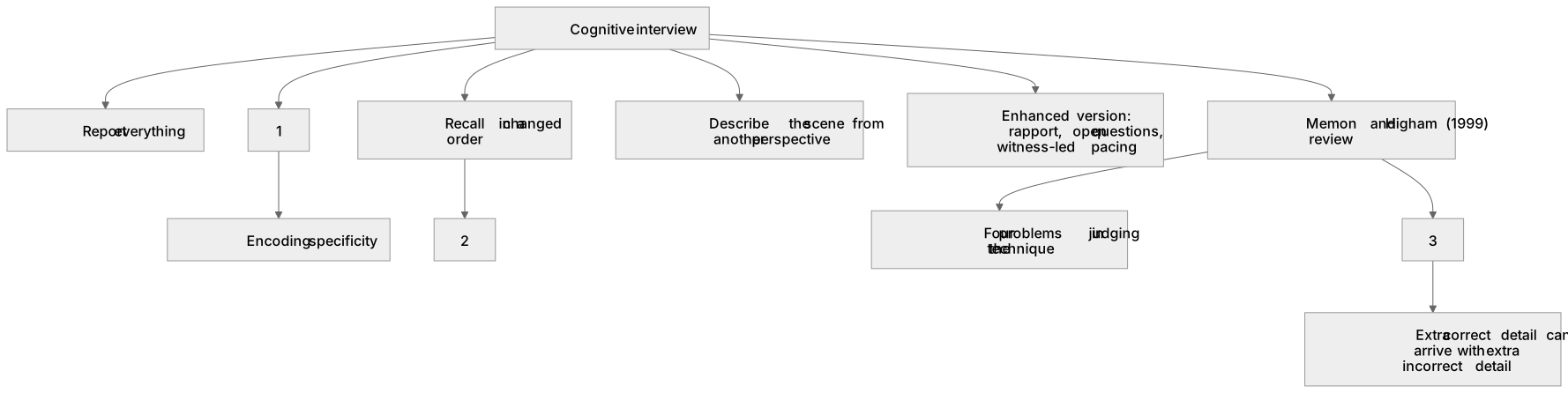
1Box 1
2Box 2
3Box 3
There is more to this lesson
The full lesson goes on to check your understanding and help you earn the marks. Create a free account to carry on, with your progress saved.
A week of Premium from your first lesson · Then the free plan continues · No card, no charge
Test your understanding of Section B: Option 2 Criminal psychology: Collection of evidence (Cognitive) – Collection and use of evidence from witnesses and suspects. Memon, A. and Higham, P. A. (1999) A review of the cognitive interview. Psychology, Crime and Law. 5, (1–2), 177–196. At least one strategy for police interviews.
Active recall beats re-reading. Take an instant quiz now to test what you’ve learned and lock it into long-term memory.
A week of Premium from your first lesson · Then the free plan continues · No card, no charge