OCR · A-Level · Psychology
Course version: H567 · Version from Sept 2015
Option 2 Criminal psychology: What makes a criminal? (Biological) –…
Full specification wording
Section B: Option 2 Criminal psychology: What makes a criminal? (Biological) – Physiological and non-physiological explanations of criminal behaviour. Raine et al. (1997) Brain abnormalities in murderers indicated by positron emission tomography. At least one biological strategy for preventing criminal behaviour.
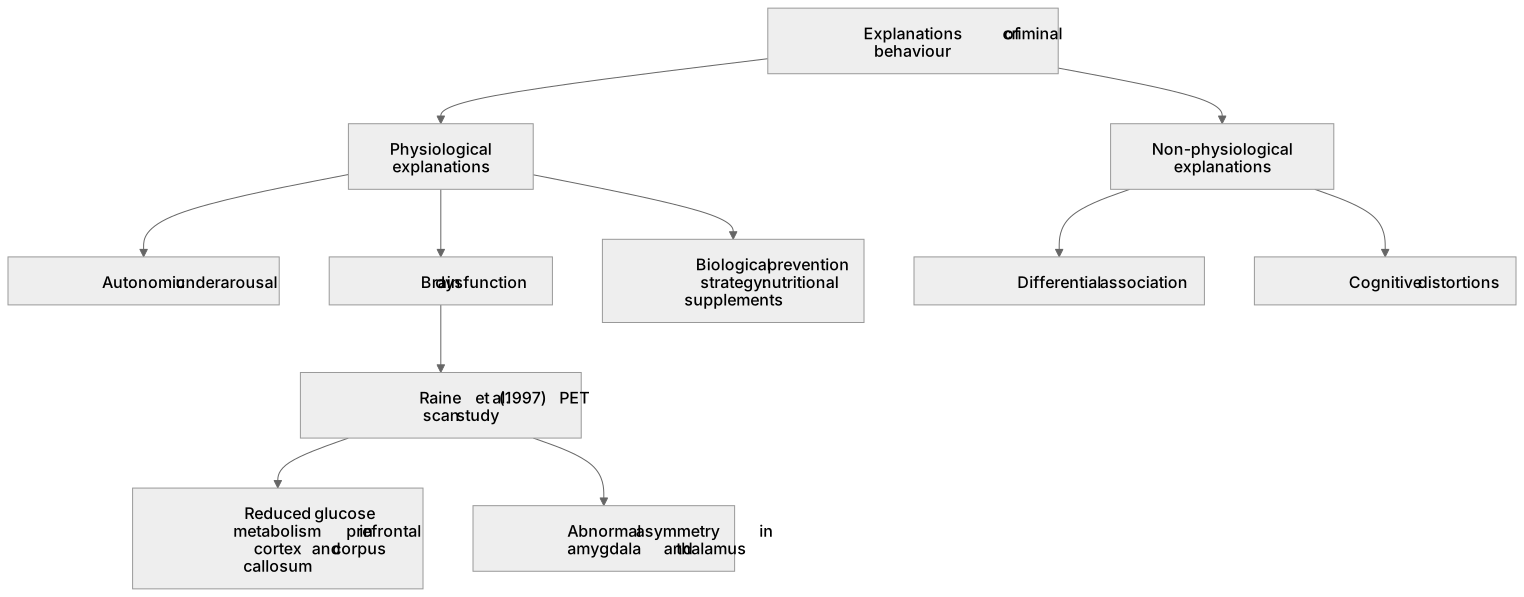
Accounts of criminal behaviour divide into physiological explanations (e.g., autonomic underarousal, brain dysfunction) and non-physiological explanations (e.g., differential association,…
- Point 1 of 6
- 3 key terms
Study notes
From the teaching notes for this specification point.
The idea
Accounts of criminal behaviour divide into physiological explanations (e.g., autonomic underarousal, brain dysfunction) and non-physiological explanations (e.g., differential association, cognitive distortions). Raine et al. (1997) used positron emission tomography (PET) to scan 41 murderers pleading not guilty by reason of insanity, matched to 41 controls (35 healthy, 6 with schizophrenia) on age and sex. During a continuous performance task, offenders showed reduced glucose metabolism in the prefrontal cortex and corpus callosum, alongside abnormal asymmetry in the amygdala and thalamus. Raine cautioned that these findings do not excuse murder or prove biology causes crime.
What earns the marks
- Detailing the matched pairs design: 41 murderers pleading NGRI were matched to 41 controls on age and sex, with the six schizophrenic murderers specifically matched to six schizophrenic controls.
- Precise findings: reduced glucose metabolism in the prefrontal cortex and corpus callosum, and abnormal asymmetry in the amygdala and thalamus (lower left, higher right).
- Contrasting explanations: explaining physiological factors like autonomic underarousal against non-physiological factors such as Sutherland's differential association theory.
- Applying a biological prevention strategy: e.g., Gesch et al.'s (2002) study showing that omega-3, vitamin, and mineral supplements reduced disciplinary incidents in young offenders.
- Evaluation credit for methodological points: PET scans provide correlational data, and the NGRI sample limits generalisability to all offenders.
- Discussing the free will versus determinism debate, specifically how biological determinism impacts the legal concept of criminal responsibility.
Common mistakes and how to put them right
Stating that all 41 controls were healthy.
Put it right: Six of the murderers had schizophrenia, so they were matched with six controls who also had schizophrenia; only the remaining 35 controls were healthy.
Stating that the murderers had structurally damaged brains.
Put it right: The PET scan measured glucose metabolism during a continuous performance task, indicating functional differences, not necessarily structural damage.
Claiming the study proves brain abnormalities cause murder.
Put it right: The research is correlational; abnormalities could result from head injury, substance abuse, or environmental factors rather than causing the behaviour.
Providing a biological prevention strategy without evidence.
Put it right: Support the strategy with a concrete example, such as the nutritional supplementation trial by Gesch et al., rather than just stating 'give them drugs'.
Exam tips
- For procedure questions, ensure you include specific controls, such as the 32-minute continuous performance task and the fluorodeoxyglucose (FDG) tracer injection.
- When evaluating biological explanations, use the reductionism debate to argue that ignoring social and cognitive factors provides an incomplete picture of criminal behaviour.
Try the lesson
The start of the Section B: Option 2 Criminal psychology: What makes a criminal? (Biological) – Physiological and non-physiological explanations of criminal behaviour. Raine et al. (1997) Brain abnormalities in murderers indicated by positron emission tomography. At least one biological strategy for preventing criminal behaviour. lesson, made from teaching notes for this specification point.
Have a go first
According to Raine et al. (1997), which pattern of brain activity was observed in the murderers pleading not guilty by reason of insanity compared to the control group?
Listen
Accounts of criminal behaviour divide into physiological explanations (e.g., autonomic underarousal, brain dysfunction) and non-physiological explanations (e.g., differential association, cognitive distortions). Raine et al. (1997) used positron emission tomography (PET) to scan 41 murderers pleading not guilty by reason of insanity, matched to 41 controls (35 healthy, 6 with schizophrenia) on age and sex. During a continuous performance task, offenders showed reduced glucose metabolism in the prefrontal cortex and corpus callosum, alongside abnormal asymmetry in the amygdala and thalamus. Raine cautioned that these findings do not excuse murder or prove biology causes crime. A strong answer earns marks for these points. detailing the matched pairs design: 41 murderers pleading NGRI were matched to 41 controls on age and sex, with the six schizophrenic murderers specifically matched to six schizophrenic controls. precise findings: reduced glucose metabolism in the prefrontal cortex and corpus callosum, and abnormal asymmetry in the amygdala and thalamus (lower left, higher right). contrasting explanations: explaining physiological factors like autonomic underarousal against non-physiological factors such as Sutherland's differential association theory. applying a biological prevention strategy: e.g., Gesch et al.'s (2002) study showing that omega-3, vitamin, and mineral supplements reduced disciplinary incidents in young offenders. A common slip: Stating that all 41 controls were healthy. Instead, Six of the murderers had schizophrenia, so they were matched with six controls who also had schizophrenia; only the remaining 35 controls were healthy. Exam tip: For procedure questions, ensure you include specific controls, such as the 32-minute continuous performance task and the fluorodeoxyglucose (FDG) tracer injection.
See it
Key words
Say what each word means before you turn the card.
physiological vs non-physiological explanations
Try answering aloud or in your head before turning the card.
biological determinism
Try answering aloud or in your head before turning the card.
matched pairs design
Try answering aloud or in your head before turning the card.
See every definition
- physiological vs non-physiological explanations
- Accounts of criminal behaviour divide into physiological explanations, such as autonomic underarousal and brain dysfunction, and non-physiological explanations, such as differential association and cognitive distortions.
- biological determinism
- A position discussed in the free will versus determinism debate, specifically in terms of how it impacts the legal concept of criminal responsibility.
- matched pairs design
- A design in which 41 murderers pleading NGRI were matched to 41 controls on age and sex, with the six schizophrenic murderers specifically matched to six schizophrenic controls.
Label the diagram
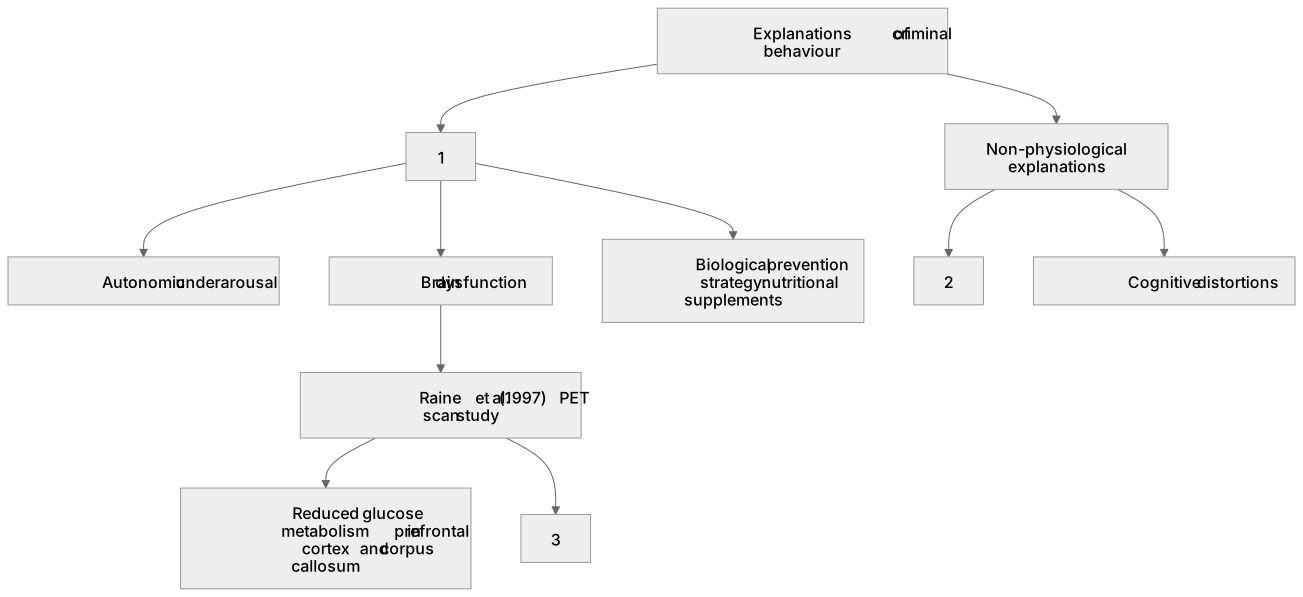
Some boxes have lost their names. Pick the right name for each number.
1Box 1
2Box 2
3Box 3
There is more to this lesson
The full lesson goes on to check your understanding and help you earn the marks. Create a free account to carry on, with your progress saved.
A week of Premium from your first lesson · Then the free plan continues · No card, no charge
Test your understanding of Section B: Option 2 Criminal psychology: What makes a criminal? (Biological) – Physiological and non-physiological explanations of criminal behaviour. Raine et al. (1997) Brain abnormalities in murderers indicated by positron emission tomography. At least one biological strategy for preventing criminal behaviour.
Active recall beats re-reading. Take an instant quiz now to test what you’ve learned and lock it into long-term memory.
A week of Premium from your first lesson · Then the free plan continues · No card, no charge