OCR · A-Level · Psychology
Course version: H567 · Version from Sept 2015
Option 2 Criminal psychology: The collection and processing of forensic…
Full specification wording
Section B: Option 2 Criminal psychology: The collection and processing of forensic evidence (Biological) – Motivating factors and bias in the collection and processing of forensic evidence. Hall and Player (2008) Will the introduction of an emotional context affect fingerprint analysis and decision-making? At least one strategy for reducing bias in the collection and processing of forensic evidence.
A forensic match is a human judgement, vulnerable to role bias and the need for closure.
- Point 2 of 6
- 4 key terms
Study notes
From the teaching notes for this specification point.
The idea
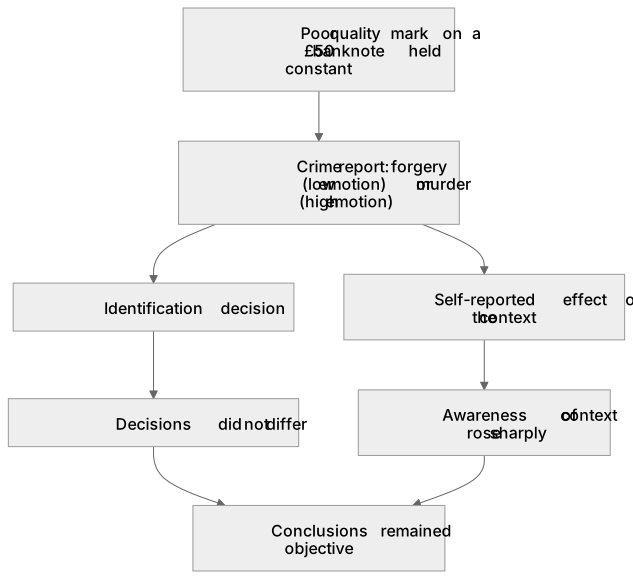
A forensic match is a human judgement, vulnerable to role bias and the need for closure. Although the statement includes '(Biological)', the mechanisms of bias are fundamentally cognitive. Hall and Player gave 70 serving fingerprint experts the same poor quality mark on a £50 banknote along with a crime report describing either a forgery (low emotion) or a murder (high emotion). About half of those given the high emotion report said the context had affected them, against a small minority in the low emotion condition, yet the identification judgements themselves did not differ. Dror found that a majority (4 out of 5) changed their decisions when given misleading context. Strategies to reduce bias include linear sequential unmasking.
What earns the marks
- Naming the manipulated variable as the emotional context of the crime report (forgery vs murder), with the mark held constant, and the measures as the identification decision and the self-reported effect of the context.
- The split result: awareness of context rose sharply while final decisions did not differ, so the conclusion is that the experts' conclusions remained objective.
- Named sources of bias, such as confirmation bias, contextual bias, role bias and reconstructive interpretation of an ambiguous mark.
- Evaluation credit for the strength of using serving experts working to their real procedures, balanced against demand characteristics, since specialists who know they are being studied have every reason to look unbiased.
- Setting the result against Dror's finding that a majority (4 out of 5) of experts reversed identifications when given misleading case context, highlighting the cognitive approach to forensic processing.
Common mistakes and how to put them right
Reporting that emotional context biased the experts' decisions.
Put it right: It changed what they said they felt, not what they concluded, and writing it the wrong way round forfeits the marks for findings.
Treating the self-report of feeling affected as proof of bias.
Put it right: People are poor judges of what influenced them, which is a comment to make about the measure rather than a finding to accept.
Answering 'train examiners better' when asked for a strategy.
Put it right: Say which information is withheld, from whom, and at which stage (e.g., linear sequential unmasking), or there is nothing for the examiner to credit.
Exam tips
- This option likes questions about how psychology explains a failure in the justice system, so keep one named misidentification case ready as supporting context.
- When evaluating the study, the ecological validity point and the demand characteristics point pull against each other; saying so explicitly is what turns description into evaluation.
- Suggest questions here want a procedural fix at the level of laboratory protocol, not advice about individual attitude.
Try the lesson
The start of the Section B: Option 2 Criminal psychology: The collection and processing of forensic evidence (Biological) – Motivating factors and bias in the collection and processing of forensic evidence. Hall and Player (2008) Will the introduction of an emotional context affect fingerprint analysis and decision-making? At least one strategy for reducing bias in the collection and processing of forensic evidence. lesson, made from teaching notes for this specification point.
Have a go first
What was the primary finding of Hall and Player's (2008) study on the effect of emotional context on fingerprint analysis?
Listen
A forensic match is a human judgement, vulnerable to role bias and the need for closure. Although the statement includes '(Biological)', the mechanisms of bias are fundamentally cognitive. Hall and Player gave 70 serving fingerprint experts the same poor quality mark on a £50 banknote along with a crime report describing either a forgery (low emotion) or a murder (high emotion). About half of those given the high emotion report said the context had affected them, against a small minority in the low emotion condition, yet the identification judgements themselves did not differ. Dror found that a majority (4 out of 5) changed their decisions when given misleading context. Strategies to reduce bias include linear sequential unmasking. A strong answer earns marks for these points. naming the manipulated variable as the emotional context of the crime report (forgery vs murder), with the mark held constant, and the measures as the identification decision and the self-reported effect of the context. the split result: awareness of context rose sharply while final decisions did not differ, so the conclusion is that the experts' conclusions remained objective. named sources of bias, such as confirmation bias, contextual bias, role bias and reconstructive interpretation of an ambiguous mark. a strategy with a stated mechanism, such as linear sequential unmasking so the mark is analysed before the suspect print is seen, blind verification by a second examiner, or a case manager who filters what contextual detail reaches the laboratory. A common slip: Reporting that emotional context biased the experts' decisions. Instead, It changed what they said they felt, not what they concluded, and writing it the wrong way round forfeits the marks for findings. Exam tip: This option likes questions about how psychology explains a failure in the justice system, so keep one named misidentification case ready as supporting context.
See it
Key words
Say what each word means before you turn the card.
contextual bias
Try answering aloud or in your head before turning the card.
confirmation bias
Try answering aloud or in your head before turning the card.
blind verification
Try answering aloud or in your head before turning the card.
linear sequential unmasking
Try answering aloud or in your head before turning the card.
See every definition
- contextual bias
- A source of bias in which the surrounding context of a case influences the processing of forensic evidence.
- confirmation bias
- A named source of bias in the collection and processing of forensic evidence, alongside role bias and reconstructive interpretation of an ambiguous mark.
- blind verification
- A strategy for reducing bias in which a second examiner verifies the mark.
- linear sequential unmasking
- A strategy for reducing bias in which the mark is analysed before the suspect print is seen.
Label the diagram
Some boxes have lost their names. Pick the right name for each number.
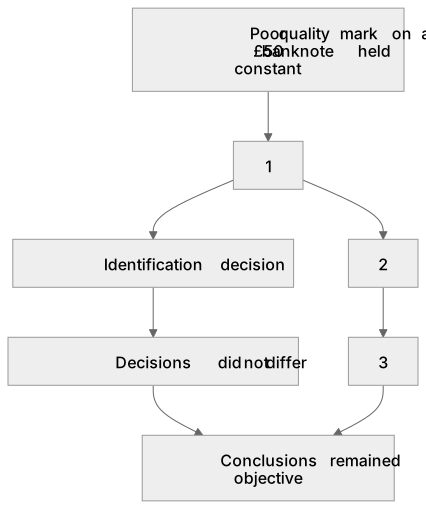
1Box 1
2Box 2
3Box 3
There is more to this lesson
The full lesson goes on to check your understanding and help you earn the marks. Create a free account to carry on, with your progress saved.
A week of Premium from your first lesson · Then the free plan continues · No card, no charge
Test your understanding of Section B: Option 2 Criminal psychology: The collection and processing of forensic evidence (Biological) – Motivating factors and bias in the collection and processing of forensic evidence. Hall and Player (2008) Will the introduction of an emotional context affect fingerprint analysis and decision-making? At least one strategy for reducing bias in the collection and processing of forensic evidence.
Active recall beats re-reading. Take an instant quiz now to test what you’ve learned and lock it into long-term memory.
A week of Premium from your first lesson · Then the free plan continues · No card, no charge