OCR · A-Level · Psychology
Course version: H567 · Version from Sept 2015
Option 3 Environmental psychology: Biological rhythms (Biological) –…
Full specification wording
Section B: Option 3 Environmental psychology: Biological rhythms (Biological) – Biological rhythms and the impact of their disruption on our behaviour. Czeisler et al. (1982) Rotating shift work schedules that disrupt sleep are improved by applying circadian principles. At least one strategy for reducing effects of jetlag or shift work.
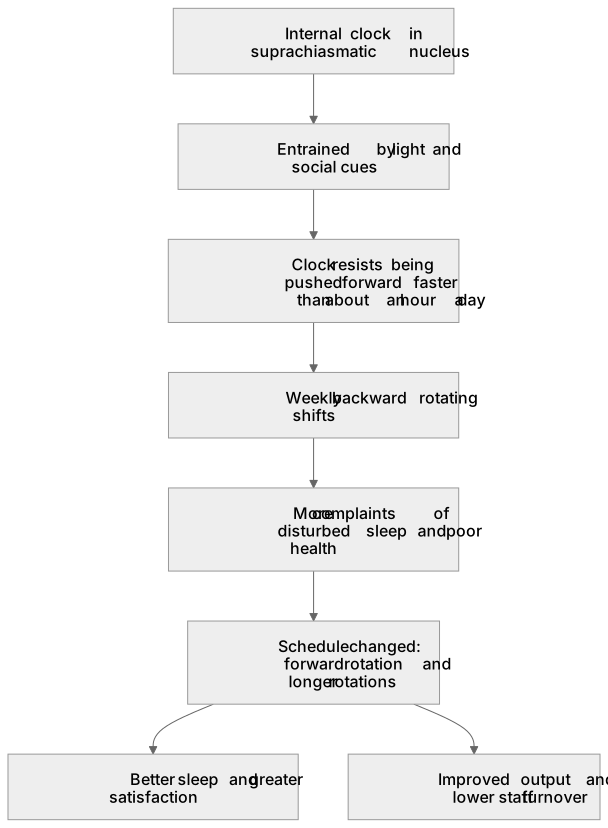
The daily rhythm is driven by an internal clock in the suprachiasmatic nucleus, entrained by light and by social cues, and it resists being pushed forward faster than roughly an hour a day.
- Point 2 of 6
- 4 key terms
Study notes
From the teaching notes for this specification point.
The idea
The daily rhythm is driven by an internal clock in the suprachiasmatic nucleus, entrained by light and by social cues, and it resists being pushed forward faster than roughly an hour a day. Czeisler and colleagues studied workers at a Utah chemical plant on a weekly backward rotating pattern and found far more complaints of disturbed sleep and poor health than among non-rotating workers at the same site. The team then changed the schedule, rotating shifts forward instead of backward and lengthening each rotation, after which workers reported better sleep and greater satisfaction, preferred the longer cycle, and the plant saw improved output and lower staff turnover.
What earns the marks
- Distinguishing the internal pacemaker from external time cues, illustrated by free-running evidence such as Siffre's months underground without clocks.
- Explaining direction of rotation, since a phase delay moving morning to afternoon to night follows the natural drift of the clock while a backward rotation forces a phase advance the body resists.
- The field experiment design with its comparison group of non-rotating workers, and for outcome measures that include productivity and turnover as well as reported sleep.
- Consequences of disruption that go beyond tiredness, such as raised cardiovascular risk among long-serving shift workers and accident risk in the small hours.
- A strategy applied properly, such as timed bright light and melatonin, forward rotation on a longer cycle, or adjusting sleep before eastward travel, with a reason why flying east is harder than flying west.
Common mistakes and how to put them right
Writing that the workers were tested in a laboratory.
Put it right: This ran in a working plant, which is the source of both its strength and its confounds.
Saying jet lag comes from the length of the flight.
Put it right: It comes from crossing time zones and from the direction of travel, and a long journey north to south produces very little of it.
Treating melatonin as a cure without saying when it is taken, since timing decides whether it advances or delays the rhythm.
Exam tips
- Questions ask you to suggest a schedule for a named workforce, so be ready to write a rota with the direction and the rotation length justified.
- Where the command word is evaluate, the sample is the obvious weakness; push further and question whether reported satisfaction is the right outcome measure.
- Learn one disruption of jet lag and one of shift work so that either version of the strategy question can be answered.
Try the lesson
The start of the Section B: Option 3 Environmental psychology: Biological rhythms (Biological) – Biological rhythms and the impact of their disruption on our behaviour. Czeisler et al. (1982) Rotating shift work schedules that disrupt sleep are improved by applying circadian principles. At least one strategy for reducing effects of jetlag or shift work. lesson, made from teaching notes for this specification point.
Have a go first
In Czeisler et al.'s (1982) study on rotating shift work, which schedule change was found to improve sleep and reduce disruption to biological rhythms?
Listen
The daily rhythm is driven by an internal clock in the suprachiasmatic nucleus, entrained by light and by social cues, and it resists being pushed forward faster than roughly an hour a day. Czeisler and colleagues studied workers at a Utah chemical plant on a weekly backward rotating pattern and found far more complaints of disturbed sleep and poor health than among non-rotating workers at the same site. The team then changed the schedule, rotating shifts forward instead of backward and lengthening each rotation, after which workers reported better sleep and greater satisfaction, preferred the longer cycle, and the plant saw improved output and lower staff turnover. A strong answer earns marks for these points. distinguishing the internal pacemaker from external time cues, illustrated by free-running evidence such as Siffre's months underground without clocks. explaining direction of rotation, since a phase delay moving morning to afternoon to night follows the natural drift of the clock while a backward rotation forces a phase advance the body resists. the field experiment design with its comparison group of non-rotating workers, and for outcome measures that include productivity and turnover as well as reported sleep. consequences of disruption that go beyond tiredness, such as raised cardiovascular risk among long-serving shift workers and accident risk in the small hours. Exam tip: Questions ask you to suggest a schedule for a named workforce, so be ready to write a rota with the direction and the rotation length justified.
See it
Key words
Say what each word means before you turn the card.
circadian rhythm
Try answering aloud or in your head before turning the card.
phase delay rotation
Try answering aloud or in your head before turning the card.
field experiment
Try answering aloud or in your head before turning the card.
external time cues
Try answering aloud or in your head before turning the card.
See every definition
- circadian rhythm
- The daily rhythm is driven by an internal clock in the suprachiasmatic nucleus, entrained by light and by social cues.
- phase delay rotation
- A rotation moving morning to afternoon to night follows the natural drift of the clock, while a backward rotation forces a phase advance the body resists.
- field experiment
- The study ran in a working plant with a comparison group of non-rotating workers, and outcome measures included productivity and turnover as well as reported sleep.
- external time cues
- The internal clock is entrained by light and by social cues, and free-running evidence such as Siffre's months underground without clocks distinguishes the internal pacemaker from these cues.
Label the diagram
Some boxes have lost their names. Pick the right name for each number.
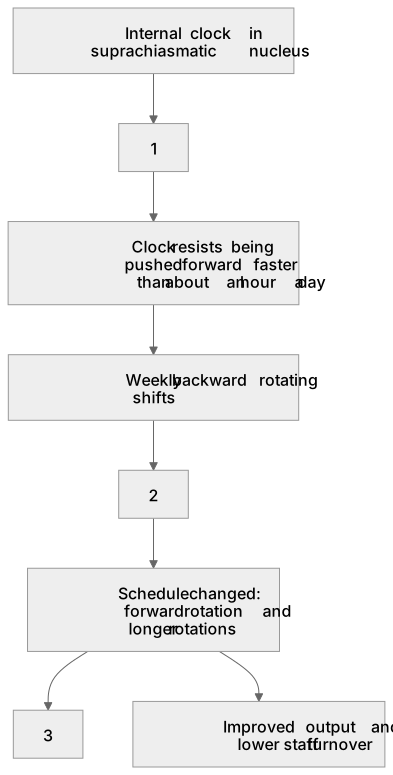
1Box 1
2Box 2
3Box 3
There is more to this lesson
The full lesson goes on to check your understanding and help you earn the marks. Create a free account to carry on, with your progress saved.
A week of Premium from your first lesson · Then the free plan continues · No card, no charge
Test your understanding of Section B: Option 3 Environmental psychology: Biological rhythms (Biological) – Biological rhythms and the impact of their disruption on our behaviour. Czeisler et al. (1982) Rotating shift work schedules that disrupt sleep are improved by applying circadian principles. At least one strategy for reducing effects of jetlag or shift work.
Active recall beats re-reading. Take an instant quiz now to test what you’ve learned and lock it into long-term memory.
A week of Premium from your first lesson · Then the free plan continues · No card, no charge