OCR · A-Level · Psychology
Course version: H567 · Version from Sept 2015
Option 3 Environmental psychology: Ergonomics – human factors (Cognitive)…
Full specification wording
Section B: Option 3 Environmental psychology: Ergonomics – human factors (Cognitive) – Cognitive overload and the impact of observation in the workplace environment. Drews and Doig (2014) Evaluation of a configural vital sign display for intensive care unit nurses. At least one workplace design based on ergonomic research.
Human factors work starts from a limited operator rather than a careless one: attention is selective, working memory holds very little, and a display that forces someone to read numbers and hold…
- Point 4 of 6
- 3 key terms
Study notes
From the teaching notes for this specification point.
The idea
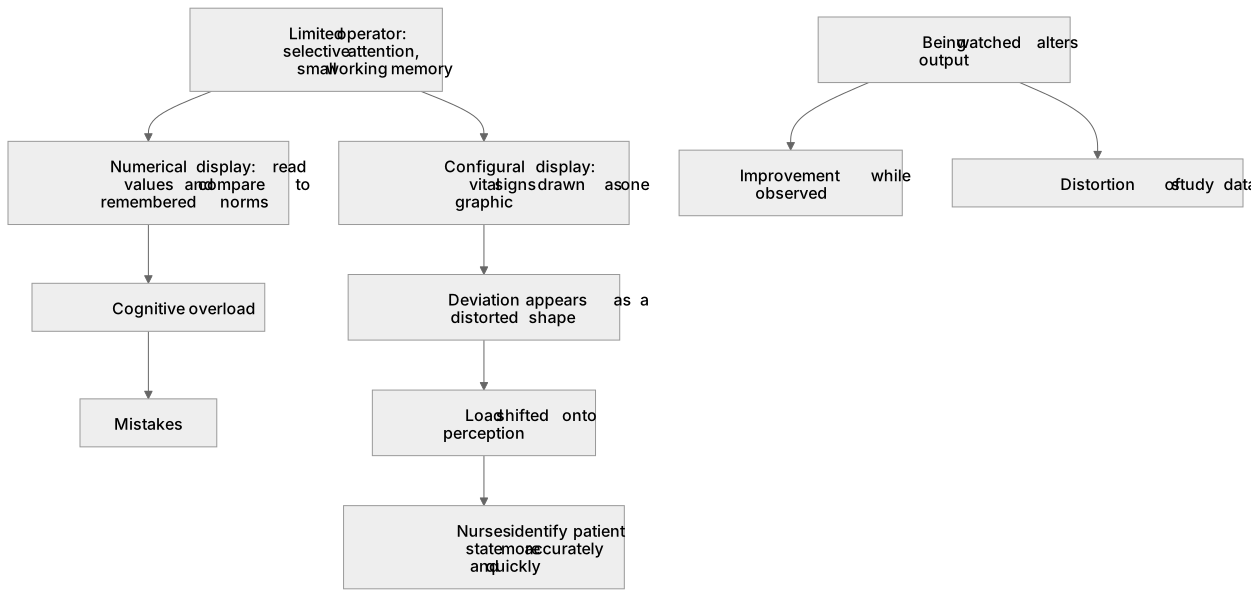
Human factors work starts from a limited operator rather than a careless one: attention is selective, working memory holds very little, and a display that forces someone to read numbers and hold them in mind while comparing them to remembered norms will eventually cost a mistake. Good design shifts that load onto perception, so a deviation appears as a shape rather than as a value to be interpreted. Drews and Doig (2014) tested exactly that claim with intensive care nurses. Alongside the design question sits the observation question, because performance changes when workers know they are watched, which makes observation both a tool for improving safety and a threat to the validity of any study that uses it.
What earns the marks
- Explaining cognitive overload with a mechanism, the limited capacity of attention and working memory and the cost of switching between sources, rather than describing it as having too much to do.
- Naming a real workplace design that came from this research, such as shape coded aircraft controls after wartime cockpit errors, or the redesign of nuclear control room panels after Three Mile Island.
Common mistakes and how to put them right
Saying the new display is better without saying better at what, when the study measured accuracy and response time on scenarios and not survival or error rates on real wards.
Treating a simulated scenario as identical to a live shift, so the alarms, interruptions and fatigue that cause overload in practice are never mentioned.
Describing the Hawthorne effect as a permanent productivity gain, when the interest is in a temporary change caused by attention from researchers.
Exam tips
- Scenario questions hand you a control room, cockpit or ward and ask you to suggest a design change. Anchor the suggestion in a named limit of attention or memory, then say what the operator would see instead.
- When asked to evaluate the key research, use the independent measures design on both sides: it prevents order and practice effects, but introduces potential participant variables between the two groups of nurses.
- If the question asks you to explain how observation affects behaviour in the workplace, answer for both directions, the improvement while watched and the distortion it creates in the data.
Try the lesson
The start of the Section B: Option 3 Environmental psychology: Ergonomics – human factors (Cognitive) – Cognitive overload and the impact of observation in the workplace environment. Drews and Doig (2014) Evaluation of a configural vital sign display for intensive care unit nurses. At least one workplace design based on ergonomic research. lesson, made from teaching notes for this specification point.
Have a go first
What was the primary aim of the configural vital sign display evaluated by Drews and Doig (2014) for intensive care unit nurses?
Listen
Human factors work starts from a limited operator rather than a careless one: attention is selective, working memory holds very little, and a display that forces someone to read numbers and hold them in mind while comparing them to remembered norms will eventually cost a mistake. Good design shifts that load onto perception, so a deviation appears as a shape rather than as a value to be interpreted. Drews and Doig (2014) tested exactly that claim with intensive care nurses. Alongside the design question sits the observation question, because performance changes when workers know they are watched, which makes observation both a tool for improving safety and a threat to the validity of any study that uses it. A strong answer earns marks for these points. the design of the key research: intensive care nurses saw clinical scenarios using an independent measures design, where they used either their usual numerical monitor display or a configural display that draws the vital signs together as one graphic whose shape distorts when a value leaves the normal range. the outcome measures and the result, that nurses identified the patient state more accurately and more quickly from the configural display and rated it as preferable, which supports the claim that pattern recognition costs less than arithmetic. Explaining cognitive overload with a mechanism, the limited capacity of attention and working memory and the cost of switching between sources, rather than describing it as having too much to do. Using the observation strand precisely: the Hawthorne research is cited for the claim that being studied alters output, and a strong answer notes that the original records have been reanalysed and the effect is far less clean than the textbook version. Exam tip: Scenario questions hand you a control room, cockpit or ward and ask you to suggest a design change. Anchor the suggestion in a named limit of attention or memory, then say what the operator would see instead.
See it
Key words
Say what each word means before you turn the card.
cognitive overload
Try answering aloud or in your head before turning the card.
display design and pattern perception
Try answering aloud or in your head before turning the card.
observation and reactivity
Try answering aloud or in your head before turning the card.
See every definition
- cognitive overload
- A state arising from the limited capacity of attention and working memory and the cost of switching between sources, rather than simply having too much to do.
- display design and pattern perception
- Design that shifts load onto perception, so a deviation appears as a shape rather than as a value to be interpreted.
- observation and reactivity
- Performance changes when workers know they are watched, making observation both a tool for improving safety and a threat to the validity of any study that uses it.
Label the diagram
Some boxes have lost their names. Pick the right name for each number.
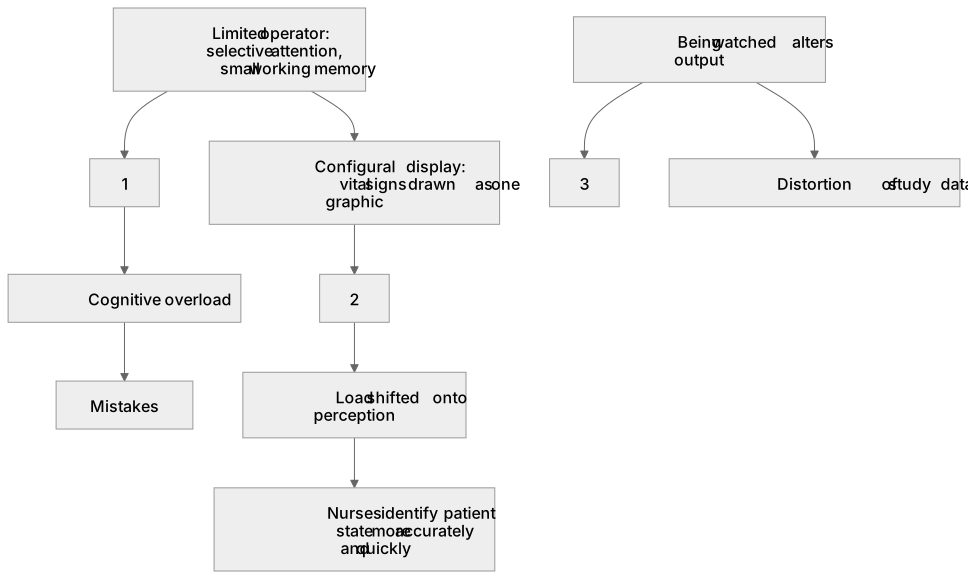
1Box 1
2Box 2
3Box 3
There is more to this lesson
The full lesson goes on to check your understanding and help you earn the marks. Create a free account to carry on, with your progress saved.
A week of Premium from your first lesson · Then the free plan continues · No card, no charge
Test your understanding of Section B: Option 3 Environmental psychology: Ergonomics – human factors (Cognitive) – Cognitive overload and the impact of observation in the workplace environment. Drews and Doig (2014) Evaluation of a configural vital sign display for intensive care unit nurses. At least one workplace design based on ergonomic research.
Active recall beats re-reading. Take an instant quiz now to test what you’ve learned and lock it into long-term memory.
A week of Premium from your first lesson · Then the free plan continues · No card, no charge