OCR · A-Level · Psychology
Course version: H567 · Version from Sept 2015
Option 3 Environmental psychology: Psychological effects of built…
Full specification wording
Section B: Option 3 Environmental psychology: Psychological effects of built environment (Social) – The impact of the built environment and urban renewal on our wellbeing. Ulrich (1984) View through a window may influence recovery from surgery. At least one example of environmental design used to improve health/wellbeing.
The claim under test is that buildings are not neutral containers: layout, light, height, noise and what a window looks onto all feed into stress, mood and recovery.
- Point 5 of 6
Study notes
From the teaching notes for this specification point.
The idea
The claim under test is that buildings are not neutral containers: layout, light, height, noise and what a window looks onto all feed into stress, mood and recovery. Two ideas do most of the work. Stress recovery theory says a natural scene lowers physiological arousal within minutes. Defensible space theory suggests that estates giving residents sight lines and ownership of the ground outside their doors are policed by the residents themselves, which is theorised to explain why some post-war high-rise urban renewal schemes produced fear rather than improvement. The prescribed hospital records study turned this from an argument about taste into one about days in a bed and doses of a drug, and it helped introduce evidence-based design into hospital briefs.
What earns the marks
- Reporting all three outcomes rather than one: a shorter postoperative stay for the tree view group by roughly a day, fewer moderate and strong painkiller doses, and fewer negative comments in the nursing notes.
- Evaluation that names a confound, for instance that nurses writing the notes could see the view, which makes that measure vulnerable in a way the discharge date is not.
- A debate point aimed at content: environmental determinism overstates the case if the design is treated as the cause of recovery, since the same view does nothing for a patient who never looks out of it.
Common mistakes and how to put them right
Calling the study a true experiment.
Put it right: Nobody allocated patients to a view, so it is a natural or quasi-experiment and causal language has to be hedged.
Remembering only the length of stay and losing the analgesic and nursing note findings, which are the results that make the stress explanation plausible.
Writing that nature is good for people as the whole answer, with no mechanism such as reduced physiological arousal or restored attention.
Treating urban renewal as automatically harmful, when the research question is which features of a scheme, not whether new buildings are bad.
Exam tips
- Questions often ask you to suggest how a named building could be improved. Pick two features, say which psychological outcome each targets, and say how you would measure the outcome.
- For evaluation, note that the study only used records from May to October when the trees were in foliage; this seasonal restriction limits generalisability to winter months.
- If asked to discuss usefulness, point to how far this single study moved hospital design, then note the cost argument that a view is easier to recommend than to retrofit.
Try the lesson
The start of the Section B: Option 3 Environmental psychology: Psychological effects of built environment (Social) – The impact of the built environment and urban renewal on our wellbeing. Ulrich (1984) View through a window may influence recovery from surgery. At least one example of environmental design used to improve health/wellbeing. lesson, made from teaching notes for this specification point.
Have a go first
What was the main finding of Ulrich's (1984) study regarding patients recovering from surgery?
Listen
The claim under test is that buildings are not neutral containers: layout, light, height, noise and what a window looks onto all feed into stress, mood and recovery. Two ideas do most of the work. Stress recovery theory says a natural scene lowers physiological arousal within minutes. Defensible space theory suggests that estates giving residents sight lines and ownership of the ground outside their doors are policed by the residents themselves, which is theorised to explain why some post-war high-rise urban renewal schemes produced fear rather than improvement. The prescribed hospital records study turned this from an argument about taste into one about days in a bed and doses of a drug, and it helped introduce evidence-based design into hospital briefs. A strong answer earns marks for these points. the matched pairs method: patients recovering from gall bladder surgery in the same hospital were paired on age, sex, weight, smoking and other variables and differed in whether their window faced a small stand of trees or a brown brick wall. reporting all three outcomes rather than one: a shorter postoperative stay for the tree view group by roughly a day, fewer moderate and strong painkiller doses, and fewer negative comments in the nursing notes. Evaluation that names a confound, for instance that nurses writing the notes could see the view, which makes that measure vulnerable in a way the discharge date is not. Naming a design used to improve wellbeing and saying what it targets, such as a hospital courtyard garden or biophilic planting aimed at stress reduction, single rooms aimed at sleep and infection, or defensible space features aimed at fear of crime. Exam tip: Questions often ask you to suggest how a named building could be improved. Pick two features, say which psychological outcome each targets, and say how you would measure the outcome.
See it
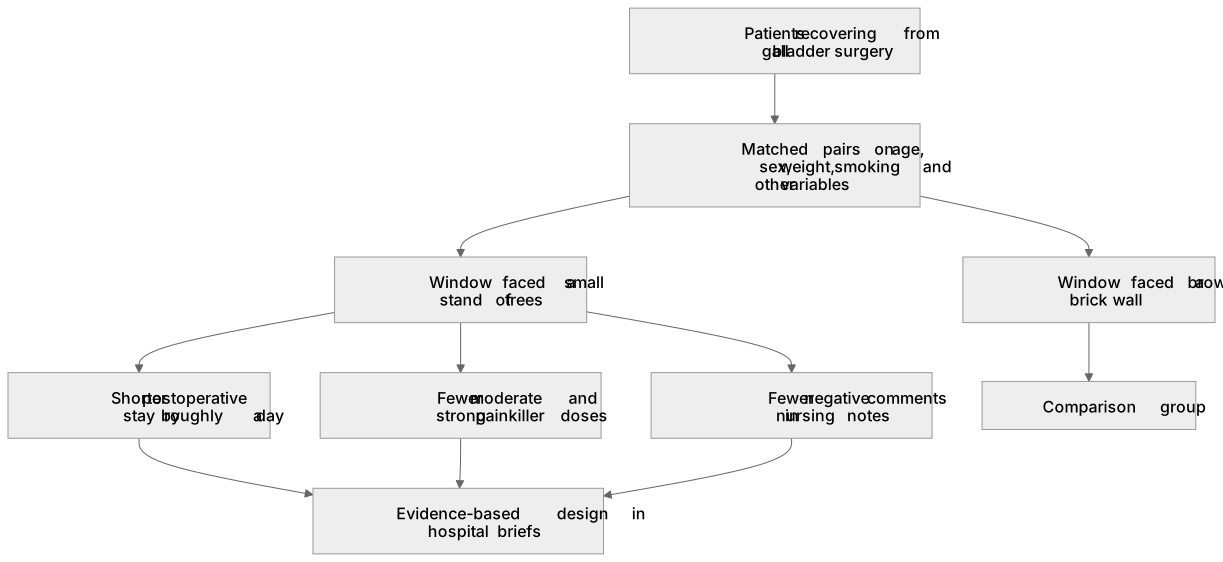
Label the diagram
Some boxes have lost their names. Pick the right name for each number.
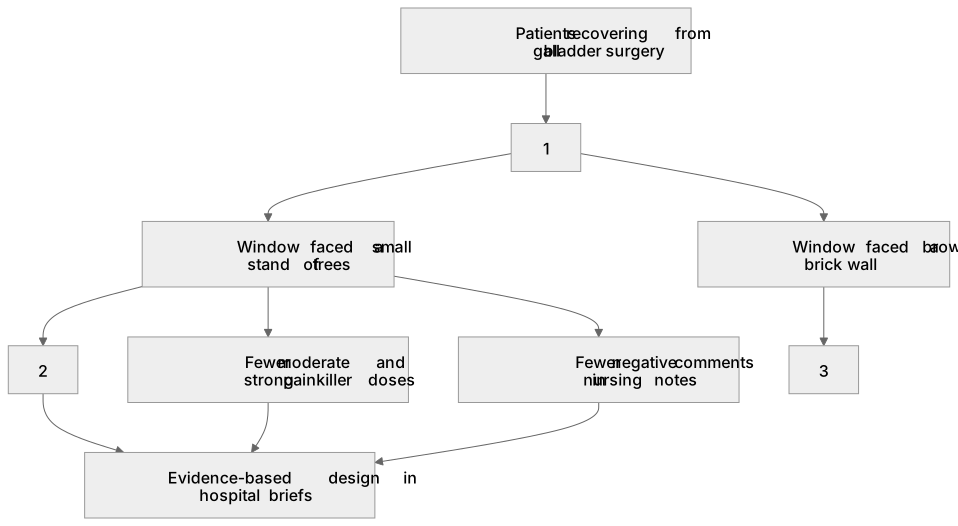
1Box 1
2Box 2
3Box 3
There is more to this lesson
The full lesson goes on to check your understanding and help you earn the marks. Create a free account to carry on, with your progress saved.
A week of Premium from your first lesson · Then the free plan continues · No card, no charge
Test your understanding of Section B: Option 3 Environmental psychology: Psychological effects of built environment (Social) – The impact of the built environment and urban renewal on our wellbeing. Ulrich (1984) View through a window may influence recovery from surgery. At least one example of environmental design used to improve health/wellbeing.
Active recall beats re-reading. Take an instant quiz now to test what you’ve learned and lock it into long-term memory.
A week of Premium from your first lesson · Then the free plan continues · No card, no charge