OCR · A-Level · Psychology
Course version: H567 · Version from Sept 2015
Practical applications: In order to encourage awareness of practical…
Full specification wording
Section C: Practical applications: In order to encourage awareness of practical applications of psychology, this section will require learners to apply their knowledge and understanding of psychology to a novel source as provided in the examination. The source could be a newspaper or magazine article, a blog, a diary entry, email exchange or equivalent written source.
Learners must apply their knowledge and understanding of psychology to a novel source provided in the examination to encourage awareness of practical applications of psychology.
- Point 1 of 2
- 3 key terms
Study notes
From the teaching notes for this specification point.
The idea
Learners must apply their knowledge and understanding of psychology to a novel source provided in the examination to encourage awareness of practical applications of psychology. The source could be a newspaper or magazine article, a blog, a diary entry, an email exchange, or an equivalent written source. Read the text analytically to identify the relevant psychological area, perspective, or core study. For example, a blog about a child copying behaviour links to observational learning. Avoid merely paraphrasing the passage; instead, explicitly connect specific quotes to psychological concepts like modelling or context-dependent retrieval to demonstrate true application.
What earns the marks
- Recognising content depends on linking a detail in the novel source to a named psychological idea, so quote or refer to the line and then state the process.
- Naming the area or perspective the material belongs to, and justifying that choice from the passage, demonstrates applied knowledge and understanding of psychology.
- Where a suggestion is asked for, provide a workable action tied to evidence, stating what would be done, by whom, and on what basis.
- Using the specific wording of the newspaper or magazine article, blog, diary entry, email exchange or equivalent written source throughout ensures the answer remains applied.
Common mistakes and how to put them right
Summarising the article. Correction: Instead of retelling the source, explicitly link specific quotes to psychological theories or studies.
Writing about a study at length and only mentioning the source in the final sentence.
Put it right: Integrate the source material throughout the response to maintain focus on application.
Inventing psychological content not present in the passage.
Put it right: Only apply concepts that directly relate to the provided text, ensuring the link is clearly justified.
Exam tips
- Read the source once for sense and once with a pen, underlining every behaviour, emotion, or situation you can attach to a studied topic.
- Plan your time effectively; spend a couple of minutes analysing the source and then write your response without needing to reread it in full. Expect complex source material and address it systematically.
Try the lesson
The start of the Section C: Practical applications: In order to encourage awareness of practical applications of psychology, this section will require learners to apply their knowledge and understanding of psychology to a novel source as provided in the examination. The source could be a newspaper or magazine article, a blog, a diary entry, email exchange or equivalent written source. lesson, made from teaching notes for this specification point.
Have a go first
Read the following diary entry: "I felt so anxious giving my presentation today. Even though I knew the material, my heart was racing and my hands were shaking the entire time." Which psychological concept is most clearly demonstrated in this source?
Listen
Learners must apply their knowledge and understanding of psychology to a novel source provided in the examination to encourage awareness of practical applications of psychology. The source could be a newspaper or magazine article, a blog, a diary entry, an email exchange, or an equivalent written source. Read the text analytically to identify the relevant psychological area, perspective, or core study. For example, a blog about a child copying behaviour links to observational learning. Avoid merely paraphrasing the passage; instead, explicitly connect specific quotes to psychological concepts like modelling or context-dependent retrieval to demonstrate true application. A strong answer earns marks for these points. recognising content depends on linking a detail in the novel source to a named psychological idea, so quote or refer to the line and then state the process. Naming the area or perspective the material belongs to, and justifying that choice from the passage, demonstrates applied knowledge and understanding of psychology. Where a suggestion is asked for, provide a workable action tied to evidence, stating what would be done, by whom, and on what basis. Using the specific wording of the newspaper or magazine article, blog, diary entry, email exchange or equivalent written source throughout ensures the answer remains applied. A common slip: Writing about a study at length and only mentioning the source in the final sentence. Instead, Integrate the source material throughout the response to maintain focus on application. Exam tip: Read the source once for sense and once with a pen, underlining every behaviour, emotion, or situation you can attach to a studied topic.
See it
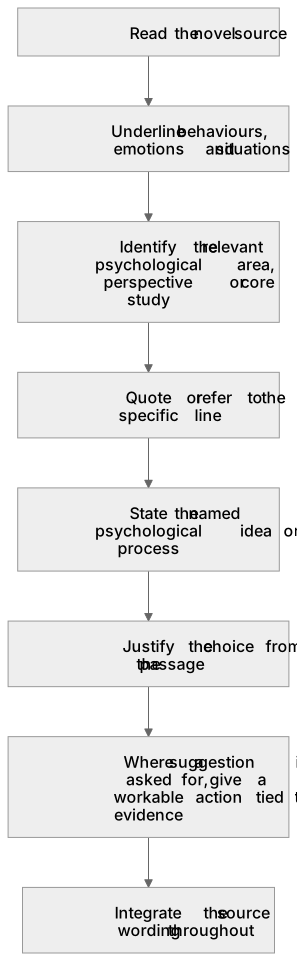
Put it in order
Put these steps in the order they happen.
- 1. State the named psychological idea or process
- 2. Integrate the source wording throughout
- 3. Justify the choice from the passage
- 4. Read the novel source
- 5. Underline behaviours, emotions and situations
- 6. Where a suggestion is asked for, give a workable action tied to evidence
- 7. Identify the relevant psychological area, perspective or core study
- 8. Quote or refer to the specific line
Key words
Say what each word means before you turn the card.
novel source material
Try answering aloud or in your head before turning the card.
applying psychology
Try answering aloud or in your head before turning the card.
identifying psychological content
Try answering aloud or in your head before turning the card.
See every definition
- novel source material
- A newspaper or magazine article, a blog, a diary entry, an email exchange or equivalent written source provided in the examination.
- applying psychology
- Linking a detail in the novel source to a named psychological idea by quoting or referring to the line and then stating the process, rather than merely paraphrasing the passage.
- identifying psychological content
- Reading the text analytically to identify the relevant psychological area, perspective or core study, and justifying that choice from the passage.
Label the diagram
Some boxes have lost their names. Pick the right name for each number.
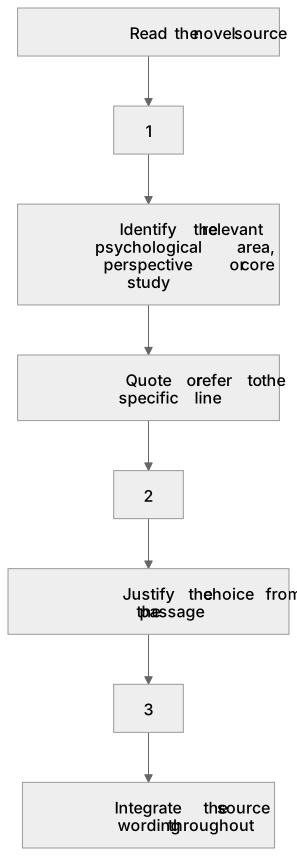
1Box 1
2Box 2
3Box 3
There is more to this lesson
The full lesson goes on to check your understanding and help you earn the marks. Create a free account to carry on, with your progress saved.
A week of Premium from your first lesson · Then the free plan continues · No card, no charge
Test your understanding of Section C: Practical applications: In order to encourage awareness of practical applications of psychology, this section will require learners to apply their knowledge and understanding of psychology to a novel source as provided in the examination. The source could be a newspaper or magazine article, a blog, a diary entry, email exchange or equivalent written source.
Active recall beats re-reading. Take an instant quiz now to test what you’ve learned and lock it into long-term memory.
A week of Premium from your first lesson · Then the free plan continues · No card, no charge