OCR · A-Level · Psychology
Course version: H567 · Version from Sept 2015
Practical applications: The practical applications of psychology:…
Full specification wording
Section C: Practical applications: The practical applications of psychology: Recognise the psychological content in the source. Make evidence-based suggestions in relation to the source. Consider the strengths and weaknesses of the suggestion(s) they themselves are making.
The practical applications of psychology involve three distinct steps.
- Point 2 of 2
- 3 key terms
Study notes
From the teaching notes for this specification point.
The idea
The practical applications of psychology involve three distinct steps. First, recognise the psychological content in the source by naming the underlying process. Second, make evidence-based suggestions in relation to the source. For example, propose a token economy for classroom rules, or suggest the cognitive interview (Fisher and Geiselman, 1992) to improve witness recall, noting that Loftus and Palmer (1974) provide the rationale against leading questions. Third, consider the strengths and weaknesses of the suggestion(s) they themselves are making. Evaluate your own idea by discussing practical costs, ethical implications, and how the effectiveness of the intervention would be measured.
What earns the marks
- A suggestion is strengthened when the psychology inside it is visible; state the principle, the procedure, and the expected change to make evidence-based suggestions in relation to the source.
- Evidence-based means explicitly naming the research the idea rests on (e.g., Fisher and Geiselman for the cognitive interview) and what that research found.
- Consider the strengths and weaknesses of the suggestion(s) they themselves are making by covering practicality, cost, time, ethics, or long-term effectiveness.
- Explaining how the effect would be measured, such as a behaviour count before and after, demonstrates that the suggestion is workable and addresses the strengths and weaknesses.
Common mistakes and how to put them right
Evaluating the original study instead of the suggestion.
Put it right: Focus on the strengths and weaknesses of your own proposed intervention, not the classic experiment it is based on.
Offering advice with no psychological basis.
Put it right: Ensure every suggestion is explicitly tied to psychological research or theory to make it evidence-based.
Producing only strengths in the evaluation.
Put it right: Provide a balanced evaluation by including weaknesses such as cost, effort, or potential lack of long-term adherence.
Exam tips
- Structure your answer to match the requirements: recognise the psychological content in the source, make a suggestion, and then evaluate it, ensuring all parts are addressed.
- When evaluating your suggestion, apply it directly to the situation in the source, questioning whether the specific individuals involved could realistically carry it out. High-level critical thinking is expected.
Try the lesson
The start of the Section C: Practical applications: The practical applications of psychology: Recognise the psychological content in the source. Make evidence-based suggestions in relation to the source. Consider the strengths and weaknesses of the suggestion(s) they themselves are making. lesson, made from teaching notes for this specification point.
Have a go first
When evaluating a novel source article in applied psychology, which action represents the first essential step before making evidence-based suggestions?
Listen
The practical applications of psychology involve three distinct steps. First, recognise the psychological content in the source by naming the underlying process. Second, make evidence-based suggestions in relation to the source. For example, propose a token economy for classroom rules, or suggest the cognitive interview (Fisher and Geiselman, 1992) to improve witness recall, noting that Loftus and Palmer (1974) provide the rationale against leading questions. Third, consider the strengths and weaknesses of the suggestion(s) they themselves are making. Evaluate your own idea by discussing practical costs, ethical implications, and how the effectiveness of the intervention would be measured. A strong answer earns marks for these points. A suggestion is strengthened when the psychology inside it is visible; state the principle, the procedure, and the expected change to make evidence-based suggestions in relation to the source. Evidence-based means explicitly naming the research the idea rests on (e.g., Fisher and Geiselman for the cognitive interview) and what that research found. Consider the strengths and weaknesses of the suggestion(s) they themselves are making by covering practicality, cost, time, ethics, or long-term effectiveness. Explaining how the effect would be measured, such as a behaviour count before and after, demonstrates that the suggestion is workable and addresses the strengths and weaknesses. A common slip: Evaluating the original study instead of the suggestion. Instead, Focus on the strengths and weaknesses of your own proposed intervention, not the classic experiment it is based on. Exam tip: Structure your answer to match the requirements: recognise the psychological content in the source, make a suggestion, and then evaluate it, ensuring all parts are addressed.
See it
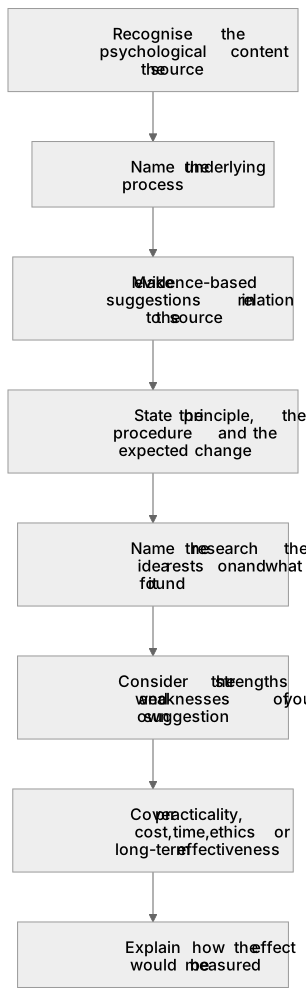
Put it in order
Put these steps in the order they happen.
- 1. Name the research the idea rests on and what it found
- 2. Explain how the effect would be measured
- 3. Consider the strengths and weaknesses of your own suggestion
- 4. Recognise the psychological content in the source
- 5. Name the underlying process
- 6. Cover practicality, cost, time, ethics or long-term effectiveness
- 7. Make evidence-based suggestions in relation to the source
- 8. State the principle, the procedure and the expected change
Key words
Say what each word means before you turn the card.
evidence-based suggestions
Try answering aloud or in your head before turning the card.
self-evaluation
Try answering aloud or in your head before turning the card.
practical applications
Try answering aloud or in your head before turning the card.
See every definition
- evidence-based suggestions
- Suggestions made in relation to the source that explicitly name the research the idea rests on and what that research found.
- self-evaluation
- Considering the strengths and weaknesses of the suggestion(s) they themselves are making, covering practicality, cost, time, ethics, or long-term effectiveness.
- practical applications
- Recognising the psychological content in the source, making evidence-based suggestions in relation to the source, and considering the strengths and weaknesses of the suggestion(s) they themselves are making.
Label the diagram
Some boxes have lost their names. Pick the right name for each number.
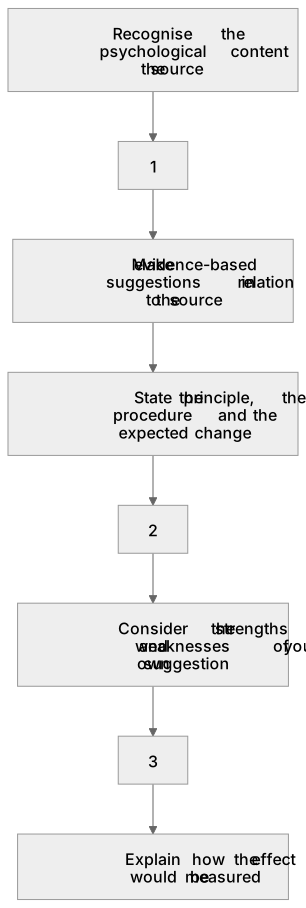
1Box 1
2Box 2
3Box 3
There is more to this lesson
The full lesson goes on to check your understanding and help you earn the marks. Create a free account to carry on, with your progress saved.
A week of Premium from your first lesson · Then the free plan continues · No card, no charge
Test your understanding of Section C: Practical applications: The practical applications of psychology: Recognise the psychological content in the source. Make evidence-based suggestions in relation to the source. Consider the strengths and weaknesses of the suggestion(s) they themselves are making.
Active recall beats re-reading. Take an instant quiz now to test what you’ve learned and lock it into long-term memory.
A week of Premium from your first lesson · Then the free plan continues · No card, no charge