AQA · GCSE · Religious Studies
Course version: 8062 · Version from Sept 2018
Beliefs and teachings: Tawhid (the Oneness of God), Qur’an Surah 112.
Tawhid is the fundamental Islamic belief in the absolute oneness, indivisibility, and uniqueness of God (Allah).
Checked against the AQA 8062 specification (opens in a new tab) on .
- Point 3 of 13
- 4 key terms
Study notes
From the checked teaching notes for this specification point.
The idea
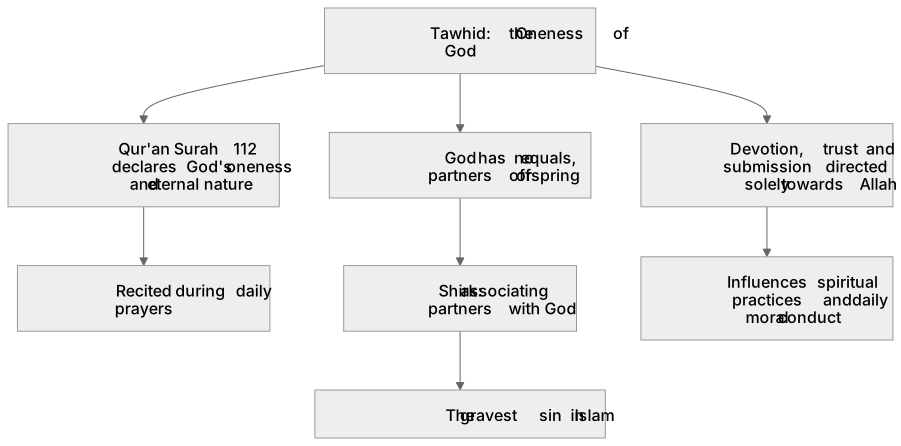
Tawhid is the fundamental Islamic belief in the absolute oneness, indivisibility, and uniqueness of God (Allah). It dictates that God has no equals, partners, or offspring, making the association of partners with God (shirk) the gravest sin in Islam. This core doctrine is perfectly encapsulated in Qur'an Surah 112 (Surah Al-Ikhlas), which Muslims frequently recite during daily prayers. The Surah explicitly declares: "He is God the One, God the eternal. He begot no one nor was He begotten. No one is comparable to Him." Understanding Tawhid shapes a Muslim's entire worldview, ensuring their ultimate devotion, trust, and submission are directed solely towards Allah, influencing both their spiritual practices and daily moral conduct.
What earns the marks
- Define Tawhid as the absolute oneness and unity of Allah.
- Explain how Tawhid influences Muslim behaviour, such as avoiding shirk (idolatry) and submitting entirely to God's will.
- Quote or paraphrase Qur'an Surah 112 to support explanations of God's nature (for example, "He begot no one nor was He begotten").
- Analyse the significance of Surah 112 in daily worship and its role in reinforcing the concept of Tawhid.
Common mistakes and how to put them right
Confusing Tawhid with general monotheism without mentioning the specific indivisibility of Allah.
Put it right: Emphasise that Tawhid specifically rejects any partners, equals, or offspring, making it strictly anti-trinitarian.
Misidentifying or misquoting Surah 112.
Put it right: Ensure Surah 112 is specifically linked to the declaration of God's oneness and eternal nature, not general moral laws.
Stating that shirk is a minor sin.
Put it right: Clearly identify shirk (associating partners with God) as the most severe, unforgivable sin in Islam if not repented before death.
Exam tips
- Memorise at least one specific phrase from Surah 112, such as 'He is God the One', to use as a direct source of authority.
- When evaluating the importance of Tawhid, link it to practical actions, such as why Muslims do not use images of God in mosques.
- Use the term 'shirk' when explaining the opposite of Tawhid to demonstrate strong subject vocabulary.
Try the lesson
The start of the Beliefs and teachings: Tawhid (the Oneness of God), Qur’an Surah 112. lesson, made from checked teaching notes for this specification point.
Have a go first
What is the central message of Qur'an Surah 112 regarding the nature of God (Tawhid)?
Listen
Tawhid is the fundamental Islamic belief in the absolute oneness, indivisibility, and uniqueness of God (Allah). It dictates that God has no equals, partners, or offspring, making the association of partners with God (shirk) the gravest sin in Islam. This core doctrine is perfectly encapsulated in Qur'an Surah 112 (Surah Al-Ikhlas), which Muslims frequently recite during daily prayers. The Surah explicitly declares: "He is God the One, God the eternal. He begot no one nor was He begotten. No one is comparable to Him. Understanding Tawhid shapes a Muslim's entire worldview, ensuring their ultimate devotion, trust, and submission are directed solely towards Allah, influencing both their spiritual practices and daily moral conduct. A strong answer earns marks for these points. Define Tawhid as the absolute oneness and unity of Allah. Explain how Tawhid influences Muslim behaviour, such as avoiding shirk (idolatry) and submitting entirely to God's will. Quote or paraphrase Qur'an Surah 112 to support explanations of God's nature (for example, "He begot no one nor was He begotten"). Analyse the significance of Surah 112 in daily worship and its role in reinforcing the concept of Tawhid. A common slip: Confusing Tawhid with general monotheism without mentioning the specific indivisibility of Allah. Instead, Emphasise that Tawhid specifically rejects any partners, equals, or offspring, making it strictly anti-trinitarian. Exam tip: Memorise at least one specific phrase from Surah 112, such as 'He is God the One', to use as a direct source of authority.
See it
Key words
Say what each word means before you turn the card.
Tawhid
Try answering aloud or in your head before turning the card.
Shirk
Try answering aloud or in your head before turning the card.
Sources of Authority
Try answering aloud or in your head before turning the card.
Submission and Worship
Try answering aloud or in your head before turning the card.
See every definition
- Tawhid
- The fundamental Islamic belief in the absolute oneness, indivisibility, and uniqueness of God (Allah).
- Shirk
- The association of partners with God, which is the gravest sin in Islam.
- Sources of Authority
- Qur'an Surah 112, which Muslims frequently recite during daily prayers and which declares God's oneness and eternal nature.
- Submission and Worship
- Ultimate devotion, trust, and submission directed solely towards Allah, influencing both spiritual practices and daily moral conduct.
Label the diagram
Some boxes have lost their names. Pick the right name for each number.
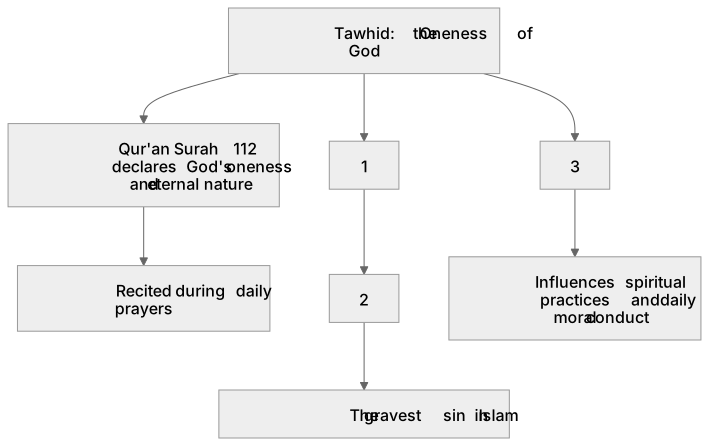
1Box 1
2Box 2
3Box 3
There is more to this lesson
The full lesson goes on to check your understanding and help you earn the marks. Create a free account to carry on, with your progress saved.
A week of Premium from your first lesson · Then the free plan continues · No card, no charge
Test your understanding of Beliefs and teachings: Tawhid (the Oneness of God), Qur’an Surah 112.
Active recall beats re-reading. Take an instant quiz now to test what you’ve learned and lock it into long-term memory.
A week of Premium from your first lesson · Then the free plan continues · No card, no charge