AQA · GCSE · Religious Studies
Course version: 8062 · Version from Sept 2018
The nature of God: omnipotence, beneficence, mercy, fairness and…
Full specification wording
Beliefs and teachings: The nature of God: omnipotence, beneficence, mercy, fairness and justice/Adalat in Shi’a Islam, including different ideas about God’s relationship with the world: immanence and transcendence.
Muslims believe Allah possesses supreme attributes, including omnipotence (all-powerful), beneficence (all-loving), and mercy (compassionate and forgiving).
Checked against the AQA 8062 specification (opens in a new tab) on .
- Point 4 of 13
- 4 key terms
Study notes
From the checked teaching notes for this specification point.
The idea
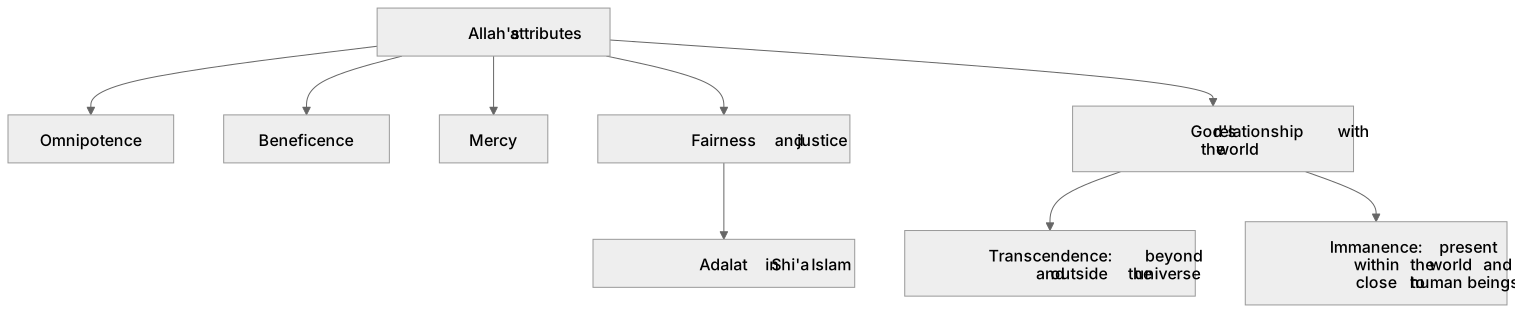
Muslims believe Allah possesses supreme attributes, including omnipotence (all-powerful), beneficence (all-loving), and mercy (compassionate and forgiving). A key distinction arises in Shi'a Islam, which emphasises Adalat (divine justice), teaching that God is inherently fair and holds humans accountable for their moral choices. God's relationship with the universe is understood through two contrasting but complementary concepts: transcendence and immanence. Transcendence means God is beyond and outside the physical universe, not limited by time or space. Conversely, immanence means God is intimately present within the world and close to human beings, as illustrated by the Qur'anic teaching that Allah is closer than a jugular vein.
What earns the marks
- Define omnipotence, beneficence, and mercy as core attributes of Allah that provide comfort and demand respect from Muslims.
- Explain Adalat as a fundamental Root of Religion in Shi'a Islam, representing God's perfect justice and fairness.
- Distinguish between transcendence (God being outside the universe and beyond human comprehension) and immanence (God being present and involved in the world).
- Apply these attributes to Muslim life, showing how belief in a merciful God encourages repentance, while belief in a just God encourages moral behaviour.
Common mistakes and how to put them right
Treating Adalat as a core belief in both Sunni and Shi'a Islam equally.
Put it right: Specify that while all Muslims believe God is just, Adalat is specifically categorised as one of the Five Roots of Usul ad-Din in Shi'a Islam.
Claiming transcendence and immanence are contradictory and cannot both be true.
Put it right: Explain that in Islam, God is uniquely both beyond the universe (transcendent) and intimately close to creation (immanent).
Defining beneficence merely as 'powerful'.
Put it right: Define beneficence accurately as God's all-loving, all-good, and generous nature.
Exam tips
- Use the 'Bismillah' (In the name of God, the Lord of Mercy, the Giver of Mercy) as a universal quote to support points about beneficence and mercy.
- When discussing Adalat, explicitly mention Shi'a Islam to ensure you are directly addressing the specification requirement.
- Contrast transcendence and immanence in evaluation questions to show a nuanced understanding of God's complex relationship with the world.
Try the lesson
The start of the Beliefs and teachings: The nature of God: omnipotence, beneficence, mercy, fairness and justice/Adalat in Shi’a Islam, including different ideas about God’s relationship with the world: immanence and transcendence. lesson, made from checked teaching notes for this specification point.
Have a go first
Which of the following terms describes the Islamic belief that God is all-powerful?
Listen
Muslims believe Allah possesses supreme attributes, including omnipotence (all-powerful), beneficence (all-loving), and mercy (compassionate and forgiving). A key distinction arises in Shi'a Islam, which emphasises Adalat (divine justice), teaching that God is inherently fair and holds humans accountable for their moral choices. God's relationship with the universe is understood through two contrasting but complementary concepts: transcendence and immanence. Transcendence means God is beyond and outside the physical universe, not limited by time or space. Conversely, immanence means God is intimately present within the world and close to human beings, as illustrated by the Qur'anic teaching that Allah is closer than a jugular vein. A strong answer earns marks for these points. Define omnipotence, beneficence, and mercy as core attributes of Allah that provide comfort and demand respect from Muslims. Explain Adalat as a fundamental Root of Religion in Shi'a Islam, representing God's perfect justice and fairness. Distinguish between transcendence (God being outside the universe and beyond human comprehension) and immanence (God being present and involved in the world). Apply these attributes to Muslim life, showing how belief in a merciful God encourages repentance, while belief in a just God encourages moral behaviour. A common slip: Treating Adalat as a core belief in both Sunni and Shi'a Islam equally. Instead, Specify that while all Muslims believe God is just, Adalat is specifically categorised as one of the Five Roots of Usul ad-Din in Shi'a Islam. Exam tip: Use the 'Bismillah' (In the name of God, the Lord of Mercy, the Giver of Mercy) as a universal quote to support points about beneficence and mercy.
See it
Key words
Say what each word means before you turn the card.
Omnipotence
Try answering aloud or in your head before turning the card.
Beneficence
Try answering aloud or in your head before turning the card.
Mercy
Try answering aloud or in your head before turning the card.
Adalat
Try answering aloud or in your head before turning the card.
See every definition
- Omnipotence
- All-powerful, one of the supreme attributes Muslims believe Allah possesses.
- Beneficence
- All-loving, all-good and generous nature, one of the supreme attributes Muslims believe Allah possesses.
- Mercy
- Compassionate and forgiving, one of the supreme attributes Muslims believe Allah possesses.
- Adalat
- Divine justice emphasised in Shi'a Islam, teaching that God is inherently fair and holds humans accountable for their moral choices.
Label the diagram
Some boxes have lost their names. Pick the right name for each number.
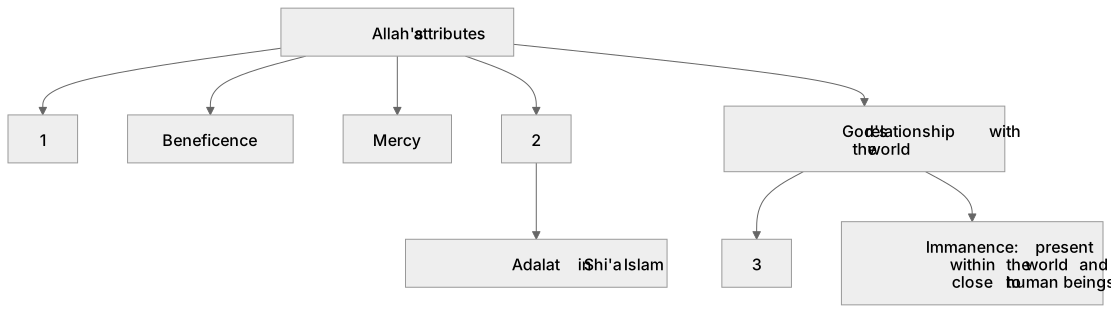
1Box 1
2Box 2
3Box 3
There is more to this lesson
The full lesson goes on to check your understanding and help you earn the marks. Create a free account to carry on, with your progress saved.
A week of Premium from your first lesson · Then the free plan continues · No card, no charge
Test your understanding of Beliefs and teachings: The nature of God: omnipotence, beneficence, mercy, fairness and justice/Adalat in Shi’a Islam, including different ideas about God’s relationship with the world: immanence and transcendence.
Active recall beats re-reading. Take an instant quiz now to test what you’ve learned and lock it into long-term memory.
A week of Premium from your first lesson · Then the free plan continues · No card, no charge