AQA · GCSE · Religious Studies
Course version: 8062 · Version from Sept 2018
Different forms of worship and their significance:
Full specification wording
Christianity - 3.1.2.2 Practices: Different forms of worship and their significance:
Worship is the act of showing reverence, adoration, and honour to God.
Checked against the AQA 8062 specification (opens in a new tab) on .
- Point 2 of 20
- 4 key terms
Study notes
From the checked teaching notes for this specification point.
The idea
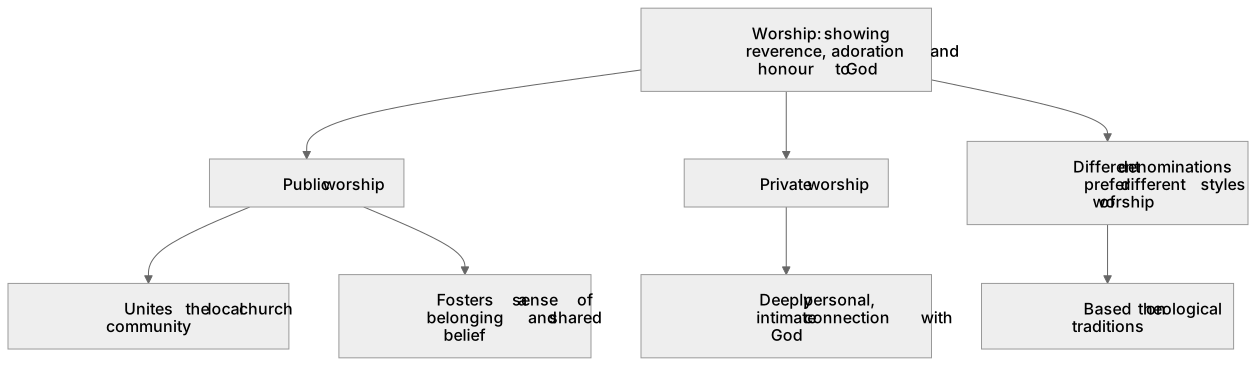
Worship is the act of showing reverence, adoration, and honour to God. Christians engage in different forms of worship to express their faith, seek forgiveness, and build a relationship with the divine. The significance of these varied forms lies in how they cater to different spiritual needs and traditions. For example, public worship unites the local church community, fostering a sense of belonging and shared belief, while private worship allows for a deeply personal, intimate connection with God. By exploring different forms, Christians can experience God's presence in structured, traditional settings or through spontaneous, individual expressions, ensuring that worship remains a vital, dynamic part of their daily lives and spiritual growth.
What earns the marks
- Define worship as an act of religious devotion directed towards God.
- Explain the significance of public worship in building community and shared identity.
- Explain the significance of private worship in developing a personal relationship with God.
- Recognise that different denominations prefer different styles of worship based on their theological traditions.
Common mistakes and how to put them right
Assuming all Christians worship in exactly the same way.
Put it right: Acknowledge the diversity of worship styles across different denominations.
Stating that private worship is less important than public worship.
Put it right: Explain that both hold equal significance but serve different spiritual purposes.
Confusing the act of worship solely with singing hymns.
Put it right: Broaden the definition to include prayer, reading scripture, meditation, and sacraments.
Exam tips
- Always link the form of worship to its specific significance for the believer or the community.
- Use specific examples of denominations, such as Catholic or Quaker, to illustrate different approaches to worship.
- When evaluating the importance of worship, contrast the benefits of communal support with the intimacy of private devotion.
Try the lesson
The start of the Christianity - 3.1.2.2 Practices: Different forms of worship and their significance: lesson, made from checked teaching notes for this specification point.
Have a go first
What is a primary reason why many Christians find liturgical worship significant?
Listen
Worship is the act of showing reverence, adoration, and honour to God. Christians engage in different forms of worship to express their faith, seek forgiveness, and build a relationship with the divine. The significance of these varied forms lies in how they cater to different spiritual needs and traditions. For example, public worship unites the local church community, fostering a sense of belonging and shared belief, while private worship allows for a deeply personal, intimate connection with God. By exploring different forms, Christians can experience God's presence in structured, traditional settings or through spontaneous, individual expressions, ensuring that worship remains a vital, dynamic part of their daily lives and spiritual growth. A strong answer earns marks for these points. Define worship as an act of religious devotion directed towards God. Explain the significance of public worship in building community and shared identity. Explain the significance of private worship in developing a personal relationship with God. Recognise that different denominations prefer different styles of worship based on their theological traditions. A common slip: Assuming all Christians worship in exactly the same way. Instead, Acknowledge the diversity of worship styles across different denominations. Exam tip: Always link the form of worship to its specific significance for the believer or the community.
See it
Key words
Say what each word means before you turn the card.
Devotion and reverence
Try answering aloud or in your head before turning the card.
Community and fellowship
Try answering aloud or in your head before turning the card.
Personal relationship with God
Try answering aloud or in your head before turning the card.
Denominational diversity
Try answering aloud or in your head before turning the card.
See every definition
- Devotion and reverence
- Worship is the act of showing reverence, adoration, and honour to God.
- Community and fellowship
- Public worship unites the local church community, fostering a sense of belonging and shared belief.
- Personal relationship with God
- Private worship allows for a deeply personal, intimate connection with God.
- Denominational diversity
- Different denominations prefer different styles of worship based on their theological traditions.
Label the diagram
Some boxes have lost their names. Pick the right name for each number.
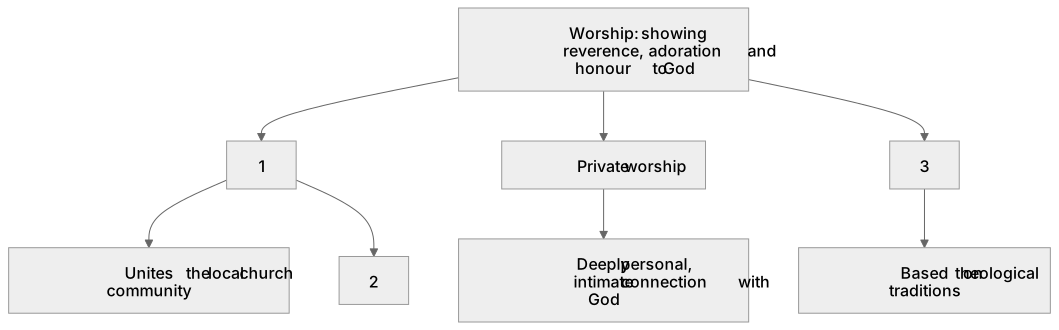
1Box 1
2Box 2
3Box 3
There is more to this lesson
The full lesson goes on to check your understanding and help you earn the marks. Create a free account to carry on, with your progress saved.
A week of Premium from your first lesson · Then the free plan continues · No card, no charge
Test your understanding of Christianity - 3.1.2.2 Practices: Different forms of worship and their significance:
Active recall beats re-reading. Take an instant quiz now to test what you’ve learned and lock it into long-term memory.
A week of Premium from your first lesson · Then the free plan continues · No card, no charge