AQA · GCSE · Religious Studies
Course version: 8062 · Version from Sept 2018
How Christian churches respond to persecution
Full specification wording
Christianity - 3.1.2.2 Practices: how Christian churches respond to persecution
Persecution involves hostility directed at individuals because of their religious beliefs.
Checked against the AQA 8062 specification (opens in a new tab) on .
- Point 19 of 20
- 4 key terms
Study notes
From the checked teaching notes for this specification point.
The idea
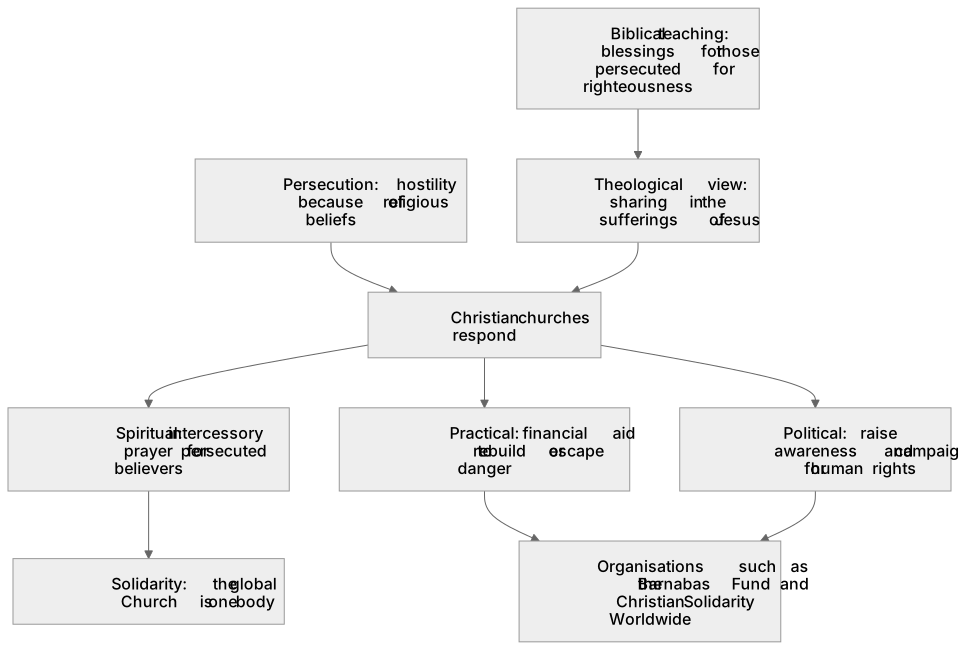
Persecution involves hostility directed at individuals because of their religious beliefs. Christian churches respond to persecution globally through spiritual, practical, and political means. Theologically, many Christians view persecution as a way to share in the sufferings of Jesus, drawing strength from biblical teachings promising blessings for those persecuted for righteousness. Practically, organisations like the Barnabas Fund and Christian Solidarity Worldwide provide vital support. They raise awareness, campaign for human rights, and send financial aid to persecuted communities to help them rebuild or escape danger. Furthermore, churches worldwide engage in intercessory prayer for persecuted believers, demonstrating solidarity and the belief that the global Church is one body.
What earns the marks
- Identify that Christians respond to persecution through prayer, financial aid, and campaigning for human rights.
- Explain the theological perspective that suffering can bring Christians closer to Jesus, who also suffered persecution.
- Reference biblical teachings, such as the Beatitudes, which state that those persecuted for righteousness are blessed.
- Provide examples of Christian charities, such as the Barnabas Fund or Christian Solidarity Worldwide, that actively support persecuted Christians.
Common mistakes and how to put them right
Stating that Christians always respond to persecution with violence or retaliation.
Put it right: Explain that Jesus taught his followers to love their enemies and pray for those who persecute them.
Providing vague answers about helping people.
Put it right: Name specific organisations like Christian Solidarity Worldwide and detail their specific actions, such as lobbying governments.
Assuming persecution only happened in biblical times.
Put it right: Acknowledge that persecution is a current, ongoing issue for many Christian communities globally.
Exam tips
- Memorise at least one specific Christian charity that helps persecuted Christians and be able to describe two ways it provides support.
- Use the teaching 'If one part suffers, every part suffers with it' (1 Corinthians 12:26) to explain why Christians in safe countries support those facing persecution.
- In evaluation questions, consider whether practical aid or spiritual support (like prayer) is the most effective response to persecution.
Try the lesson
The start of the Christianity - 3.1.2.2 Practices: how Christian churches respond to persecution lesson, made from checked teaching notes for this specification point.
Have a go first
Which of the following is a common way that Christian churches respond to the persecution of Christians worldwide?
Listen
Persecution involves hostility directed at individuals because of their religious beliefs. Christian churches respond to persecution globally through spiritual, practical, and political means. Theologically, many Christians view persecution as a way to share in the sufferings of Jesus, drawing strength from biblical teachings promising blessings for those persecuted for righteousness. Practically, organisations like the Barnabas Fund and Christian Solidarity Worldwide provide vital support. They raise awareness, campaign for human rights, and send financial aid to persecuted communities to help them rebuild or escape danger. Furthermore, churches worldwide engage in intercessory prayer for persecuted believers, demonstrating solidarity and the belief that the global Church is one body. A strong answer earns marks for these points. Identify that Christians respond to persecution through prayer, financial aid, and campaigning for human rights. Explain the theological perspective that suffering can bring Christians closer to Jesus, who also suffered persecution. Reference biblical teachings, such as the Beatitudes, which state that those persecuted for righteousness are blessed. Provide examples of Christian charities, such as the Barnabas Fund or Christian Solidarity Worldwide, that actively support persecuted Christians. A common slip: Stating that Christians always respond to persecution with violence or retaliation. Instead, explain that Jesus taught his followers to love their enemies and pray for those who persecute them. Exam tip: Memorise at least one specific Christian charity that helps persecuted Christians and be able to describe two ways it provides support.
See it
Key words
Say what each word means before you turn the card.
Suffering
Try answering aloud or in your head before turning the card.
Solidarity
Try answering aloud or in your head before turning the card.
Charity
Try answering aloud or in your head before turning the card.
Human rights
Try answering aloud or in your head before turning the card.
See every definition
- Suffering
- Many Christians view persecution as a way to share in the sufferings of Jesus.
- Solidarity
- Churches worldwide engage in intercessory prayer for persecuted believers, demonstrating solidarity and the belief that the global Church is one body.
- Charity
- Organisations like the Barnabas Fund and Christian Solidarity Worldwide send financial aid to persecuted communities to help them rebuild or escape danger.
- Human rights
- Christian organisations campaign for human rights as part of their response to persecution.
Label the diagram
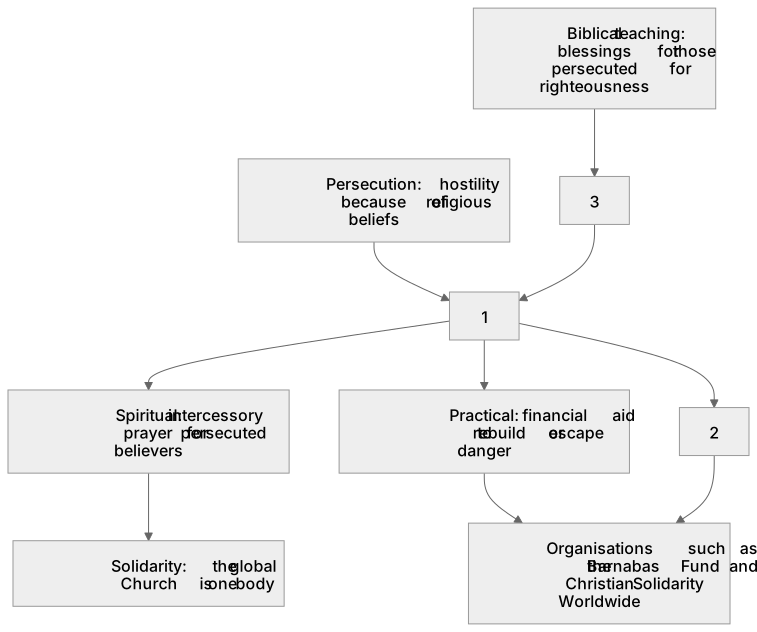
Some boxes have lost their names. Pick the right name for each number.
1Box 1
2Box 2
3Box 3
There is more to this lesson
The full lesson goes on to check your understanding and help you earn the marks. Create a free account to carry on, with your progress saved.
A week of Premium from your first lesson · Then the free plan continues · No card, no charge
Test your understanding of Christianity - 3.1.2.2 Practices: how Christian churches respond to persecution
Active recall beats re-reading. Take an instant quiz now to test what you’ve learned and lock it into long-term memory.
A week of Premium from your first lesson · Then the free plan continues · No card, no charge