AQA · GCSE · Religious Studies
Course version: 8062 · Version from Sept 2018
Christianity - 3.1.2.2 Practices: working for reconciliation
Reconciliation is the process of restoring harmony after relationships have broken down.
Checked against the AQA 8062 specification (opens in a new tab) on .
- Point 18 of 20
- 2 key terms
Study notes
From the checked teaching notes for this specification point.
The idea
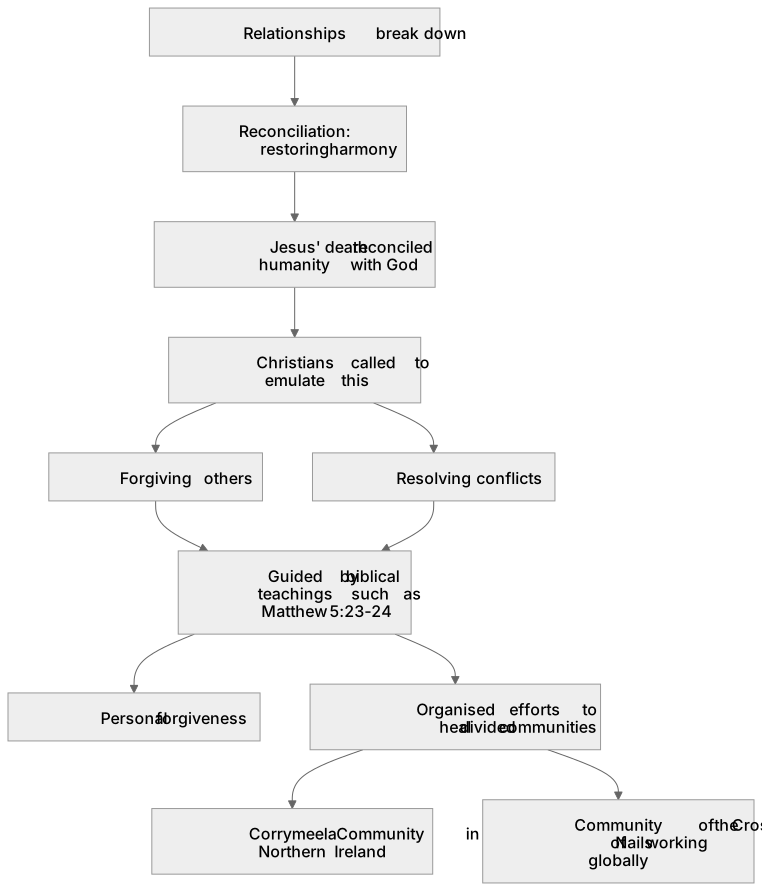
Reconciliation is the process of restoring harmony after relationships have broken down. For Christians, working for reconciliation is a central duty, reflecting the belief that Jesus' death reconciled humanity with God. Christians are called to emulate this by forgiving others and resolving conflicts, guided by biblical teachings such as Matthew 5:23-24, which urges believers to reconcile with others before offering gifts to God. In practice, this involves both personal forgiveness and organised efforts to heal divided communities. For example, the Corrymeela Community in Northern Ireland brings together people from different backgrounds to build trust and peace. Similarly, the Community of the Cross of Nails works globally to promote peace and heal the wounds of war, demonstrating that reconciliation is an active, ongoing commitment.
What earns the marks
- Define reconciliation as the restoration of broken relationships and the active promotion of peace.
- Explain the theological basis: Jesus' atonement reconciled humanity with God, setting an example for Christians to follow.
- Provide a biblical reference, such as Jesus teaching followers to reconcile with their brothers before worshipping God.
- Give a concrete example of a Christian organisation working for reconciliation, such as the Corrymeela Community or the Coventry Cathedral Cross of Nails.
Common mistakes and how to put them right
Confusing reconciliation with simply saying sorry.
Put it right: Explain that reconciliation requires active effort to rebuild trust and restore the relationship.
Assuming reconciliation only applies to global conflicts.
Put it right: State that it applies equally to personal relationships and community disputes.
Failing to link the practice to Christian beliefs.
Put it right: Connect the action of reconciliation to Jesus' teachings on forgiveness or the concept of atonement.
Exam tips
- Use the Corrymeela Community as a specific case study to illustrate how Christians work for reconciliation in divided societies.
- Link the concept of reconciliation to the sacrament of penance and reconciliation in Catholic and Orthodox traditions.
- When evaluating the importance of reconciliation, contrast it with the consequences of holding grudges or seeking revenge.
Try the lesson
The start of the Christianity - 3.1.2.2 Practices: working for reconciliation lesson, made from checked teaching notes for this specification point.
Have a go first
What is the primary meaning of 'reconciliation' in Christian practice?
Listen
Reconciliation is the process of restoring harmony after relationships have broken down. For Christians, working for reconciliation is a central duty, reflecting the belief that Jesus' death reconciled humanity with God. Christians are called to emulate this by forgiving others and resolving conflicts, guided by biblical teachings such as Matthew 5:23-24, which urges believers to reconcile with others before offering gifts to God. In practice, this involves both personal forgiveness and organised efforts to heal divided communities. For example, the Corrymeela Community in Northern Ireland brings together people from different backgrounds to build trust and peace. Similarly, the Community of the Cross of Nails works globally to promote peace and heal the wounds of war, demonstrating that reconciliation is an active, ongoing commitment. A strong answer earns marks for these points. Define reconciliation as the restoration of broken relationships and the active promotion of peace. Explain the theological basis: Jesus' atonement reconciled humanity with God, setting an example for Christians to follow. Provide a biblical reference, such as Jesus teaching followers to reconcile with their brothers before worshipping God. Give a concrete example of a Christian organisation working for reconciliation, such as the Corrymeela Community or the Coventry Cathedral Cross of Nails. A common slip: Confusing reconciliation with simply saying sorry. Instead, explain that reconciliation requires active effort to rebuild trust and restore the relationship. Exam tip: Use the Corrymeela Community as a specific case study to illustrate how Christians work for reconciliation in divided societies.
See it
Key words
Say what each word means before you turn the card.
Forgiveness
Try answering aloud or in your head before turning the card.
Atonement
Try answering aloud or in your head before turning the card.
See every definition
- Forgiveness
- Personal pardon that Christians practise as part of working for reconciliation, restoring harmony after relationships have broken down.
- Atonement
- The belief that Jesus' death reconciled humanity with God, setting an example for Christians to follow.
Label the diagram
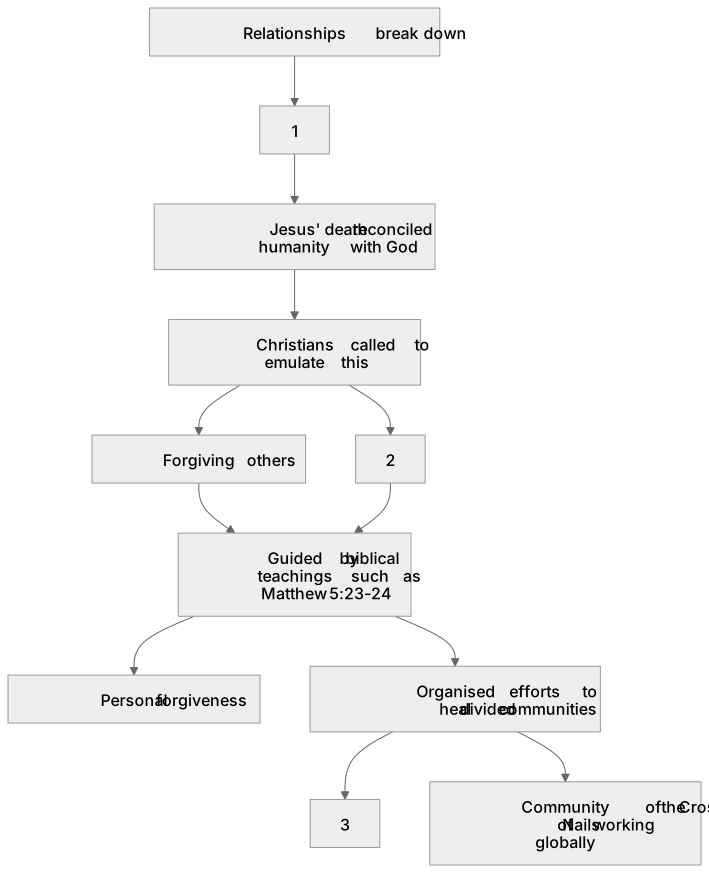
Some boxes have lost their names. Pick the right name for each number.
1Box 1
2Box 2
3Box 3
There is more to this lesson
The full lesson goes on to check your understanding and help you earn the marks. Create a free account to carry on, with your progress saved.
A week of Premium from your first lesson · Then the free plan continues · No card, no charge
Test your understanding of Christianity - 3.1.2.2 Practices: working for reconciliation
Active recall beats re-reading. Take an instant quiz now to test what you’ve learned and lock it into long-term memory.
A week of Premium from your first lesson · Then the free plan continues · No card, no charge