AQA · GCSE · Religious Studies
Course version: 8062 · Version from Sept 2018
The role and importance of pilgrimage and celebrations including:
Full specification wording
Christianity - 3.1.2.2 Practices: The role and importance of pilgrimage and celebrations including:
Pilgrimage is a physical journey to a sacred place that serves a deeply spiritual role for many Christians, offering a dedicated time for prayer, reflection, and seeking healing.
- Point 11 of 20
- 3 key terms
Study notes
From the checked teaching notes for this specification point.
The idea
Pilgrimage is a physical journey to a sacred place that serves a deeply spiritual role for many Christians, offering a dedicated time for prayer, reflection, and seeking healing. Its importance lies in strengthening faith, feeling connected to the global Christian community, and experiencing historical sites of religious significance, such as Lourdes or Iona. Celebrations, including major festivals like Christmas and Easter, play a crucial role in remembering key events in the life of Jesus. These celebrations are important because they unite the congregation, reinforce core theological beliefs such as the incarnation and resurrection, and provide a rhythm to the liturgical year.
What earns the marks
- Explain the role of pilgrimage as a spiritual journey that allows Christians to step away from daily life and focus entirely on God.
- Identify the importance of pilgrimage in seeking physical or spiritual healing, or in expressing gratitude and penance.
- Describe the role of Christian celebrations in commemorating central events of Jesus' life, such as the incarnation at Christmas.
- Evaluate the importance of celebrations in fostering community cohesion and passing on faith traditions to the next generation.
Common mistakes and how to put them right
Claiming that pilgrimage is a compulsory duty for all Christians.
Put it right by explaining that it is an optional, though highly valued, spiritual practice.
Focusing only on the historical facts of a celebration without explaining its spiritual importance.
Put it right by linking the event to its theological meaning, such as salvation.
Confusing a holiday with a pilgrimage.
Put it right by emphasising that a pilgrimage must have a specific religious intent and destination.
Exam tips
- Always link the practice of pilgrimage to specific spiritual benefits, such as feeling closer to God or experiencing miraculous healing.
- When discussing celebrations, explicitly mention how they reinforce core Christian beliefs like the resurrection or the incarnation.
- Use concrete examples of pilgrimage sites, such as Lourdes or Iona, to illustrate the different reasons Christians might undertake these journeys.
Try the lesson
The start of the Christianity - 3.1.2.2 Practices: The role and importance of pilgrimage and celebrations including: lesson, made from checked teaching notes for this specification point.
Have a go first
What is the primary purpose of the Christian celebration of Easter?
Listen
Pilgrimage is a physical journey to a sacred place that serves a deeply spiritual role for many Christians, offering a dedicated time for prayer, reflection, and seeking healing. Its importance lies in strengthening faith, feeling connected to the global Christian community, and experiencing historical sites of religious significance, such as Lourdes or Iona. Celebrations, including major festivals like Christmas and Easter, play a crucial role in remembering key events in the life of Jesus. These celebrations are important because they unite the congregation, reinforce core theological beliefs such as the incarnation and resurrection, and provide a rhythm to the liturgical year. A strong answer earns marks for these points. Explain the role of pilgrimage as a spiritual journey that allows Christians to step away from daily life and focus entirely on God. Identify the importance of pilgrimage in seeking physical or spiritual healing, or in expressing gratitude and penance. Describe the role of Christian celebrations in commemorating central events of Jesus' life, such as the incarnation at Christmas. Evaluate the importance of celebrations in fostering community cohesion and passing on faith traditions to the next generation. A common slip: Claiming that pilgrimage is a compulsory duty for all Christians. Instead, explaining that it is an optional, though highly valued, spiritual practice. Exam tip: Always link the practice of pilgrimage to specific spiritual benefits, such as feeling closer to God or experiencing miraculous healing.
See it
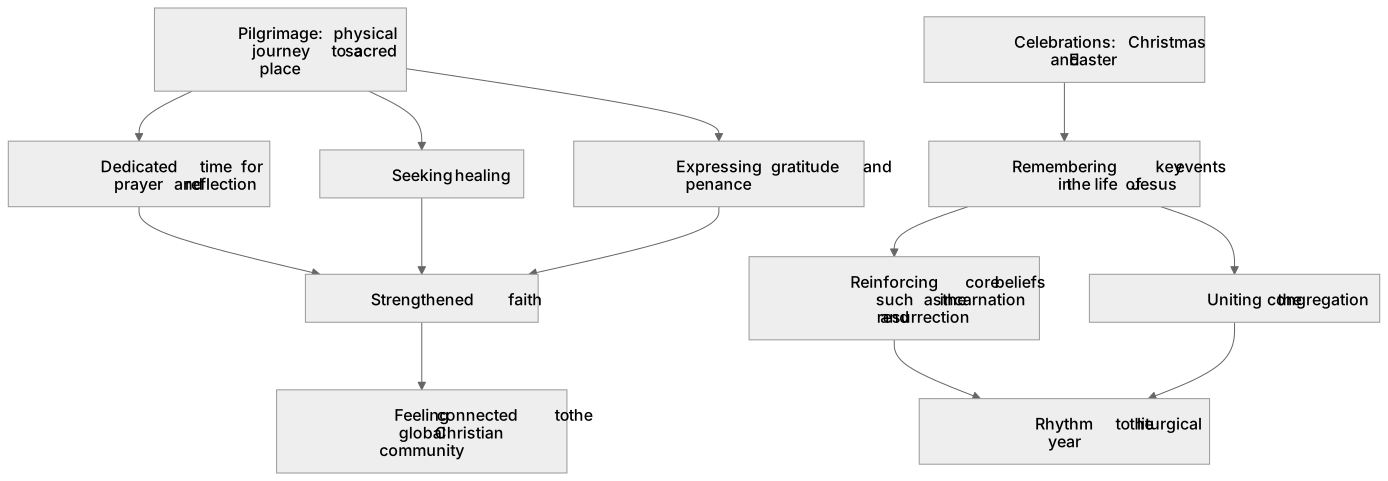
Key words
Say what each word means before you turn the card.
Pilgrimage
Try answering aloud or in your head before turning the card.
Celebrations
Try answering aloud or in your head before turning the card.
Incarnation
Try answering aloud or in your head before turning the card.
See every definition
- Pilgrimage
- A physical journey to a sacred place that serves a deeply spiritual role for many Christians, offering a dedicated time for prayer, reflection, and seeking healing.
- Celebrations
- Major festivals like Christmas and Easter that play a crucial role in remembering key events in the life of Jesus.
- Incarnation
- A core theological belief reinforced by celebrations, commemorated at Christmas as a central event of Jesus' life.
Label the diagram
Some boxes have lost their names. Pick the right name for each number.
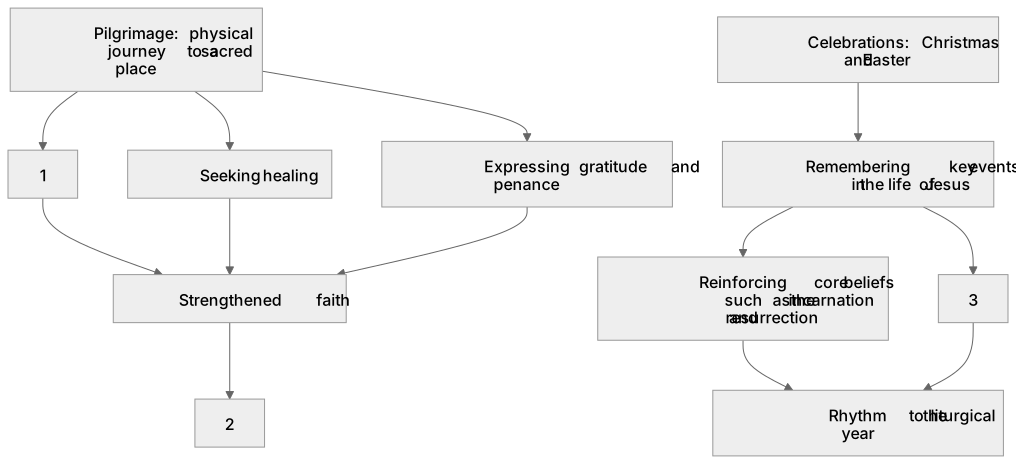
1Box 1
2Box 2
3Box 3
There is more to this lesson
The full lesson goes on to check your understanding and help you earn the marks. Create a free account to carry on, with your progress saved.
A week of Premium from your first lesson · Then the free plan continues · No card, no charge
Test your understanding of Christianity - 3.1.2.2 Practices: The role and importance of pilgrimage and celebrations including:
Active recall beats re-reading. Take an instant quiz now to test what you’ve learned and lock it into long-term memory.
A week of Premium from your first lesson · Then the free plan continues · No card, no charge