AQA · GCSE · Religious Studies
Course version: 8062 · Version from Sept 2018
The sacrament of Holy Communion/Eucharist and its significance for…
Full specification wording
Christianity - 3.1.2.2 Practices: the sacrament of Holy Communion/Eucharist and its significance for Christians, including different ways in which it is celebrated and different interpretations of its meaning.
Holy Communion, also known as the Eucharist, is a sacrament commemorating Jesus' Last Supper.
Checked against the AQA 8062 specification (opens in a new tab) on .
- Point 10 of 20
- 4 key terms
Study notes
From the checked teaching notes for this specification point.
The idea
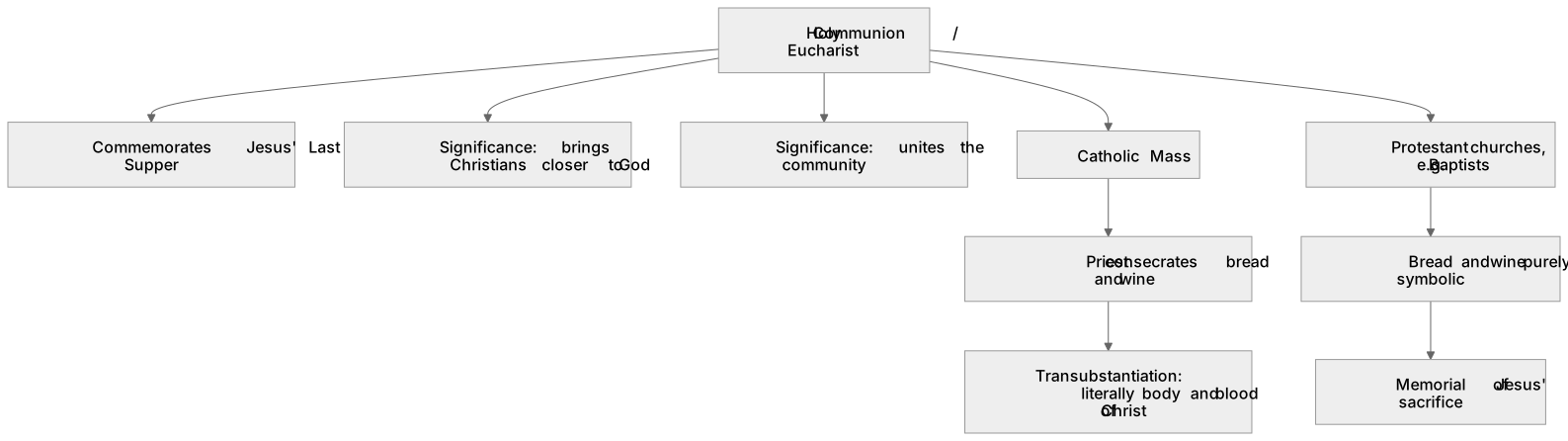
Holy Communion, also known as the Eucharist, is a sacrament commemorating Jesus' Last Supper. Its significance lies in bringing Christians closer to God and uniting the community. Different denominations celebrate it in distinct ways. In Catholic Mass, the priest consecrates bread and wine, which they believe literally become the body and blood of Christ (transubstantiation). In contrast, many Protestant churches, such as Baptists, view the bread and wine as purely symbolic, serving as a memorial of Jesus' sacrifice. The celebration varies from highly liturgical services with formal rituals to informal gatherings, reflecting differing interpretations of its meaning.
What earns the marks
- Explain the Catholic belief in transubstantiation, where the bread and wine become the actual body and blood of Christ.
- Describe the Protestant view of memorialism, where the elements are symbolic reminders of Jesus' sacrifice.
- Identify the significance of the Eucharist in uniting the Christian community and providing spiritual nourishment.
- Contrast the liturgical, formal celebration in Catholic churches with the less formal, symbolic sharing in Nonconformist churches.
Common mistakes and how to put them right
Assuming all Christians believe the bread and wine literally become Jesus' body and blood.
Put it right by explaining that many Protestants view it as purely symbolic.
Confusing the terms Eucharist and Holy Communion as different practices.
Put it right by stating they are different names for the same sacrament.
Stating that Quakers and the Salvation Army celebrate Holy Communion regularly.
Put it right by noting that these specific denominations do not typically practice this sacrament.
Exam tips
- Use specific denominational terms like 'Catholic' and 'Baptist' when contrasting interpretations of the Eucharist.
- Learn the term 'transubstantiation' as the Roman Catholic formulation; note that Orthodox believers affirm the real presence but generally use the language of mystery rather than transubstantiation.
- When evaluating the significance of Holy Communion, discuss both individual spiritual benefits and the strengthening of the church community.
Try the lesson
The start of the Christianity - 3.1.2.2 Practices: the sacrament of Holy Communion/Eucharist and its significance for Christians, including different ways in which it is celebrated and different interpretations of its meaning. lesson, made from checked teaching notes for this specification point.
Have a go first
What is the primary event remembered during the sacrament of Holy Communion?
Listen
Holy Communion, also known as the Eucharist, is a sacrament commemorating Jesus' Last Supper. Its significance lies in bringing Christians closer to God and uniting the community. Different denominations celebrate it in distinct ways. In Catholic Mass, the priest consecrates bread and wine, which they believe literally become the body and blood of Christ (transubstantiation). In contrast, many Protestant churches, such as Baptists, view the bread and wine as purely symbolic, serving as a memorial of Jesus' sacrifice. The celebration varies from highly liturgical services with formal rituals to informal gatherings, reflecting differing interpretations of its meaning. A strong answer earns marks for these points. Explain the Catholic belief in transubstantiation, where the bread and wine become the actual body and blood of Christ. Describe the Protestant view of memorialism, where the elements are symbolic reminders of Jesus' sacrifice. Identify the significance of the Eucharist in uniting the Christian community and providing spiritual nourishment. Contrast the liturgical, formal celebration in Catholic churches with the less formal, symbolic sharing in Nonconformist churches. A common slip: Assuming all Christians believe the bread and wine literally become Jesus' body and blood. Instead, explaining that many Protestants view it as purely symbolic. Exam tip: Use specific denominational terms like 'Catholic' and 'Baptist' when contrasting interpretations of the Eucharist.
See it
Key words
Say what each word means before you turn the card.
Holy Communion
Try answering aloud or in your head before turning the card.
transubstantiation
Try answering aloud or in your head before turning the card.
memorialism
Try answering aloud or in your head before turning the card.
Eucharist
Try answering aloud or in your head before turning the card.
See every definition
- Holy Communion
- A sacrament, also known as the Eucharist, commemorating Jesus' Last Supper.
- transubstantiation
- The Catholic belief that the bread and wine literally become the body and blood of Christ.
- memorialism
- The Protestant view that the bread and wine are purely symbolic, serving as a memorial of Jesus' sacrifice.
- Eucharist
- A different name for the same sacrament of Holy Communion.
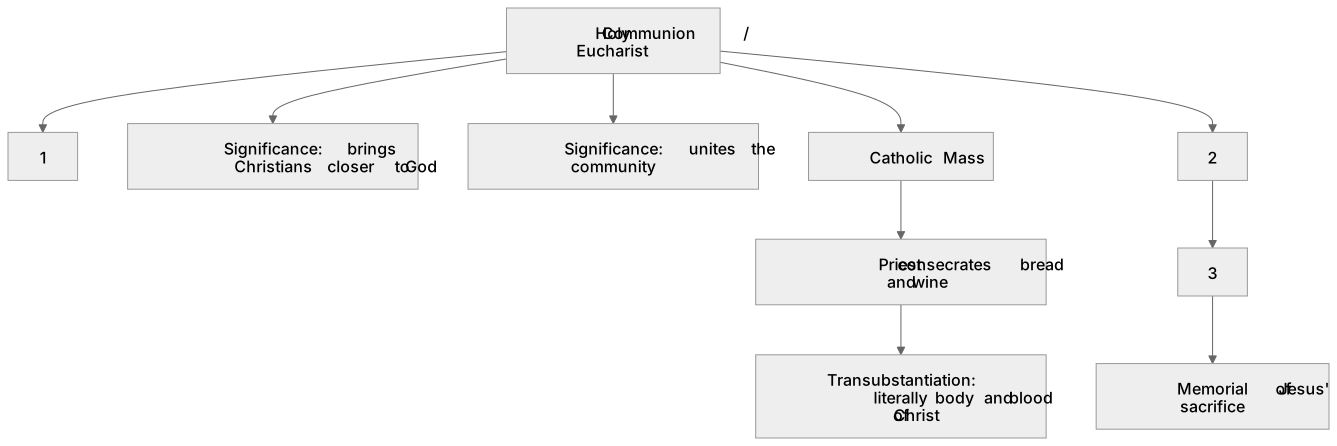
Label the diagram
Some boxes have lost their names. Pick the right name for each number.
1Box 1
2Box 2
3Box 3
There is more to this lesson
The full lesson goes on to check your understanding and help you earn the marks. Create a free account to carry on, with your progress saved.
A week of Premium from your first lesson · Then the free plan continues · No card, no charge
Test your understanding of Christianity - 3.1.2.2 Practices: the sacrament of Holy Communion/Eucharist and its significance for Christians, including different ways in which it is celebrated and different interpretations of its meaning.
Active recall beats re-reading. Take an instant quiz now to test what you’ve learned and lock it into long-term memory.
A week of Premium from your first lesson · Then the free plan continues · No card, no charge