AQA · GCSE · Religious Studies
Duties and festivals
Master the core of Buddhist belief with this comprehensive guide to the Dhamma, Duties, and Festivals. From the Three Marks of Existence to the profound differences between Theravada and Mahayana ideals, this resource provides the exact terminology, analytical links, and specific knowledge required to achieve top marks in your GCSE Religious Studies exam.
- 7 min read
- 3 worked examples
- 2 practice questions
- 6 key terms
Study Notes
Overview
This study guide covers the foundational teachings of Buddhism, known collectively as the Dhamma (or Dharma). For GCSE candidates, understanding the Dhamma is absolutely crucial, as it forms the basis for all Buddhist beliefs and practices. Examiners expect you to not only define key terms but to explain how these concepts interlock. You will need to demonstrate clear knowledge of the Three Marks of Existence (anicca, anatta, dukkha), the concept of Dependent Arising (paticcasamupada), and how human personality is understood through the Five Aggregates (khandhas). Furthermore, high-level answers require a precise comparison between Theravada and Mahayana traditions, particularly regarding their ultimate spiritual ideals: the Arhat and the Bodhisattva. Finally, we will explore how these profound teachings are expressed practically through Buddhist duties and major festivals like Vesak.
Key Concepts & Teachings
The Dhamma (Dharma)
Definition: The universal truth, the teachings of the Buddha, and the path to Enlightenment.
What it means: The Dhamma is often represented as a wheel (the Dharmachakra). It is one of the Three Refuges (or Three Jewels) in Buddhism, alongside the Buddha and the Sangha. Taking refuge in the Dhamma means trusting it as a practical guide to ending suffering.
Why it matters for the exam: You must be able to explain that the Dhamma is not a set of commandments from a god, but a practical 'medicine' prescribed by the Buddha to cure the 'disease' of suffering.
The Three Marks of Existence (Tilakkhana)
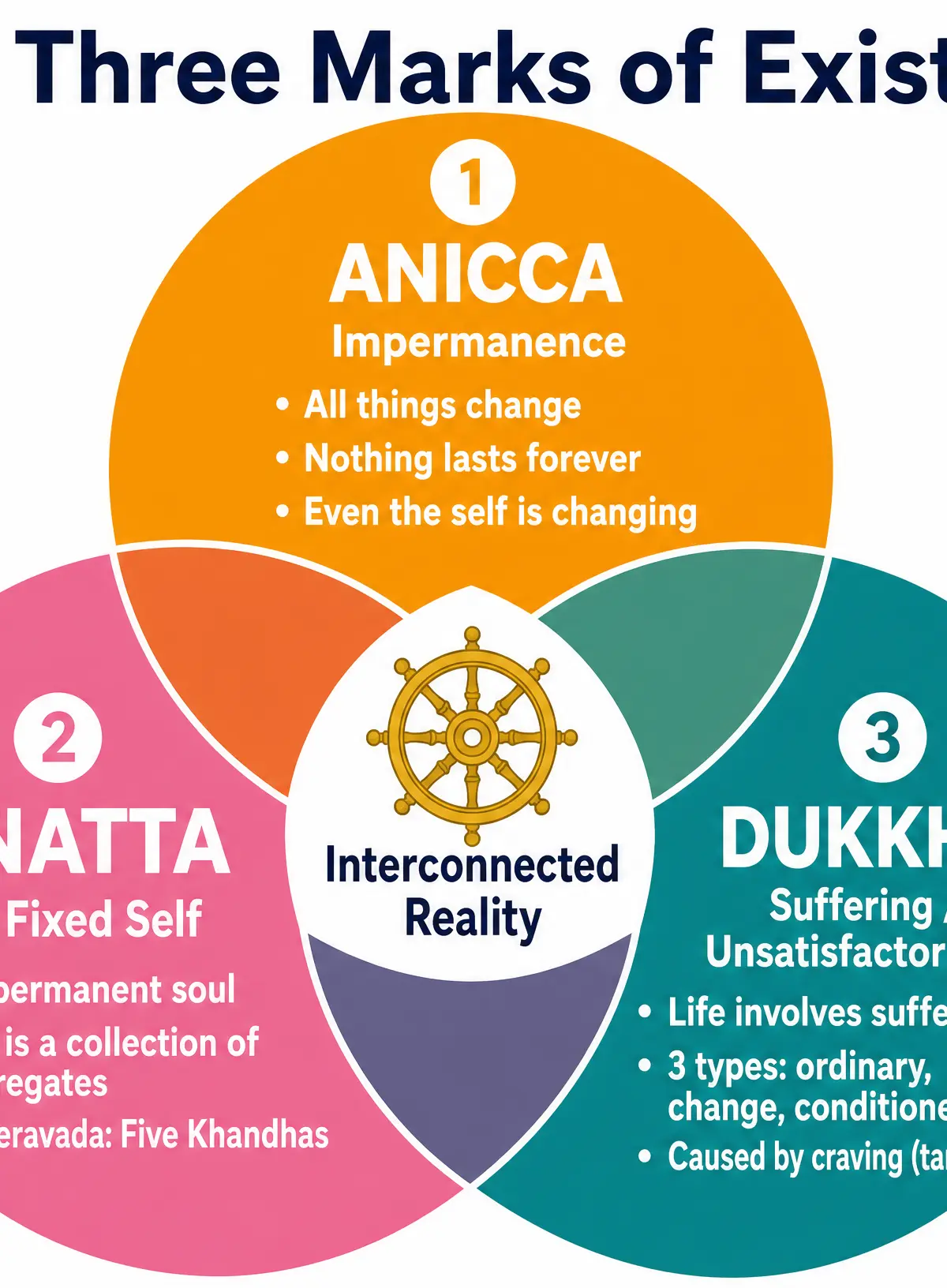
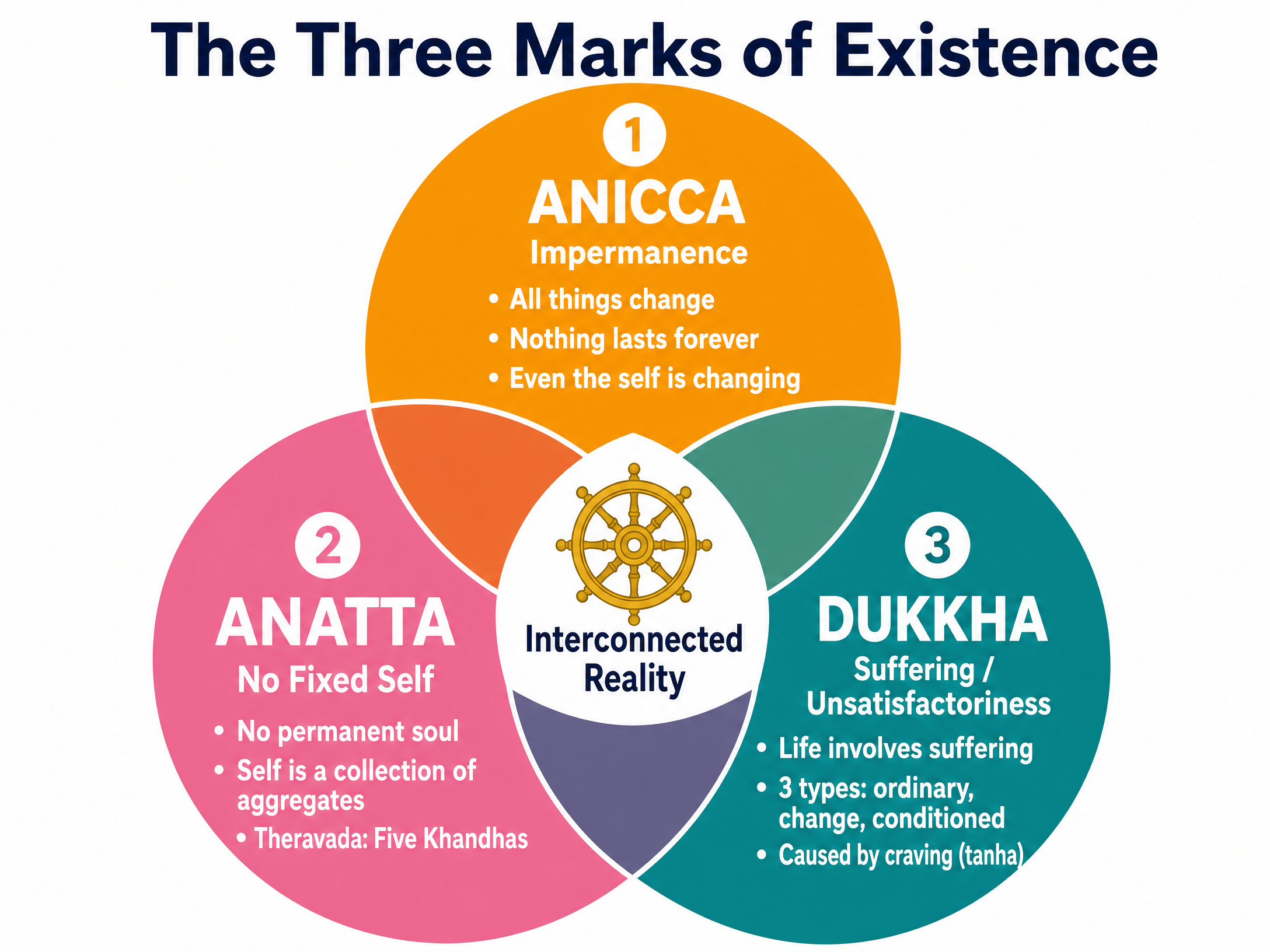
1. Anicca (Impermanence): The teaching that everything in the universe is in a constant state of flux. Nothing lasts forever—not mountains, not relationships, not emotions.
2. Anatta (No Fixed Self): The teaching that there is no permanent, unchanging soul. What we call 'me' is just a temporary collection of changing processes.
3. Dukkha (Suffering/Unsatisfactoriness): The teaching that life involves suffering. This is caused by craving (tanha) and clinging to things that are impermanent (anicca).
Specific Knowledge: Examiners heavily reward candidates who can link these three together: Because everything is impermanent (anicca), there can be no fixed self (anatta). Because we falsely believe things are permanent and that we have a fixed self, we cling to them, which inevitably causes suffering (dukkha).
The Five Aggregates (Khandhas) - Theravada
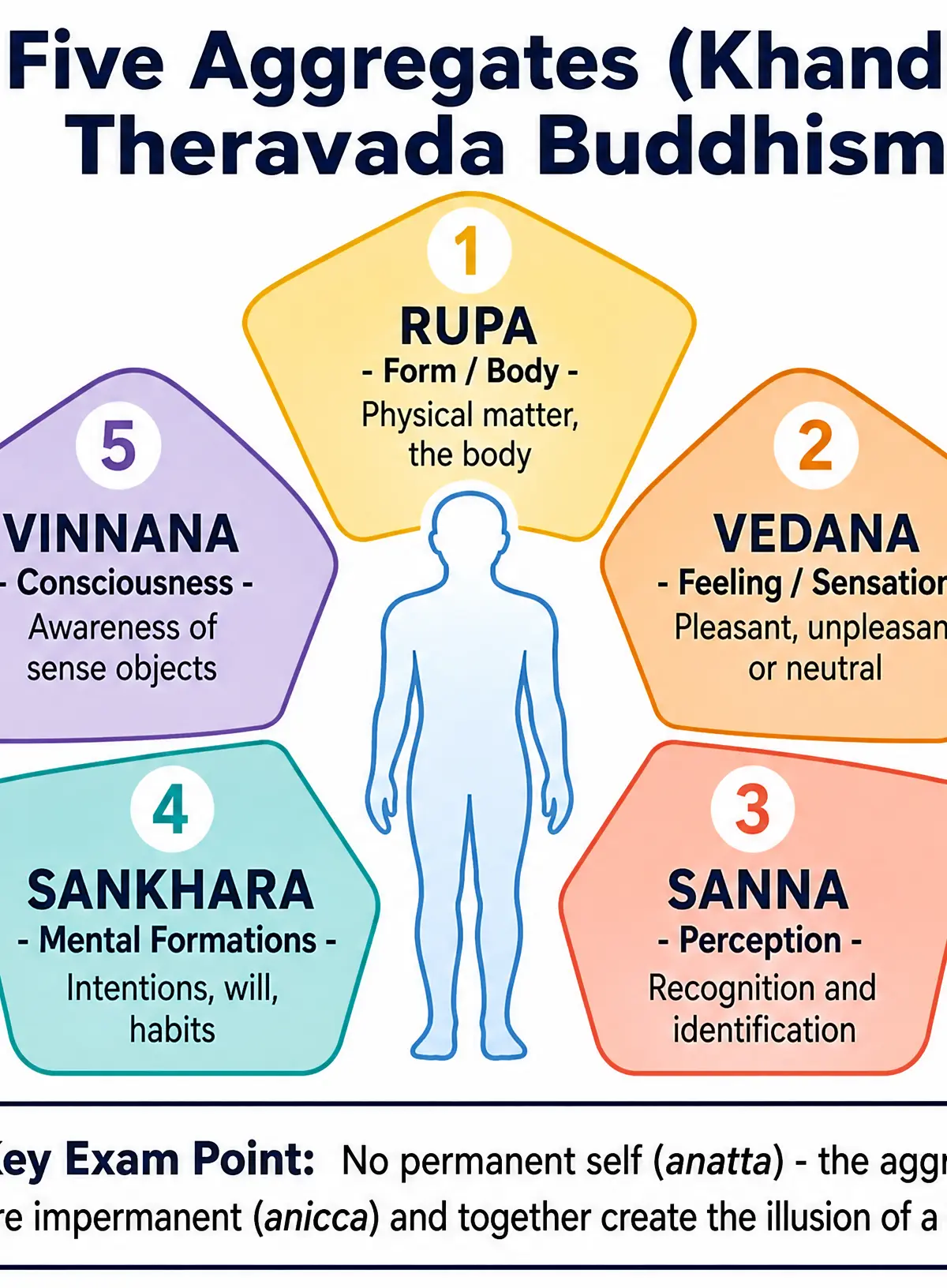
Definition: The Theravada explanation of what makes up a human being.
The Five Parts:
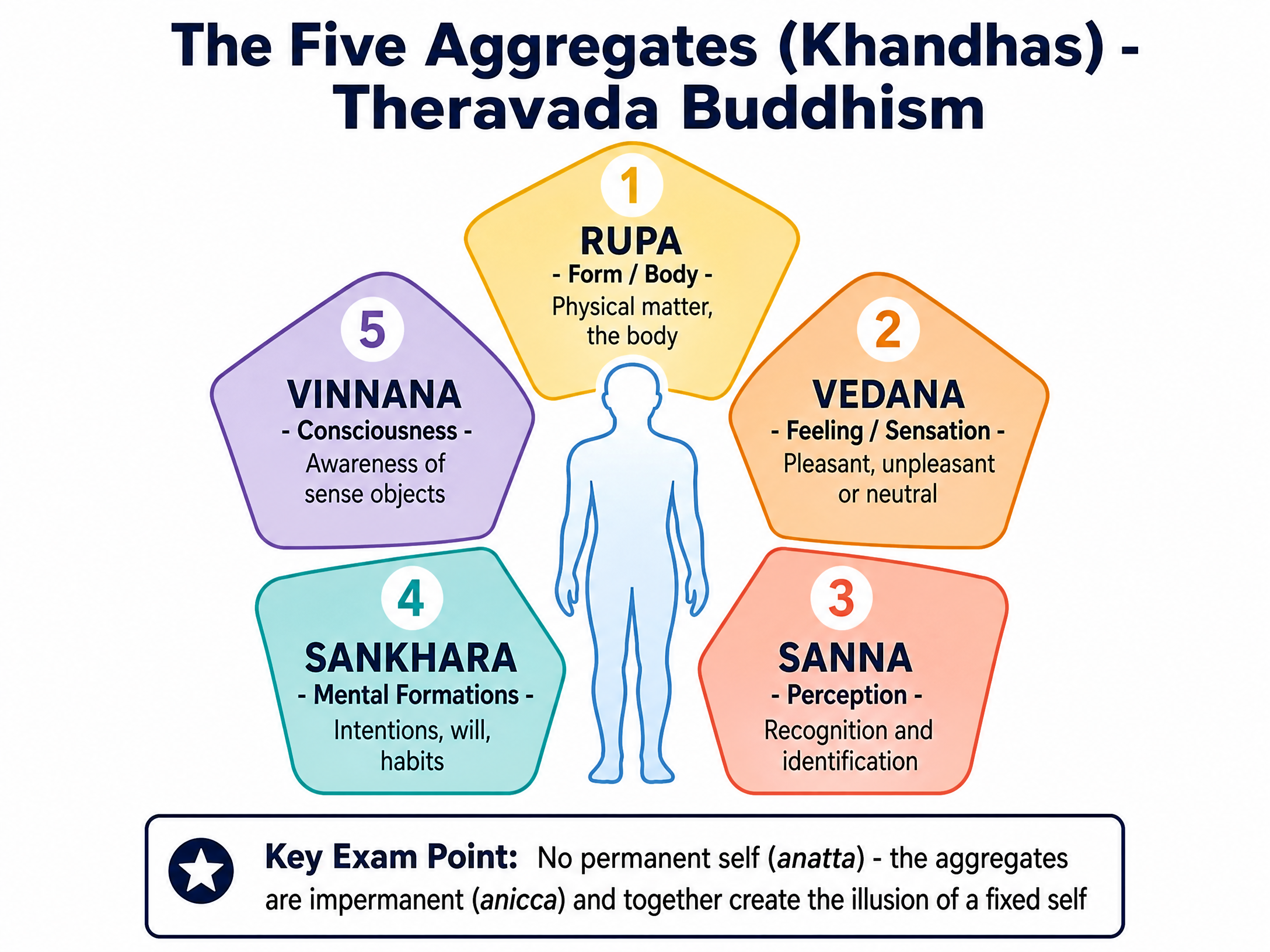
- Rupa: Form (the physical body)
- Vedana: Sensation/Feeling (pleasant, unpleasant, neutral)
- Sanna: Perception (recognising things)
- Sankhara: Mental Formations (intentions, habits, likes/dislikes)
- Vinnana: Consciousness (awareness)
Exam Link: You must use the Five Aggregates to explain anatta. Just as a chariot is just a collection of wheels, axles, and wood (the analogy of King Milinda and Nagasena), a person is just a temporary collection of these five aggregates. There is no permanent 'driver' or soul.
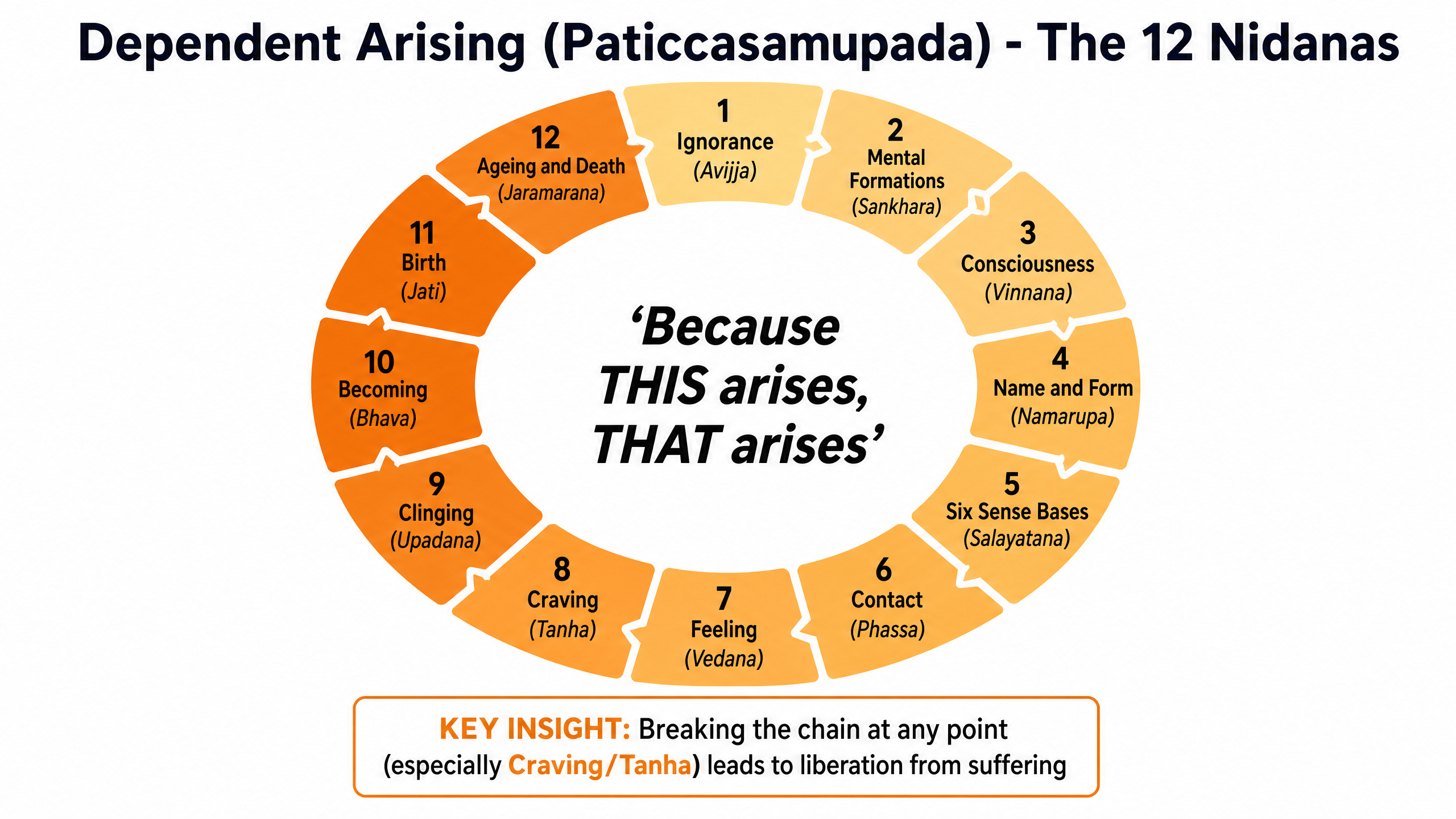
Dependent Arising (Paticcasamupada)
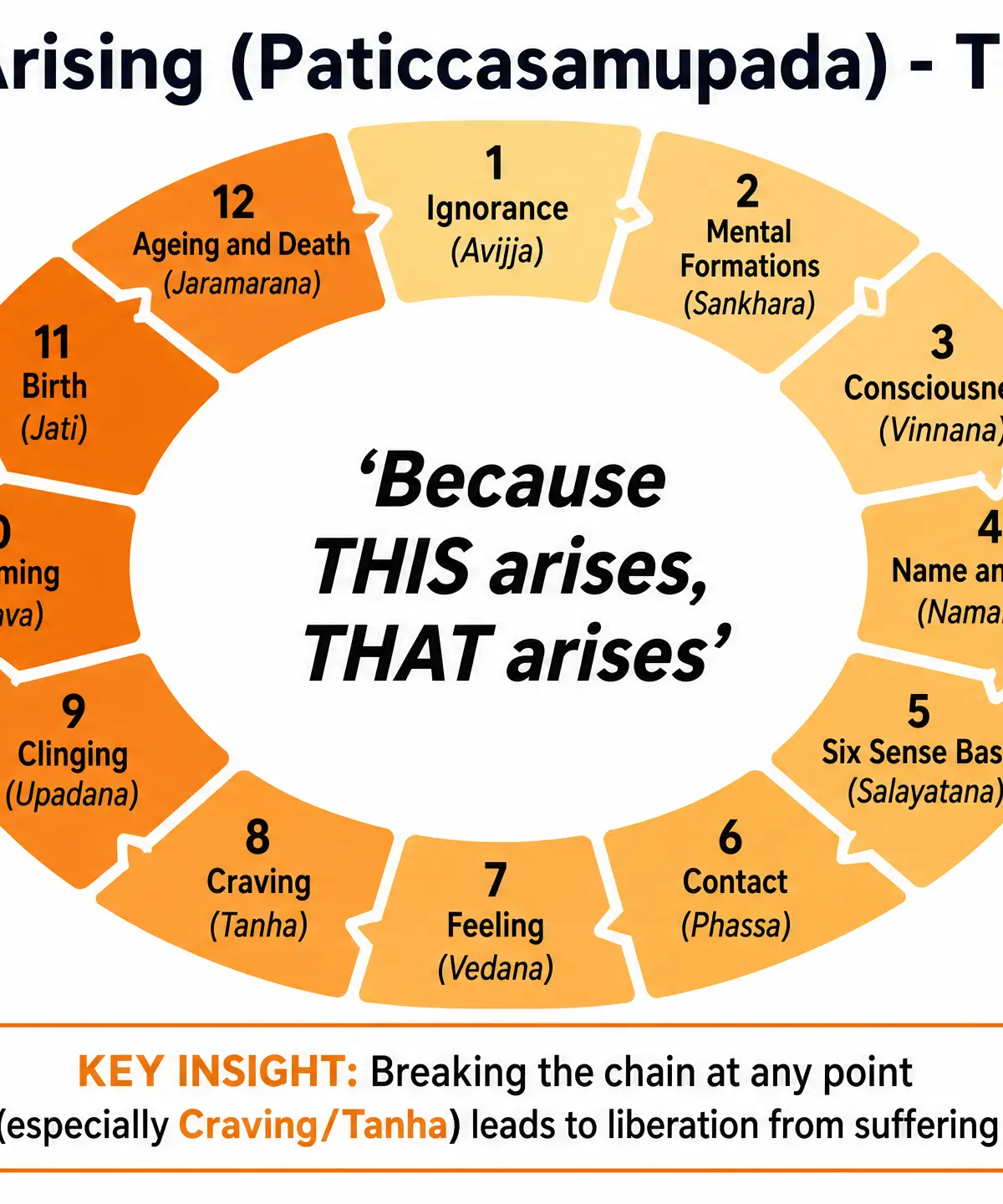
Definition: The concept that everything arises in dependence upon multiple causes and conditions.
What it means: 'Because this arises, that arises.' It is often depicted as the 12 Nidanas (links) on the outer rim of the Tibetan Wheel of Life. It shows how ignorance leads to a chain reaction resulting in suffering and rebirth.
Significance: It proves that we are not victims of fate. By breaking the chain—specifically by stopping craving (tanha)—we can achieve liberation (Nirvana).
Theravada vs Mahayana Traditions
Human Destiny Ideals
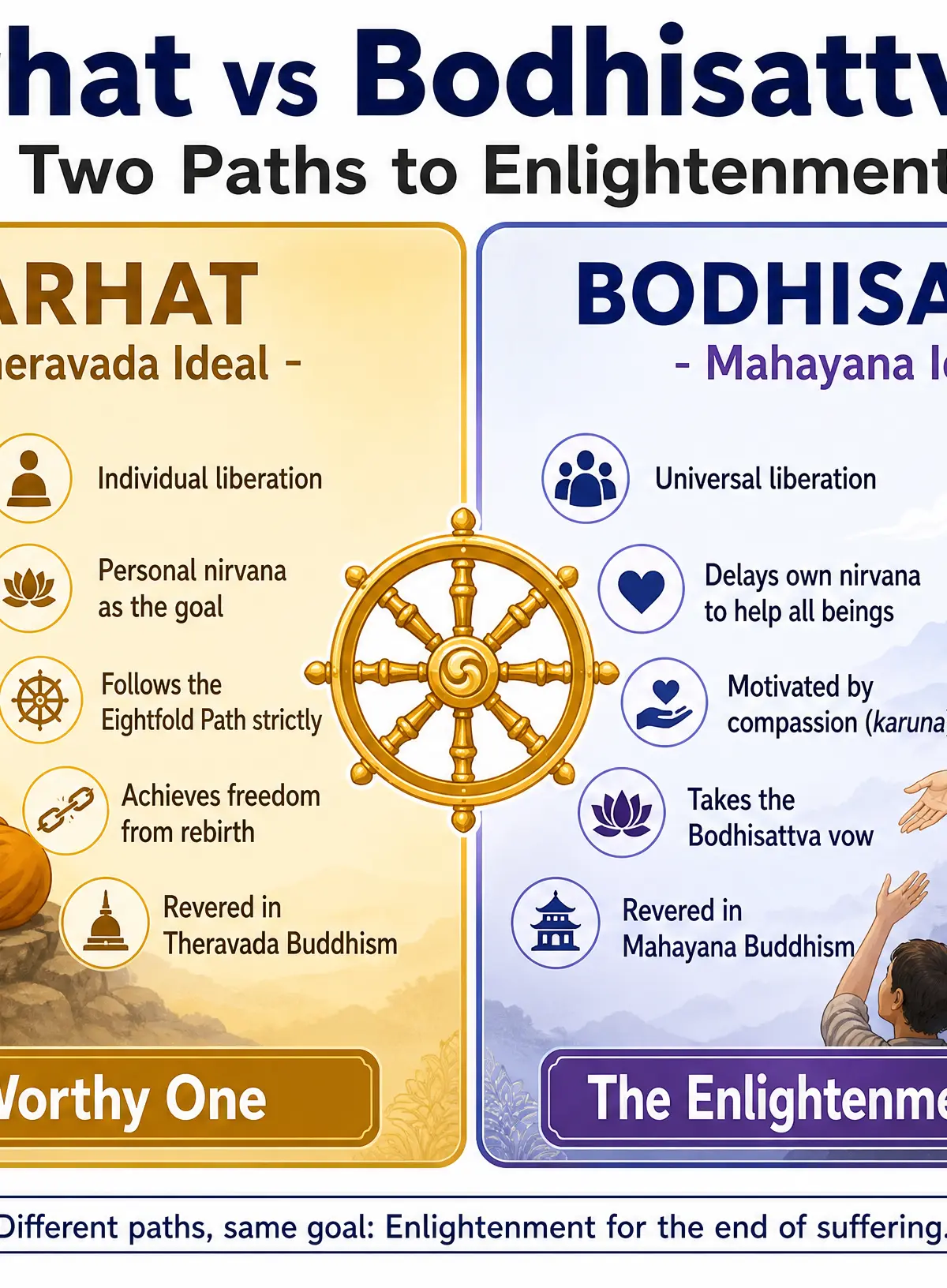
The Arhat (Theravada Ideal):
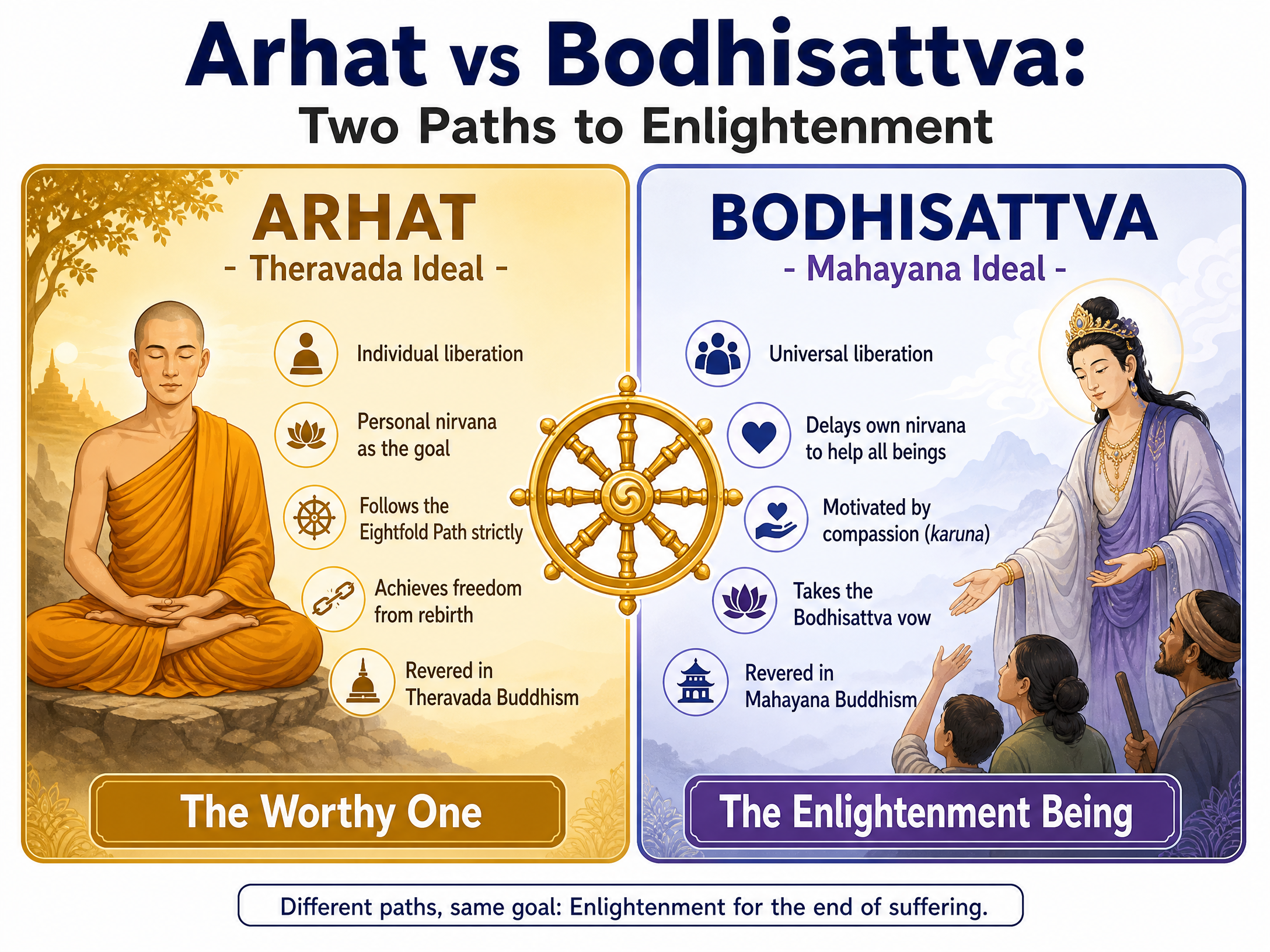
An Arhat ('Worthy One') is someone who has followed the Eightfold Path, overcome the three poisons (greed, hatred, ignorance), and achieved Nirvana. Their goal is personal liberation from the cycle of samsara.
The Bodhisattva (Mahayana Ideal):
A Bodhisattva ('Enlightenment Being') is someone who achieves enlightenment but deliberately chooses to remain in the cycle of samsara to help all other sentient beings achieve liberation first. Their driving force is Karuna (compassion).
Mahayana Perspectives on Personality
Sunyata (Emptiness): The Mahayana teaching that nothing has an independent, inherent existence. It is an expansion of the concept of anatta applied to all phenomena.
Buddha-nature (Tathagatagarbha): The teaching that all sentient beings inherently possess the seed of Buddhahood. We are all already Buddhas; we just need to clear away the ignorance to realise it.
The Pure Land: A celestial realm created by Amitabha Buddha. Pure Land Buddhists believe that by chanting Amitabha's name with devotion, they will be reborn in this land, where achieving enlightenment is much easier.
Buddhist Festivals and Duties
Key Festivals
Vesak (Buddha Day): The most important Theravada festival, celebrated on the full moon in May. It commemorates the birth, enlightenment, and passing away (Parinirvana) of the Buddha. Buddhists light lanterns (symbolising enlightenment driving away the darkness of ignorance), make offerings, and meditate.
Dharma Day (Asalha Puja): Celebrates the Buddha's first teaching (the setting in motion of the wheel of the Dhamma) at Deer Park.
Sangha Day (Kathina): Celebrates the spiritual community. Lay people offer robes and supplies to monks, demonstrating dana (generosity) and the interdependence of the monastic and lay communities.
Duties (The Precepts)
Buddhist ethics are not rules commanded by a god, but training principles undertaken voluntarily. The core duties for lay Buddhists are the Five Precepts:
- To abstain from taking life (ahimsa/non-violence)
- To abstain from taking what is not given
- To abstain from sexual misconduct
- To abstain from false speech
- To abstain from intoxicants that cloud the mind
Audio Revision
Listen to our comprehensive 10-minute revision podcast covering all these topics, complete with examiner tips and a quick-fire quiz:

Visual Resources
4 diagrams and illustrations
Interactive Diagrams
1 interactive diagram to visualise key concepts
Conceptual Flow Outline
The Cycle of Dependent Arising and the Path to Liberation
Worked Examples
3 worked examples — open one to explore the question and available guidance.
Practice Questions
Test your understanding — click to reveal model answers
Explain two ways in which the Five Aggregates (Khandhas) influence Buddhist understanding of the self. (4 marks)
Hint: Think about what the aggregates are, and how they relate to the concept of 'anatta'.
Explain the significance of the Bodhisattva ideal in Mahayana Buddhism. (5 marks)
Hint: Define what a Bodhisattva is, their motivation, and how this differs from Theravada.