AQA · GCSE · Religious Studies
Course version: 8062 · Version from Sept 2018
Personal virtues including ahimsa, respect, empathy, mind/sense control,…
Full specification wording
Hinduism - 3.1.4.1 Beliefs and teachings: Personal virtues including ahimsa, respect, empathy, mind/sense control, humility, love.
Hindu ethics emphasise cultivating personal virtues to achieve spiritual progress and maintain dharma.
- Point 17 of 19
- 3 key terms
Study notes
From the teaching notes for this specification point.
The idea
Hindu ethics emphasise cultivating personal virtues to achieve spiritual progress and maintain dharma. Ahimsa (non-violence) is the foundational virtue, requiring individuals to avoid harming any living being through actions, words, or thoughts, often leading to a vegetarian diet. Respect is shown towards elders, teachers (gurus), and all life, recognising the divine presence (atman) within everyone. Empathy and love involve feeling compassion for others' suffering and acting selflessly. Mind and sense control are crucial for overcoming material desires and distractions, often practised through yoga and meditation to focus on the divine. Humility requires abandoning ego and pride, acknowledging that all abilities come from Brahman. Together, these virtues help Hindus accumulate positive karma and move closer to moksha.
What earns the marks
- Define ahimsa as the principle of non-violence in thought, word, and deed, rooted in the belief that the divine exists in all beings.
- Explain how mind and sense control are achieved through practices like yoga, helping individuals detach from material illusions (maya).
- Describe how respect and humility are demonstrated in daily life, such as bowing to elders or gurus and letting go of the ego.
- Discuss the role of empathy and love in fulfilling one's dharma and generating positive karma by selflessly serving others.
Common mistakes and how to put them right
Limiting ahimsa only to physical violence.
Put it right: Explain that ahimsa also prohibits harmful words and malicious thoughts.
Treating mind and sense control as a punishment or suppression.
Put it right: Describe it as a positive spiritual discipline that frees the individual from the distraction of temporary material desires.
Viewing these virtues as optional good deeds.
Put it right: Emphasise that cultivating these virtues is a fundamental part of fulfilling dharma and progressing towards moksha.
Exam tips
- Provide concrete examples of ahimsa in practice, such as choosing a vegetarian diet or engaging in peaceful protests.
- Link the virtue of respect directly to the Hindu belief that the atman (soul) in every being is a spark of the supreme Brahman.
- Use the virtues to build strong arguments in evaluation questions about how a Hindu should live their daily life.
Try the lesson
The start of the Hinduism - 3.1.4.1 Beliefs and teachings: Personal virtues including ahimsa, respect, empathy, mind/sense control, humility, love. lesson, made from teaching notes for this specification point.
Have a go first
Which of the following best describes the Hindu personal virtue of ahimsa?
Listen
Hindu ethics emphasise cultivating personal virtues to achieve spiritual progress and maintain dharma. Ahimsa (non-violence) is the foundational virtue, requiring individuals to avoid harming any living being through actions, words, or thoughts, often leading to a vegetarian diet. Respect is shown towards elders, teachers (gurus), and all life, recognising the divine presence (atman) within everyone. Empathy and love involve feeling compassion for others' suffering and acting selflessly. Mind and sense control are crucial for overcoming material desires and distractions, often practised through yoga and meditation to focus on the divine. Humility requires abandoning ego and pride, acknowledging that all abilities come from Brahman. Together, these virtues help Hindus accumulate positive karma and move closer to moksha. A strong answer earns marks for these points. Define ahimsa as the principle of non-violence in thought, word, and deed, rooted in the belief that the divine exists in all beings. Explain how mind and sense control are achieved through practices like yoga, helping individuals detach from material illusions (maya). Describe how respect and humility are demonstrated in daily life, such as bowing to elders or gurus and letting go of the ego. Discuss the role of empathy and love in fulfilling one's dharma and generating positive karma by selflessly serving others. A common slip: Limiting ahimsa only to physical violence. Instead, Explain that ahimsa also prohibits harmful words and malicious thoughts. Exam tip: Provide concrete examples of ahimsa in practice, such as choosing a vegetarian diet or engaging in peaceful protests.
See it
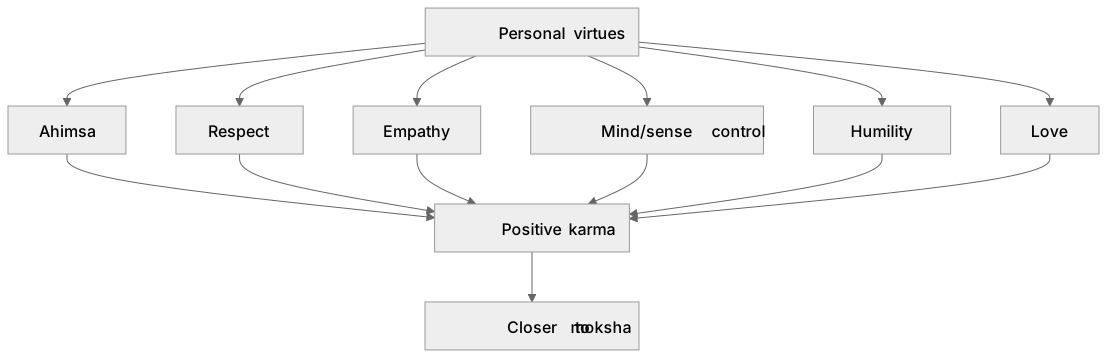
Key words
Say what each word means before you turn the card.
Ahimsa
Try answering aloud or in your head before turning the card.
Mind and sense control
Try answering aloud or in your head before turning the card.
Humility
Try answering aloud or in your head before turning the card.
See every definition
- Ahimsa
- The foundational virtue of non-violence, requiring individuals to avoid harming any living being through actions, words, or thoughts.
- Mind and sense control
- Crucial for overcoming material desires and distractions, often practised through yoga and meditation to focus on the divine.
- Humility
- Requires abandoning ego and pride, acknowledging that all abilities come from Brahman.
Label the diagram
Some boxes have lost their names. Pick the right name for each number.
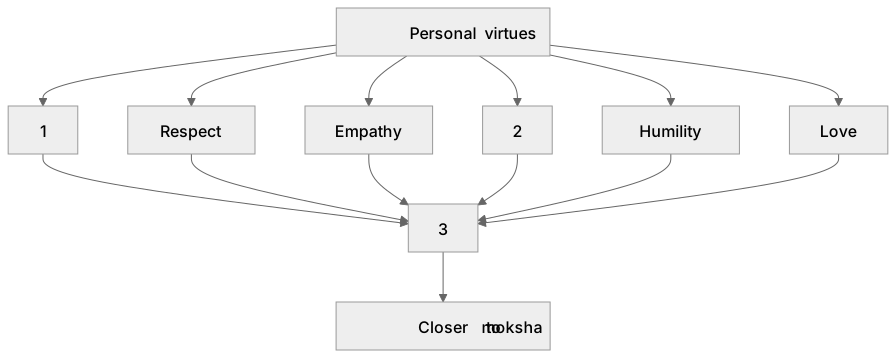
1Box 1
2Box 2
3Box 3
There is more to this lesson
The full lesson goes on to check your understanding and help you earn the marks. Create a free account to carry on, with your progress saved.
A week of Premium from your first lesson · Then the free plan continues · No card, no charge
Test your understanding of Hinduism - 3.1.4.1 Beliefs and teachings: Personal virtues including ahimsa, respect, empathy, mind/sense control, humility, love.
Active recall beats re-reading. Take an instant quiz now to test what you’ve learned and lock it into long-term memory.
A week of Premium from your first lesson · Then the free plan continues · No card, no charge